Accent, Identity, and Eye Dialect
Accent, dialect, and identity: everyone has an accent, a speaker's repertoire shifting across settings, eye dialect as an author's selective spelling, 'standard' as a social role rather than a linguistic medal, and noting a feature before judging a person.
- 8 min
- 8 steps
- 3 questions
- Lesson 10 of 36
In this lesson
- The Word Cabinet
- A repertoire, not three sealed voices
- Worked observation: one request, three settings
- Eye dialect: when an author makes speech visible
- “Standard” is a role, not a linguistic gold medal
- The VOICE method
- Rule of thumb
Open alongside this lesson
-
Use Ya Blinkah: Eye Dialect on a Massachusetts Highway Sign (opens in a new tab)
Hear the direct highway-sign case, then ask what a respelling makes readers notice and who it invites readers to imitate.
-
Accent Leveling (opens in a new tab)
Use this as an entry point to mobility, contact, and why highly local features may become less distinct.
-
Imitating Speech (opens in a new tab)
Consider the difference between observing a feature and turning a whole community into a performance.
-
Language Conveys More than Semantic Meaning (opens in a new tab)
Review indexical meaning and the way variants acquire social associations.
-
Standard Language Ideology Statement (opens in a new tab)
Use this when separating institutional conventions from claims that one dialect is inherently more logical or intelligent.
Picking up where you left off.
You probably do not speak exactly the same way while comforting a sibling, presenting a budget, teasing a close friend, and leaving a voicemail for a stranger. That does not make any version fake. It makes you a skilled social communicator.
Language carries at least two kinds of information at once. A sentence conveys a message, and its wording, rhythm, pronunciation, and timing can also suggest relationships: formal or familiar, distant or local, playful or solemn. Linguists call these associations social meaning. A feature does not contain one permanent social message; listeners learn associations from repeated encounters, media portrayals, and the situations in which they hear it 1.
This creates a responsibility. Speech can offer clues about a situation and a speaker’s affiliations, but it is never a reliable shortcut to intelligence, trustworthiness, or moral character.
The Word Cabinet
- Accent: a pattern of pronunciation. Everyone has one, including speakers whose accent is locally treated as “neutral.”
- Dialect: a systematic language variety with patterns of pronunciation, vocabulary, and grammar. A dialect is more than an accent plus slang.
- Idiolect: the evolving combination of language habits associated with one person.
- Register: language associated with a recurring activity or situation, such as legal drafting, gaming, worship, or bedside care.
- Style-shifting: changing features of speech or writing across contexts, often without conscious planning.
- Accommodation: adjusting toward—or sometimes away from—another person’s patterns during interaction.
- Eye dialect: spelling designed to make a voice look nonstandard on the page; it is a literary choice, not a recording.
These categories overlap. “Cardiology register” identifies an activity; “Wisconsin English” identifies regional patterns; one cardiologist’s favorite phrases belong to an idiolect. The goal is not to force every feature into one box. It is to ask a more precise question.
A repertoire, not three sealed voices
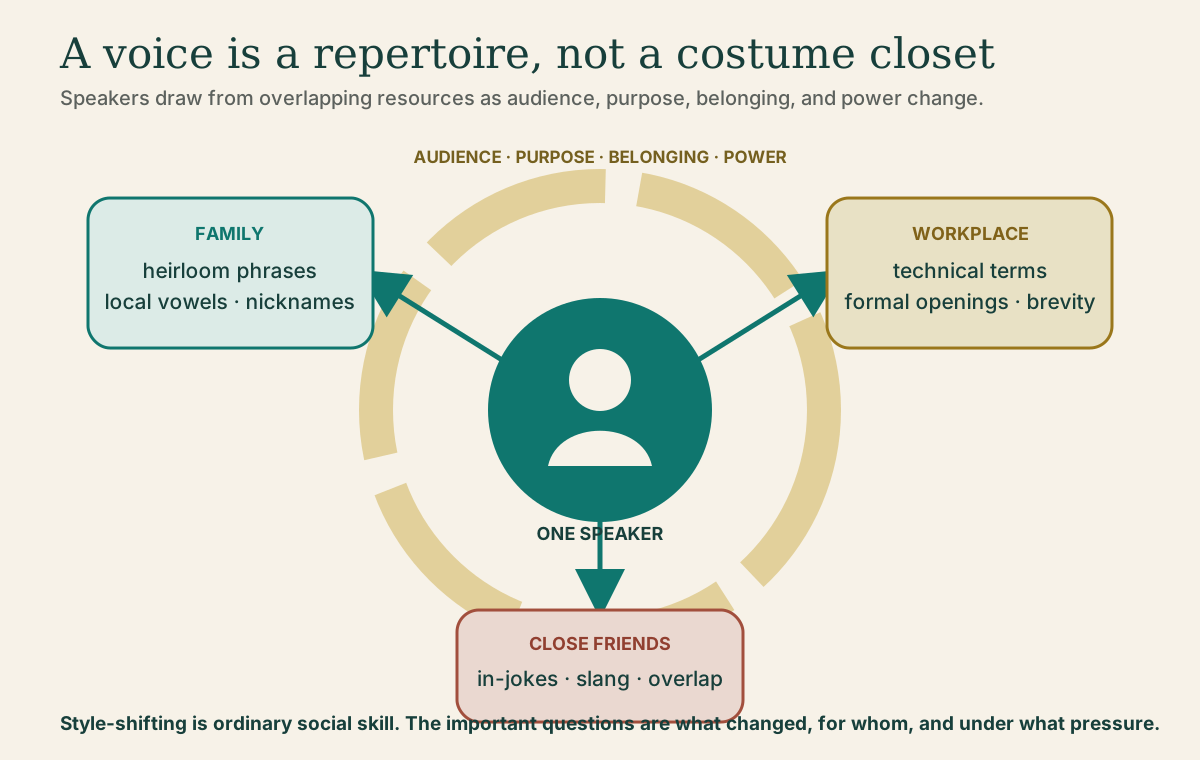
Think of your language as a repertoire: a set of pronunciations, constructions, words, interactional habits, and writing choices accumulated across your life. Different situations make different portions useful.
Style-shifting can respond to audience, topic, medium, purpose, emotion, or power. A speaker may pronounce a local vowel more strongly during a hometown story, avoid workplace abbreviations with a new client, or use a family nickname that would puzzle anyone else. Accommodation may build rapport, improve comprehension, or signal membership. Divergence—making a difference more noticeable—can protect identity or create distance.
None of those motives can be read confidently from one sound. A person may shift because of habit, safety, courtesy, anxiety, institutional pressure, or simple priming by the last person who spoke. Description comes before interpretation.
Contact can also change communities over generations. Accent leveling refers to distinctive local features becoming less marked as speakers encounter more varieties through mobility, schooling, media, and changing social networks. It does not mean that everybody ends up speaking identically; new regional and social patterns can develop while older contrasts weaken 2.
Worked observation: one request, three settings
Imagine Maya needs a ride home. You hear three versions:
- To her brother: “You coming with, or should I call somebody?”
- To a coworker she knows well: “Are you headed my way after the meeting?”
- In a message to a car service: “Could you confirm pickup at the east entrance at six?”
A weak analysis says version 1 is sloppy, version 2 is ordinary, and version 3 is correct. A useful analysis notices form and function:
| Observation | Setting | Plausible work it does |
|---|---|---|
| Omitted object after “with” | Family interaction | Relies on shared regional or household pattern |
| “Headed my way” | Familiar workplace peer | Negotiates destination without issuing a direct command |
| Exact place and time | Service transaction | Reduces ambiguity where shared context is low |
The versions differ, but all are organized. You would need more observations before calling the first feature regional, generational, or unique to Maya. Even then, report it as a tendency, not an essence.
Eye dialect: when an author makes speech visible
Writing cannot reproduce a voice. An author selects a few features and asks readers to imagine the rest. Conventional spelling usually hides pronunciation differences: two people can write going while saying it differently. Eye dialect reverses that invisibility by respelling selected words.
In the narrow literary sense, eye dialect may respell a word even when the represented pronunciation is common. Writing sez for says, for example, makes one character’s ordinary pronunciation look conspicuous while other characters retain standard spelling. The representation therefore tells us as much about the narrator’s framing as about the character’s sound. The “Use Ya Blinkah” discussion offers a direct case of a public sign turning a regional pronunciation into conspicuous spelling 3.
Respelling can be affectionate, technically useful, historically revealing, or cruel. The test is not merely whether it sounds accurate. Ask:
- Which features did the writer mark, and which did they leave invisible?
- Are standard-spelling characters treated as unaccented while only outsiders receive an “accent”?
- Does the spelling help readers understand a sound, or mainly signal ignorance and comedy?
- Is the speaker an individual with agency, or a bundle of stereotypes?
- Who has the power to imitate whom without social cost?
A trained actor studying a specific speaker for intelligibility has a different purpose from someone performing a caricature for laughs. Even accurate imitation can change meaning when audience and power change. A Way with Words’ discussions of imitation and accent performance are useful prompts for examining that boundary rather than recipes for reproducing a community 4 5.
“Standard” is a role, not a linguistic gold medal
A standard variety can make public documents predictable and help people learn institutional expectations. Those are real functions. The error is turning one edited convention into a claim that its habitual speakers think more clearly, or that other varieties have no grammar.
All stable dialects have patterns. Some carry more institutional prestige because their speakers historically controlled schools, publishers, courts, and other gatekeeping institutions. The University of Michigan’s linguistics statement names the belief in one inherently superior form standard language ideology and emphasizes the harms that follow when language prejudice stands in for judgments about people 6. Language is also one of the resources through which people negotiate identity, not a label that fixes identity once and forever 7.
This distinction allows two thoughts at once:
- “This application expects edited formal English, so I will teach that convention explicitly.”
- “A student who uses another dialect is not missing language or logic.”
Editing should add options, not demand the erasure of a home voice.
Playback is optional. If the player is unavailable, open the video at its source.
The VOICE method
When you notice a speech difference, write a VOICE note before drawing a social conclusion:
- V — Variant: Quote or describe the exact feature. Avoid “an accent” when you mean one vowel or construction.
- O — Occasion: Record topic, medium, activity, and who was present.
- I — Interpretation: List at least two plausible social meanings, including a non-social explanation such as ease or priming.
- C — Constraint: Ask about audience, institutional pressure, safety, and who has permission to speak which way.
- E — Evidence: Seek repeated examples and the speaker’s perspective before making a pattern claim.
Mnemonic: Hear a VOICE; do not invent a verdict.
Practice: make a style map
For one day, collect six examples from your own speech or writing. Use only material you can ethically record—prefer your own words over covertly collecting someone else’s.
| Exact feature | Audience and activity | What changed? | Two possible reasons |
|---|---|---|---|
| “Thanks” / “Thank you for your time” | friend / formal email | closing formula | intimacy; genre expectation |
Then circle one supposed change that may simply reflect topic. If you used technical vocabulary at work, did your identity shift, or did the task require different nouns? Finally, rewrite one judgment (“I sounded unprofessional”) as an observation (“I used three sentence fragments in a rapid group chat”).
Rule of thumb
Name the feature, the setting, and the evidence before naming the person. Treat style-shifting as social skill, treat written accent as an argument made by an author, and never confuse institutional prestige with linguistic worth.
Practice
The second description names features, audiences, and contexts without treating either style as defective or making geography deterministic.
Practice
Eye dialect is a literary representation, not neutral audio data; a spelling can mark a character as nonstandard even when many readers pronounce the word similarly.
Practice
Standards can be useful shared conventions while still reflecting history, power, and institutions rather than inherent linguistic superiority.
Lesson complete
Nice work.
Sources for this lesson
- 2Accent Leveling. A Way with Words. verifiedSegment about dialect features becoming less distinct when speakers and communities interact. Cited at: segment overview.
- 3Use Ya Blinkah: Eye Dialect on a Massachusetts Highway Sign. A Way with Words. verifiedDirect segment on eye dialect, regional imitation, and a Massachusetts highway sign written as Use Ya Blinkah. Cited at: segment overview.
- 4Imitating Speech. A Way with Words. verifiedSegment useful for examining representation, audience, accuracy, stereotype, and respect when imitating another person's speech. Cited at: segment overview.
- 5Accent Imitation. A Way with Words. verifiedSegment on accommodation and the social effects of shifting toward another accent. Cited at: segment overview.
- 6Standard Language Ideology Statement. Department of Linguistics, University of Michigan. verifiedDepartmental statement explaining that stigmatized varieties are structured systems and that judgments about language can reproduce social inequality. Cited at: statement.
- 7Language and Identity. Essentials of Linguistics 2e, eCampusOntario. verifiedOpen textbook chapter on the relationships among language practices, community membership, and identity. Cited at: language and identity.
Further reading
- Grant Barrett. Everybody Should Talk Like This: Grant Barrett at TEDxAmericasFinestCity. TEDxAmericasFinestCity. 2011. verifiedPublic talk by the A Way with Words co-host on language attitudes, listed in the show's official video directory.