When a Brand Becomes the Thing: Genericization and Verbing
Brand names that become ordinary words: four stages from source identifier to generic, nouns turning into verbs, USPTO's distinctiveness scale from fanciful to generic, proprietary eponyms, why speakers generalize brands, and keeping language and law separate.
- 5 min
- 8 steps
- 3 questions
- Lesson 36 of 36
In this lesson
- Four stages that need not all occur
- Linguistic conversion: a noun starts working as a verb
- The legal source/category distinction
- Proprietary eponym, generic trademark, or brand shorthand?
- Why speakers generalize brands
- The MARK test
- Practice lab: two evidence lanes
Open alongside this lesson
-
Naming Aspirin (opens in a new tab)
Treat each example as jurisdiction- and product-specific; a familiar common noun may still be protected elsewhere.
-
Strong Trademarks (opens in a new tab)
Distinguish everyday linguistic usage from the legal question of whether a term identifies source for specified goods or services.
-
Lexical Change (opens in a new tab)
Place brand-name conversion inside broader processes of coinage, borrowing, semantic change, and category shift.
Picking up where you left off.
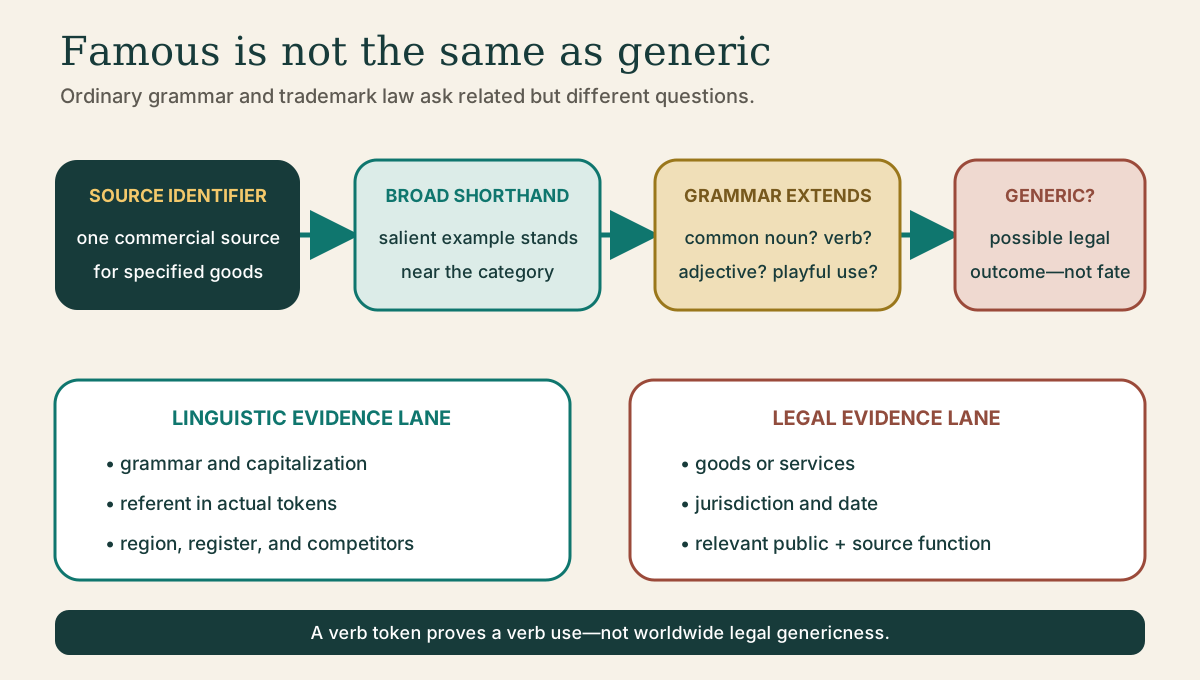
A company invents or adopts a distinctive name. The product succeeds. Speakers begin using the name for similar products, perhaps even turning it into a verb. Has the brand “become the word”?
Linguistically, several changes may be underway. Legally, the answer requires narrower evidence. Popularity, verb use, and genericness are not synonyms.
A Way with Words notes that aspirin was once a Bayer brand name and became a common drug term in the United States, alongside examples such as cellophane and kerosene 1. The segment is a starting list, not a worldwide legal opinion. Trademark status can differ across jurisdictions, dates, spellings, and goods.
Four stages that need not all occur
- Source identifier: the name points to one commercial source.
- Metonymic shorthand: speakers use the salient brand to request or discuss a kind of product, even when source remains relevant.
- Category or verb extension: the form appears as a common noun or a new verb.
- Legal genericness: the relevant public primarily understands the term as the common product/service category rather than a source identifier.
A form can stop at stage two or three. A very famous mark can remain legally strong because consumers still associate it with one source.
Linguistic conversion: a noun starts working as a verb
English readily changes lexical category without visible affixation:
- to message from a noun;
- to host from a person-role noun;
- brand-derived verbs in contexts such as searching, editing, transporting, or copying.
This process is conversion or zero derivation. A token such as “I googled it” demonstrates a verb use. It does not by itself demonstrate that speakers call every search engine a google, that consumers no longer recognize a source, or that a court has changed a trademark’s status.
Lexical change includes coinage, conversion, borrowing, semantic extension, and competition among forms 2. Brand language participates in ordinary grammar even while law assigns some uses special consequences.
The legal source/category distinction
USPTO guidance arranges marks by distinctiveness:
- fanciful: invented terms;
- arbitrary: existing words unrelated to the goods;
- suggestive: hints requiring imagination;
- descriptive: directly describes a quality or feature;
- generic: common name for the goods or services.
Generic terms cannot function as U.S. trademarks for the relevant goods because they do not identify source 3. But the relation is product-specific. Apple is generic for apples and arbitrary for computers. A word is not simply “a trademark” or “not a trademark” in every context.
Capitalization is also weak evidence. Journalists may lowercase a form by style; consumers may capitalize common nouns; a company may prefer an adjective phrase. Legal status turns on evidence about public understanding and source function, not typography alone.
Proprietary eponym, generic trademark, or brand shorthand?
Popular writing uses several overlapping labels:
- proprietary eponym: a brand name used to refer to a broader product type, sometimes while protection remains;
- genericized trademark: a term formerly protected as a mark but now legally or functionally generic in the stated jurisdiction;
- brand shorthand: an informal descriptive label for metonymic everyday use;
- brand-derived verb: a conversion into a verb, regardless of legal outcome.
Define your term and scope. “People sometimes say X for the whole category” is an observable linguistic claim. “X is legally generic in the United States for these goods as of this date” is a legal claim requiring authoritative evidence.
Why speakers generalize brands
A brand form may be:
- shorter or easier to retrieve than the technical category;
- the first or dominant example a speaker encountered;
- phonologically memorable;
- supported by advertising and retail placement;
- useful as a verb when the generic paraphrase is clumsy;
- part of a regional household vocabulary.
Generalization can also fail. Competing brands may remain salient, the category term may already be short, or speakers may police the source distinction.
The MARK test
- M — Market and jurisdiction: which goods, services, country, and date?
- A — Attested grammar: proper noun, common noun, verb, adjective, or playful token?
- R — Referent: one source, any category member, an action, or a prototype?
- K — Knowledge of source: what evidence shows how relevant consumers understand the term?
Do not use MARK as legal advice. Use it to keep a language lesson from making an unbounded legal assertion.
Practice lab: two evidence lanes
Choose one familiar brand-derived expression. Build parallel columns:
Linguistic lane
- Collect ten public tokens.
- Label grammatical category and referent.
- Note capitalization, modifiers, competitors, and whether the product came from the named source.
Legal lane
- Identify jurisdiction and specified goods or services.
- Consult the trademark office and reliable case or registration records.
- Record current status and date without extrapolating globally.
Finish with two sentences, not one: “Speakers use the name as a verb in these examples. That usage alone does not establish legal genericness.”
Rule of thumb
A brand can enter ordinary grammar before it leaves trademark law. Separate source from category, language evidence from legal evidence, and one jurisdiction from the world.
Practice
Verbing is linguistic evidence, not a complete legal determination of genericness.
Practice
The source-versus-category function is central; fame alone can strengthen rather than destroy a mark.
Practice
A legally generic term in one country can remain protected in another, and status attaches to specified goods or services.
Lesson complete
Nice work.
Sources for this lesson
- 1Naming Aspirin. A Way with Words. 2012. verifiedSegment on former brand names that became common product terms, with a reminder that trademark status can differ by jurisdiction and item. Cited at: transcript.
- 2Lexical Change. Essentials of Linguistics 2e, eCampusOntario. verifiedOpen textbook chapter on coinage, borrowing, word loss, and other changes in a language's vocabulary. Cited at: open textbook.
- 3Strong Trademarks. United States Patent and Trademark Office. 2023. verifiedOfficial explanation of fanciful, arbitrary, suggestive, descriptive, and generic terms and why generic terms cannot function as trademarks. Cited at: official guidance.
Previous: What Do You Call Someone from There? Demonyms, Endonyms, and Local Authority