The Many Lives of T: Stop, Flap, Glottal, and Silence
One phoneme, several sounds: the aspirated t in top, the plain t in stop, the flap in water, the glottal stop in kitten, and silent t, a three-layer transcription, a method for tracking a consonant's environment, and a recording lab.
- 5 min
- 7 steps
- 3 questions
- Lesson 27 of 36
In this lesson
- One phoneme, several phones
- The flap that listeners spell as d
- The glottal closure in kitten
- A three-layer transcription
- The TAP method
- Practice lab: five contexts, two styles
Open alongside this lesson
-
American Glottalization (opens in a new tab)
Hear kitten and mitten as an entry point, then compare the segment's description with corpus evidence.
-
Flaps and Other Variants of /t/ in American English: Allophonic Distribution Without Constraints, Rules, or Abstractions (opens in a new tab)
Use the distribution of actual variants to replace the idea that every written t has one normal sound.
-
American English Has Got a Lot of Glottal Stops (opens in a new tab)
Follow the sample, context, and regression evidence before making age or regional claims.
Picking up where you left off.
Say top, stop, water, kitten, and right now naturally. If you listen closely—or inspect an acoustic recording—you may find that the letter t corresponds to several different events.
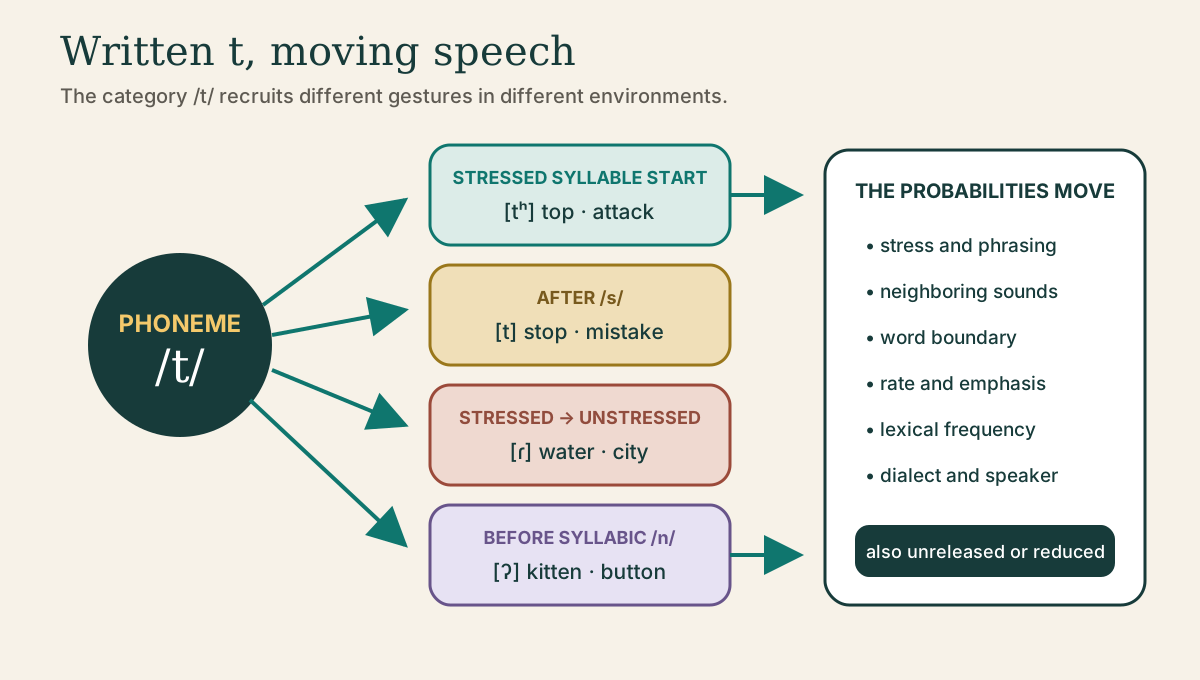
That is not inconsistency. English speakers learn a category, /t/, together with patterns for realizing it in different environments. A pronunciation dictionary’s idealized [t] is one member of the family, not the sound of every token.
One phoneme, several phones
Here is a practical inventory for many North American speakers:
| Environment | Common realization | Example |
|---|---|---|
| beginning of a stressed syllable | aspirated stop [tʰ] | top, attack |
| after /s/ | relatively unaspirated [t] | stop, mistake |
| after a stressed vowel, before an unstressed vowel | flap [ɾ] | water, city |
| before syllabic /n/ | glottal or glottalized realization [ʔ] | kitten, button |
| end of a phrase or before a consonant | unreleased, glottalized, or released stop | right, right now |
| dense consonant cluster in casual speech | variable reduction | didn’t, exactly |
The table is a map of strong tendencies, not a voice-recognition algorithm. Word frequency, phrasing, rate, emphasis, speaker, community, and the exact neighboring sounds all shift the probabilities. A corpus study of 3,719 /t/ tokens found several variants whose distributions do not collapse into one classroom rule 1.
The flap that listeners spell as d
In many American pronunciations of water, the tongue makes one very brief contact near the alveolar ridge. Phoneticians call the sound a flap or tap, [ɾ]. To an English listener it may resemble a quick d, which is why pronunciation guides sometimes write “wader.” That spelling is only a hint. A careful [d] stop and a flap are not the same articulatory event.
The stress pattern matters. Compare:
- áTom versus atómic;
- wríter versus retáin;
- cít-y versus an emphatic T! said alone.
A flap is strongly favored when the consonant follows a stressed vowel and the next syllable is unstressed. Boundaries can be crossed: get it may flap in connected speech. Emphasis can restore a more released stop.
Flapping may make metal and medal very close, but do not assume every /t/–/d/ pair becomes a perfect homophone. Other cues—especially vowel duration or vowel quality—can survive. The right question is empirical: which cues does this speaker produce and perceive?
The glottal closure in kitten
A glottal stop [ʔ] is made by closing the vocal folds. English speakers use one transparently between the two parts of uh-oh. Many also use glottal closure in words with /t/, especially before a syllabic nasal: kitten, mitten, button. The tongue may still participate, or the glottal closure may carry most of what the listener perceives.
A Way with Words uses kitten and mitten to make this American pattern audible 2. Another segment notices reduction in didn’t and names such as Martin 3. These examples should not be bundled into “dropping t.” Glottal replacement, glottal reinforcement, nasal release, deletion, and cluster reduction are different analyses, and a casual ear may not separate them.
Eddington and Channer examined 1,101 word-final /t/ tokens before vowels in a spontaneous-speech corpus. Glottal stops occurred in a substantial minority, and the probability varied with linguistic and social factors 4. That result supports two lessons at once: glottalization is ordinary American speech, and it is variable rather than mandatory.
A three-layer transcription
Avoid making spelling do all the work. Record three layers:
- Orthographic: what word was intended—water.
- Phonemic: the contrastive category—/ˈwɔtər/ in a broad analysis.
- Phonetic: what this token sounded like—perhaps [ˈwɔɾɚ].
Broad phonemic transcriptions differ across analyses and dialects; narrow phonetic transcription requires training. The useful habit is the separation itself. Letters, categories, and actual articulations answer different questions.
The TAP method
When a consonant surprises you, use TAP:
- T — Track the environment: stress, syllable, neighbors, boundary, and rate.
- A — Ask what contrast survives: can this realization distinguish a word here, or is it a variant of an existing phoneme?
- P — Preserve variation: record several tokens and styles before announcing a rule.
Mnemonic: a written t is a trailhead, not a destination.
Practice lab: five contexts, two styles
Record each phrase twice—once naturally, once with careful contrastive emphasis:
- Tom stopped.
- Write it over.
- A little water.
- A cotton button.
- Right now.
For each /t/, note whether you hear a strong burst, a quick flap, glottal closure, no audible release, or uncertainty. Do not force a symbol from a phone microphone recording. Then ask what changed under emphasis.
The goal is not accent correction. It is to discover that fluent speech is a coordinated movement system whose details respond to context.
Rule of thumb
Letters stay still; speech sounds move. Describe the phoneme, the environment, and the token before judging a pronunciation from its spelling.
Practice
A flap [ɾ] is a brief tongue contact common in that prosodic environment; it is one realization of the /t/ category.
Practice
Glottalization is patterned and does not imply that the speaker lacks a [t] realization in other contexts.
Practice
The slogan hides phonetic detail and distribution. American /t/ may be aspirated, unaspirated, flapped, glottalized, unreleased, or reduced.
Lesson complete
Nice work.
Sources for this lesson
- 1David Eddington. Flaps and Other Variants of /t/ in American English: Allophonic Distribution Without Constraints, Rules, or Abstractions. Cognitive Linguistics. 2007. verifiedCorpus study of 3,719 /t/ tokens showing that American /t/ has several context-sensitive realizations. Cited at: corpus study.
- 2American Glottalization. A Way with Words. verifiedSegment on glottal realizations in words such as kitten and mitten and their growing visibility in American speech. Cited at: segment.
- 3No You Di-int!. A Way with Words. verifiedTranscript examples of glottalization and consonant reduction in forms such as didn't and Martin. Cited at: transcript.
- 4David Eddington, Caitlin Channer. American English Has Got a Lot of Glottal Stops. American Speech. 2010. verifiedCorpus study of 1,101 word-final prevocalic /t/ tokens linking glottal realization to linguistic and social factors. Cited at: study and dataset description.
Previous: When Two Vowels Become One: Contrasts, Allophones, and Mergers