What a Slip Reveals: Spoonerisms and the Architecture of Speech
What speech errors show about planning: spoonerisms, anticipations, perseverations, and exchanges, how slips preserve syllable structure, evidence that speakers plan ahead, deliberate versus spontaneous slips, self-repair, and a consent-first slip log.
- 6 min
- 9 steps
- 3 questions
- Lesson 29 of 36
In this lesson
- The Word Cabinet
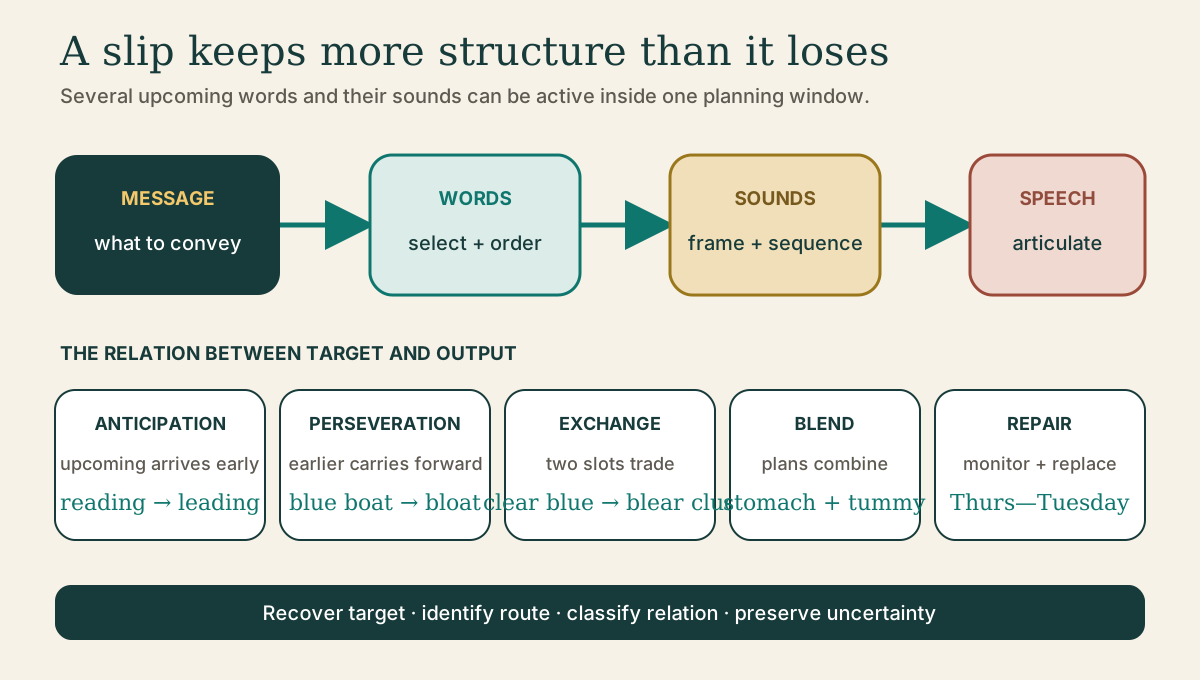
- Four directions a slip can take
- What structure survives
- Planning extends beyond the current sound
- Spoonerism, slip, or performance?
- Self-repair is evidence too
- Practice lab: a consent-first slip log
- Rule of thumb
Open alongside this lesson
-
Spoonerisms with Greg Pliska (opens in a new tab)
Enjoy the deliberate exchanges, then separate crafted puzzles from spontaneous production evidence.
-
A Spreading-Activation Theory of Retrieval in Sentence Production (opens in a new tab)
Track how lexical and sound-level activation predicts substitutions, exchanges, blends, and legal-sounding outcomes.
-
The Tip of the Tongue Phenomenon (opens in a new tab)
Compare a word that cannot be retrieved with one whose components are activated in the wrong pattern.
Picking up where you left off.
A classic spoonerism exchanges sounds between nearby words. A Way with Words plays with the form because the results can be startlingly apt or absurd 1. But the joke points toward a serious question: why do speech errors preserve so much structure?
People rarely produce an entirely un-English burst of random noise. Slips tend to involve nearby words, similar sounds, comparable positions, or semantically related candidates. That pattern suggests that speaking requires advance planning and simultaneous activation—not a word-by-word teleprompter read by the mouth.
The Word Cabinet
- target: the word or sequence the speaker appears to have intended;
- error: the produced form that differs from the recoverable target;
- anticipation: an upcoming element appears too early;
- perseveration: an earlier element continues into a later position;
- exchange: two elements trade positions;
- substitution: one word or sound replaces another;
- blend: parts of competing plans combine;
- repair: work by a participant to address trouble in speaking, hearing, or understanding;
- lexical bias: the tendency for sound errors to produce real words more often than a purely random process would predict.
Not every odd phrase is a production error. A mondegreen arises through hearing or memory; an eggcorn is a meaningful reanalysis; a malapropism selects a similar-sounding word; a typo may come from motor or interface constraints. First reconstruct the event.
Four directions a slip can take
Use invented examples so the mechanism stays visible:
| Intended plan | Possible result | Pattern |
|---|---|---|
| reading list | leading list | anticipation: upcoming /l/ arrives early |
| blue boat | blue bloat | perseveration: earlier /l/ carries forward |
| clear blue | blear clue | exchange: initial consonants trade slots |
| stomach + tummy | stummy | blend: competing words contribute material |
Real classification is messier. The intended phrase may be uncertain; a recording may be absent; several mechanisms can produce the same spelling. Treat the categories as hypotheses about relations, not labels attached by appearance.
What structure survives
Exchange errors often preserve syllable position: an onset trades with an onset more readily than with a vowel in an unrelated position. Word-category substitutions often stay within a grammatical slot: one noun replaces another, or one verb competes with another. Sound sequences also tend to respect the language’s phonotactics.
Gary Dell’s spreading-activation model formalized a way to explain these regularities. Meaning, words, and phonological pieces activate connected candidates; selected items feed activation back through the network. Under particular timing and noise conditions, a highly activated neighbor can win or an activated sound can enter the wrong frame 2.
The model does not mean there is a visible network diagram in the head exactly like a textbook figure. It is a theory that earns value by predicting which errors occur, what constraints they respect, and how conditions alter their rate.
Planning extends beyond the current sound
An anticipation from the next word is evidence that part of that word was already active. An exchange between nearby words suggests a planning window containing both. A perseveration shows that activation from recently produced material does not vanish instantly.
This complements tip-of-the-tongue research. In a TOT state, meaning or fragments of a word may be available while the full form remains inaccessible 3. In a slip, several forms may be available strongly enough that a component is selected in the wrong place. Both phenomena reveal partial, staged access.
Spoonerism, slip, or performance?
Deliberate spoonerisms are excellent demonstrations but poor spontaneous-error data. A writer can search for two words whose exchanged onsets create another pair, revise the line, and practice delivery. A genuine slip arrives unintentionally during ordinary production.
Use ROUTE:
- R — Recover the target: what evidence supports the intended form?
- O — Observe the output: use audio if ethically available; spelling can mislead.
- U — Understand the event: speaking, hearing, remembering, typing, or joking?
- T — Track the source: upcoming, previous, competing word, or similar sound?
- E — Evaluate alternatives: exchange, blend, malapropism, eggcorn, or unknown?
The route matters as much as the result. Blear clue intentionally constructed for a quiz and accidentally produced in a meeting share a pattern but not a cognitive event.
Self-repair is evidence too
Speakers often interrupt themselves: “Meet me Thursday—sorry, Tuesday.” The cut-off, editing expression, and replacement show monitoring in real time. Do not clean every restart out of a transcript before analyzing it. What looks like mess may reveal planning, detection, and correction.
At the same time, avoid armchair diagnosis. Ordinary slips happen to everyone. A collection of amusing errors cannot establish a language disorder, memory condition, intoxication, or dishonesty.
Practice lab: a consent-first slip log
For one week, record only slips you make yourself or examples already public with permission to quote. Do not covertly record private talk.
For each item, write:
- intended phrase and actual output;
- whether audio exists or the example is reconstructed from memory;
- event type: speaking, hearing, writing, or deliberate wordplay;
- likely pattern and source direction;
- a competing analysis;
- whether and how repair occurred.
After ten items, look for structure: same grammatical category, same syllable position, real-word outcomes, or nearby sources. Ten examples will not prove a universal model, but they will replace “random mistake” with inspectable observations.
Rule of thumb
A slip is not a hole in language; it is language’s machinery briefly visible. Reconstruct the target, trace the moving part, and preserve uncertainty about the path.
Practice
Exchanges often preserve structural position, suggesting that more than one upcoming word and its sound frame were active during planning.
Practice
The source’s direction relative to the error identifies the pattern.
Practice
The same surface pattern can be produced intentionally or accidentally; the event’s route is part of the evidence.
Lesson complete
Nice work.
Sources for this lesson
- 1Spoonerisms with Greg Pliska. A Way with Words. verifiedPlayful transcript examples of exchanged initial sounds, useful as observations before studying speech planning. Cited at: segment.
- 2Gary S. Dell. A Spreading-Activation Theory of Retrieval in Sentence Production. Psychological Review. 1986. verifiedFoundational production model explaining patterned speech errors through activation among lexical and phonological representations. Cited at: model and error constraints.
- 3Roger Brown, David McNeill. The Tip of the Tongue Phenomenon. Journal of Verbal Learning and Verbal Behavior. 1966. verifiedClassic experiment eliciting tip-of-the-tongue states and showing partial access to letters, syllable count, stress, and related forms before full retrieval. Cited at: classic experiment.
Further reading
- Anne Cutler, Sally Butterfield. Rhythmic Cues to Speech Segmentation: Evidence from Juncture Misperception. Journal of Memory and Language. 1992. verifiedExperimental study using boundary misperceptions to show that English listeners exploit strong and weak syllable patterns when segmenting continuous speech.