When Sounds Appear, Disappear, or Trade Places
Four sound processes: insertion as in 'warsh,' deletion in fast speech, assimilation between neighbors, and metathesis, why less sound isn't less grammar, a diagnostic for naming a process, and comparing careful with connected speech.
- 6 min
- 9 steps
- 3 questions
- Lesson 28 of 36
In this lesson
- Four operations
- Insertion: the r in warsh
- Deletion: less sound is not less grammar
- Assimilation: neighbors negotiate
- Metathesis: order is the phenomenon
- The MOVE diagnostic
- Practice lab: careful versus connected speech
- Rule of thumb
Open alongside this lesson
-
Wash vs. Warsh: How and Why Is That Extraneous R Part of a Dialect? (opens in a new tab)
Use one noticeable r as a case study in insertion, geography, inheritance, and stigma.
-
Metathesis in Language 2.0 (opens in a new tab)
Compare true sound-order alternations with cases better explained by insertion, deletion, overlap, or historical change.
-
Phonological Processes (opens in a new tab)
Keep assimilation, deletion, epenthesis, and metathesis separate before examining why they may combine.
Picking up where you left off.
Why does one person say wash while another says something like warsh? Why can comfortable emerge with fewer audible syllables than its spelling suggests? Why do sound sequences sometimes seem to reverse?
The tempting answer is “people are sloppy.” The useful answer identifies an operation, its environment, and its distribution. Human speech is full of recurring strategies for coordinating neighboring gestures. Some become stable features of a dialect; some belong to a single word’s history; some remain variable reductions in fast speech.
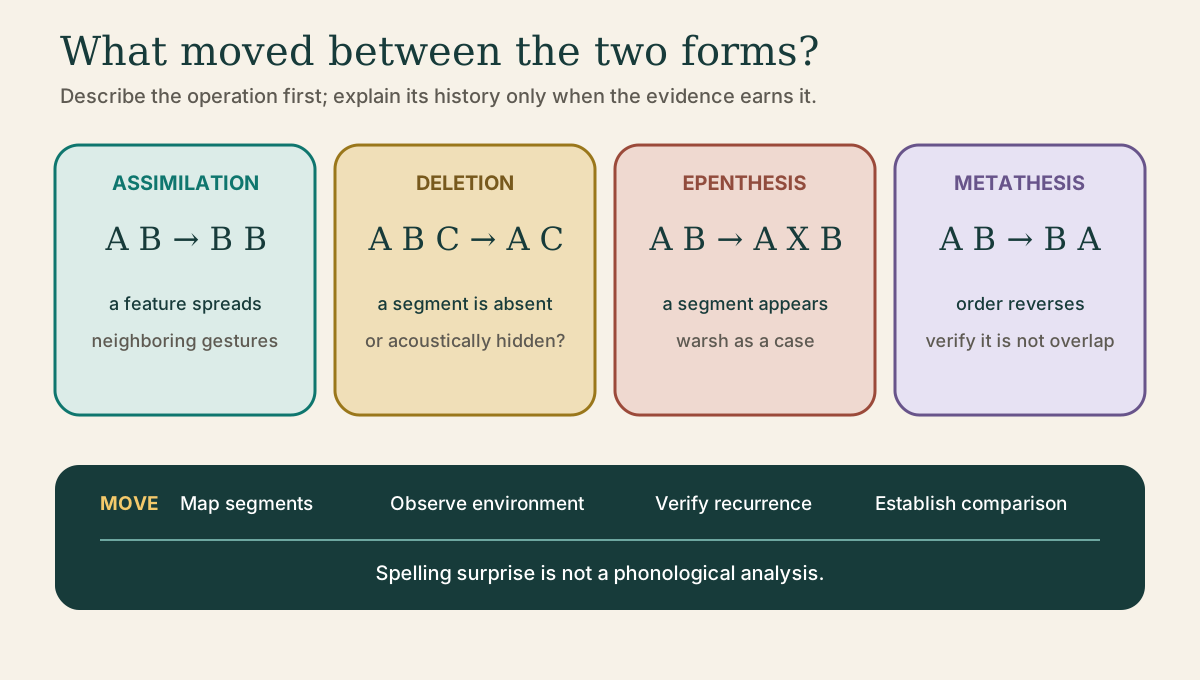
Four operations
| Process | Structural change | Working question |
|---|---|---|
| assimilation | one sound becomes more like a neighbor | Did a feature such as place or voicing spread? |
| deletion | a segment is not realized | Did a crowded or weak position lose material? |
| epenthesis | a segment is inserted | Did an added sound help coordinate or reanalyze the sequence? |
| metathesis | sounds occur in the opposite order | Is the difference truly order rather than addition plus loss? |
These are descriptions of patterns, not moral labels. They can operate synchronically—within a living speaker’s grammar—or diachronically, as a historical change preserved in a word. A Cambridge phonology overview treats them as standard types of sound process rather than a miscellaneous bin of mistakes 1.
Insertion: the r in warsh
In the A Way with Words case, warsh is associated with parts of the American Midlands and adjoining regions. The hosts call the added r an epenthetic or excrescent sound and connect its distribution to settlement and dialect history 2. The safe claim is the distribution: the form recurs across speakers and places. A single, tidy origin story is harder to prove.
This r is not the same mechanism as every phenomenon called intrusive r. In some non-rhotic varieties, an r-like sound may appear between vowels across a word boundary, as in an imagined idea-r-of it. Warsh places r inside a lexical item before a consonant. Similar labels do not guarantee identical phonological analyses.
Use three evidence levels:
- Token: one speaker produced an r-like segment in one word.
- Pattern: the speaker or community does so repeatedly in a set of environments.
- History: dated recordings, dialect surveys, and settlement evidence support an account of how the pattern spread.
DARE’s maps and survey materials are more useful at levels two and three than a list of social-media comments 3. Even then, a map shows where responses occurred; it does not by itself prove ancestry caused the pronunciation.
Deletion: less sound is not less grammar
Conversational speech compresses. In a cluster such as the middle of exactly or the end of just missed, gestures overlap and a segment may lack a distinct release. A listener may describe deletion even when acoustic traces remain.
Ask:
- Is the sound absent in careful speech too?
- Does the following consonant share a place or manner that masks it?
- Does deletion change a contrast, or is the word still recoverable from context?
- Is the reduction available across many words or stored in this one form?
Do not infer that a person “doesn’t know the ending.” Morphology and phonetics can diverge: a plural, tense, or lexical consonant can be grammatically present even when its phonetic realization is reduced.
Assimilation: neighbors negotiate
In a phrase such as in Paris, the /n/ may be produced farther forward because /p/ requires the lips. In handbag, nasal and stop gestures can overlap enough that the middle sounds differ from a slow spelling pronunciation. Assimilation describes one sound taking on a feature of another.
Direction matters:
- anticipatory/regressive: a later sound affects an earlier one;
- perseverative/progressive: an earlier sound affects a later one;
- coalescent: features combine into an outcome that resembles neither input alone.
This vocabulary turns “it sounds mushy” into testable claims about place, voicing, manner, or timing.
Metathesis: order is the phenomenon
Metathesis is often introduced with playful child forms, but it is a genuine cross-linguistic pattern. The Ohio State Metathesis in Language project defines it as two sounds appearing in one order in one form and the opposite order in a related form. Its database also flags a scientific caution: some reported cases remain controversial because overlap, insertion, deletion, or historical analysis may fit better 4.
That warning matters for English examples. If comfortable is pronounced with a compressed middle, writing the result as “comfterble” may suggest a neat swap that the actual gestures do not contain. A spelling-based comparison can invent metathesis where acoustic analysis would find reduction and overlap.
The MOVE diagnostic
Use MOVE before naming a process:
- M — Map the segments: transcribe what is actually present as cautiously as possible.
- O — Observe the environment: neighboring sounds, stress, rate, boundary, and style.
- V — Verify recurrence: one token, one word, one speaker, or a productive community pattern?
- E — Establish the comparison: related form, careful form, earlier form, or merely the spelling?
The comparison baseline is decisive. “Different from spelling” does not tell you which sound process occurred.
Practice lab: careful versus connected speech
Record these once as isolated words and once in the sentence provided:
- handbag — “Put the handbag down.”
- comfortable — “This chair is comfortable enough.”
- exactly — “That is exactly right.”
- wash — use your ordinary pronunciation; do not imitate another dialect.
For each item, mark possible assimilation, deletion, insertion, or reordering. Then add an uncertainty note. A phone recording may show duration and obvious gaps but cannot support every narrow phonetic claim.
Finally, find one regional pronunciation in a dialect archive. Describe where it was collected and what the source can establish. Separate that from any migration story the source merely suggests.
Rule of thumb
Count the operations before judging the output. Added, missing, shared, and reordered sounds are ordinary materials of phonological systems—and the right label depends on evidence, not spelling surprise.
Practice
Insertion adds a segment; metathesis changes order. Further evidence is needed to determine whether the added sound is phonological, historical, or only apparent.
Practice
Regional patterning and transmission point to a dialect feature. Spelling can record or stigmatize speech, but it is not the source of every spoken segment.
Practice
Metathesis is a real cross-linguistic pattern, but individual cases require analysis of the actual forms and history.
Lesson complete
Nice work.
Sources for this lesson
- 1Phonological Processes. Cambridge University Press. 2025. verifiedTextbook chapter distinguishing assimilation, deletion, insertion, and metathesis as recurring sound processes. Cited at: phonological processes.
- 2Wash vs. Warsh: How and Why Is That Extraneous R Part of a Dialect?. A Way with Words. 2023. verifiedTranscript and map-oriented discussion of r insertion in a Midlands-associated pronunciation. Cited at: transcript and map discussion.
- 3Regional Distributions. Dictionary of American Regional English, University of Wisconsin–Madison. verifiedInteractive and static distributions for selected responses from the DARE field survey. Cited at: regional evidence.
- 4Metathesis in Language 2.0. The Ohio State University Department of Linguistics. verifiedNSF-supported cross-linguistic database and research guide on sound-order alternations, their conditioning, and disputed cases. Cited at: research database.
Previous: The Many Lives of T: Stop, Flap, Glottal, and Silence