When Two Vowels Become One: Contrasts, Allophones, and Mergers
Phones, phonemes, and allophones through two mergers: cot and caught, and the conditioned pin-pen merger, four questions to tell a contrast from an allophone or a merger, and a twelve-word contrast test.
- 6 min
- 7 steps
- 3 questions
- Lesson 26 of 36
In this lesson
- The Word Cabinet
- Case one: cot and caught
- Case two: pin and pen
- Contrast, allophone, or merger?
- Practice lab: build a twelve-token contrast test
- Rule of thumb
Open alongside this lesson
-
Vowel Mergers (opens in a new tab)
Begin with cot/caught, Don/dawn, and pin/pen, then test which contrasts your own speech maintains.
-
The Organization of Dialect Diversity in North America (opens in a new tab)
Compare your impression with mapped production and perception evidence rather than assigning a whole state one accent.
-
The Nationwide Speech Project: A New Corpus of American English Dialects (opens in a new tab)
Inspect speaker selection, elicitation tasks, and acoustic measurements behind a controlled dialect comparison.
Picking up where you left off.
For some speakers, cot and caught sound different. For others, they are as alike as two repetitions of the same word. Neither group is failing to pronounce a letter. They have different organizations of the vowel system.
That distinction—between a different sound and a different system—is the doorway into phonology. Phonetics asks what the speech organs and acoustic signal are doing. Phonology asks how a language or dialect organizes those possibilities into meaningful contrasts and predictable variants.
An A Way with Words segment gathers three revealing pairs: cot/caught, Don/dawn, and pin/pen 1. The pairs are useful because they expose two kinds of merger: one that can apply broadly to two historical vowel classes, and one strongly favored in a specific sound environment.
The Word Cabinet
- phone: a physically produced speech sound, written in phonetic brackets: [t];
- phoneme: a contrastive sound category in a language or variety, written between slashes: /t/;
- allophone: a context-linked realization of a phoneme that does not by itself change one word into another;
- minimal pair: two words that differ in one sound position and have different meanings, such as sip and zip for many English speakers;
- merger: loss of a previously available contrast between sound classes;
- conditioned merger: loss of a contrast only in a particular environment;
- near-merger: a small production difference that speakers may not consciously hear, or an unstable mismatch between perception and production;
- lexical set: a group of words that pattern together historically or phonologically, even when their spellings vary.
Minimal pairs are a method, not a list memorized from a textbook. The University of Sheffield overview makes the logic explicit: if substituting one sound for another in the same environment creates a different recognized word, the sounds contrast there 2. The result belongs to the particular language or dialect being tested. Sounds contrastive in one system can be allophonic or merged in another.
Case one: cot and caught
Historically, the vowel classes represented by cot and caught were distinct in many North American varieties. A broad low-back merger makes pairs such as cot/caught and Don/dawn homophones for many present-day speakers. William Labov’s atlas work maps both the merger and areas that resist it 3.
Do not turn the map into a password. Region affects probability, but age, mobility, family networks, community, style, and the individual word can all matter. The Nationwide Speech Project was designed precisely because dialect comparison needs comparable speakers and recording tasks, not impressions assembled from whoever happens to be available 4.
A robust individual test has at least three parts:
- Production: record randomized words in a carrier phrase such as “Say ___ again.” Do not alternate cot, caught, cot, caught; rapid alternation encourages performance.
- Perception: have another person or a randomized playback present the tokens without labels. Can the speaker classify them above chance?
- Transfer: test several pairs. One memorized pronunciation does not establish the behavior of a whole lexical class.
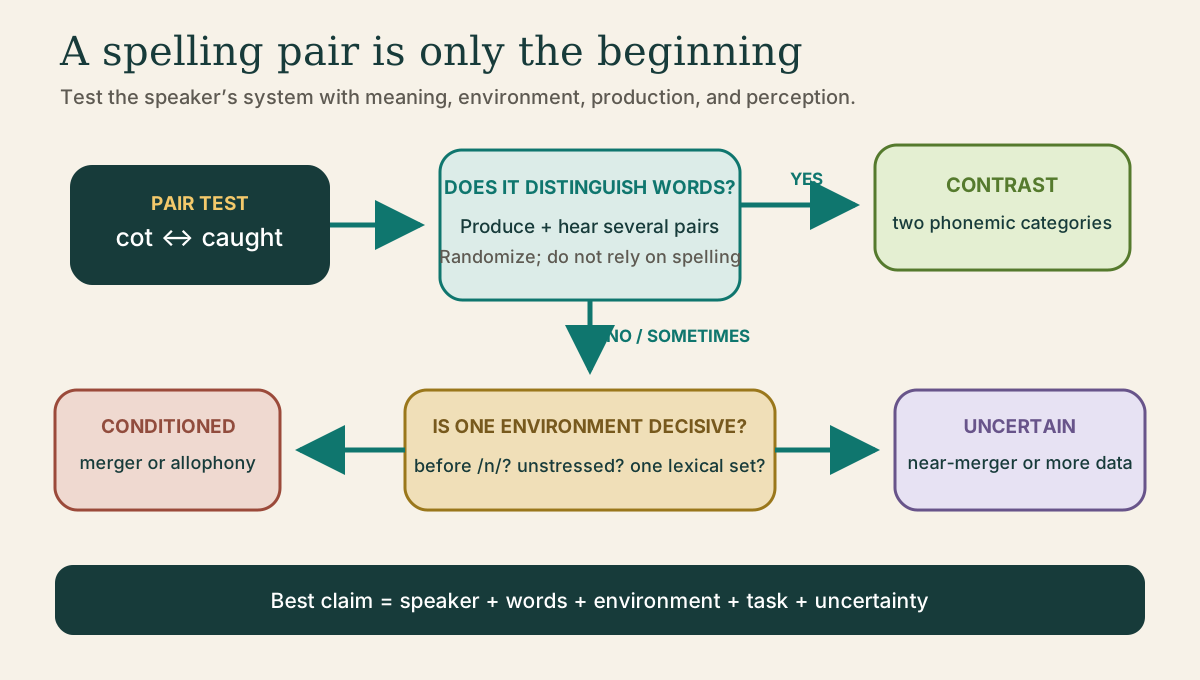
If production and perception show no reliable distinction, merged is a good description. If both show a stable contrast, distinct is better. If the acoustic signal differs slightly but the speaker judges the words the same, investigate a near-merger rather than forcing a binary verdict.
Case two: pin and pen
The pin–pen merger is conditioned. In varieties that have it, /ɪ/ and /ɛ/ can converge before nasal consonants, making pin and pen alike while pit and pet remain different. A Way with Words emphasizes that the pattern is regional and systematic—not evidence that a speaker cannot tell the spellings apart 5.
The environment is part of the rule:
| Test | Before a nasal | Elsewhere |
|---|---|---|
| likely diagnostic pair | pin–pen, him–hem | bit–bet, pick–peck |
| possible outcome | contrast neutralized | contrast preserved |
| analysis | conditioned merger | two phonemes still contrast elsewhere |
Calling the speakers’ whole /ɪ/–/ɛ/ system “merged” would throw away the most interesting fact: the following nasal predicts where neutralization is likely.
Contrast, allophone, or merger?
Ask four questions in order:
- Does the difference distinguish words for this speaker? If yes, you may have a phonemic contrast.
- Is the variation predictable from sound context? If yes, test an allophonic rule or conditioned merger.
- Do production and perception agree? If no, keep near-merger or unstable variation open.
- Does the pattern recur across words and speakers? If no, it may be lexical, stylistic, or simply under-sampled.
Spelling is not one of the tests. Orthography preserves history and conventions; it does not provide a live acoustic measurement.
Practice lab: build a twelve-token contrast test
Choose one pair set: cot/caught, Don/dawn, or pin/pen. Add four control words. Then:
- Put each word in the same short carrier phrase.
- Randomize the list and record it twice in a comfortable style.
- Trim or have a partner play the tokens without showing the spelling.
- Classify what you hear and calculate the accuracy.
- Repeat with a more careful style.
Write the result as a bounded claim: “In this small task, this speaker maintained the contrast in 11 of 12 classifications,” not “Wisconsin says it this way.” One person can demonstrate a system; one person cannot map a region.
Rule of thumb
A merger changes the inventory of contrasts, not the intelligence of the speaker. Use pairs to test the system, environments to refine the pattern, and corpora to move from one voice to a community.
Practice
The contrast survives elsewhere but is neutralized before a nasal consonant, so the environment belongs in the description.
Practice
Production and perception from the individual are stronger than spelling, outsider impressions, or geographic stereotypes.
Practice
Allophones are context-linked realizations of a category; a phonemic contrast distinguishes lexical meaning.
Lesson complete
Nice work.
Sources for this lesson
- 1Vowel Mergers. A Way with Words. verifiedTranscript-led introduction to cot/caught, Don/dawn, and pin/pen as patterned mergers rather than careless pronunciation. Cited at: transcript and audio.
- 2How Is Phonology Studied?. University of Sheffield. verifiedAccessible university overview of phonemes, allophones, and minimal-pair reasoning. Cited at: minimal pairs and allophones.
- 3William Labov. The Organization of Dialect Diversity in North America. University of Pennsylvania Linguistics Laboratory. 1996. verifiedPrimary phonological-atlas overview mapping mergers and chain shifts, including cot/caught and pin/pen. Cited at: atlas overview.
- 4Cynthia G. Clopper, David B. Pisoni. The Nationwide Speech Project: A New Corpus of American English Dialects. Speech Communication. 2006. verifiedOpen research article describing a controlled corpus built to compare regional American English pronunciation. Cited at: corpus design.
- 5Pin vs. Pen. A Way with Words. verifiedSegment on the conditioned pin-pen merger, especially before nasal consonants, and on why a regional contrast is not a test of correctness. Cited at: segment.