Friendly Noise: Phatic Communication
Small talk that does real work: phatic communication, reading 'How are you?' in three different encounters, keeping a phone line alive with small sounds, conventional email openings that still carry content, and mapping openings and closings.
- 7 min
- 8 steps
- 3 questions
- Lesson 20 of 36
In this lesson
- The Word Cabinet
- Method: RACE past the “empty talk” verdict
- Worked case 1: one question, three encounters
- Worked case 2: keeping the line alive
- Worked case 3: written ritual with real content
- Practice: make a contact map
- Rule of thumb
Open alongside this lesson
-
How Are You? Is Sometimes More Than a Question (opens in a new tab)
Start with the familiar puzzle of a question that often acknowledges another person before it requests a health report.
-
Noises We Sing, Hum, or Mutter While Waiting (opens in a new tab)
Compare private humming with vocal signals that keep an open telephone channel socially alive.
-
Phatic Replacements Word Game (opens in a new tab)
Notice how conventional greetings and leave-takings can be swapped while preserving an interactional job.
-
The Phatic: Communication and Communion (opens in a new tab)
Use this modern history to distinguish relationship-building phatic communion from channel-oriented phatic contact.
Picking up where you left off.
“How are you?” looks like a request for information. Sometimes it is. In a clinic, after a difficult week, or between close friends, the answer may become the main event. During a quick hallway crossing, the same words may chiefly say: I recognize you; our channel is open; we are on ordinary terms.
That second use is often called phatic communication. It is easy to dismiss as “small talk” or “empty language,” but that verdict measures only factual novelty. A doorstop contains little new information too; it still does a job. Brief talk can begin an encounter, affirm a relationship, test whether another person can hear, smooth a transition, or close contact without rupture.
A Way with Words uses “How are you?” to introduce this social work 1. One historical correction matters: the show page’s summary attributes the term to Walter Redfern. Modern scholarship traces phatic communion to anthropologist Bronisław Malinowski; Redfern was a later commentator who memorably described such language as social cement 2. The correction sharpens the idea without spoiling the example.
The Word Cabinet
- phatic communion: language oriented toward creating or sustaining social bonds;
- phatic contact: language oriented toward opening, checking, maintaining, or closing a communicative channel;
- referential content: what an utterance says about people, things, events, or states of affairs;
- greeting: a conventional opening that acknowledges another person and commonly invites a paired response;
- leave-taking: a conventional action for ending an encounter;
- adjacency pair: two linked actions, such as greeting–greeting or question–answer, in which the first makes a kind of second action relevant;
- uptake: how another participant displays an understanding of the prior action;
- small talk: informal talk often organized around safe, readily shared topics; it may be phatic, informative, strategic, enjoyable, unwelcome, or several at once.
The history supplies two useful lenses. Malinowski’s “communion” lens foregrounds relationships. Roman Jakobson later used “phatic” for work on the contact or channel: “Hello?” tests a phone connection; “Are you still there?” checks it; “Right, talk soon” prepares to close it. These are related traditions, not one magic category. J. L. Austin also used phatic act in a different technical sense, so always define the term you mean 2.
Method: RACE past the “empty talk” verdict
Use RACE to read a brief exchange without forcing one explanation.
R — Relationship. What relationship is being acknowledged or negotiated: strangers sharing space, coworkers beginning a shift, friends reconnecting, host and guest, caller and service worker? Do not assume everyone wants the same amount of social contact.
A — Access. Is the utterance opening, checking, holding, repairing, or closing a channel? In text, an emoji or “Hey—quick question” can prepare access just as a telephone “Hello?” does.
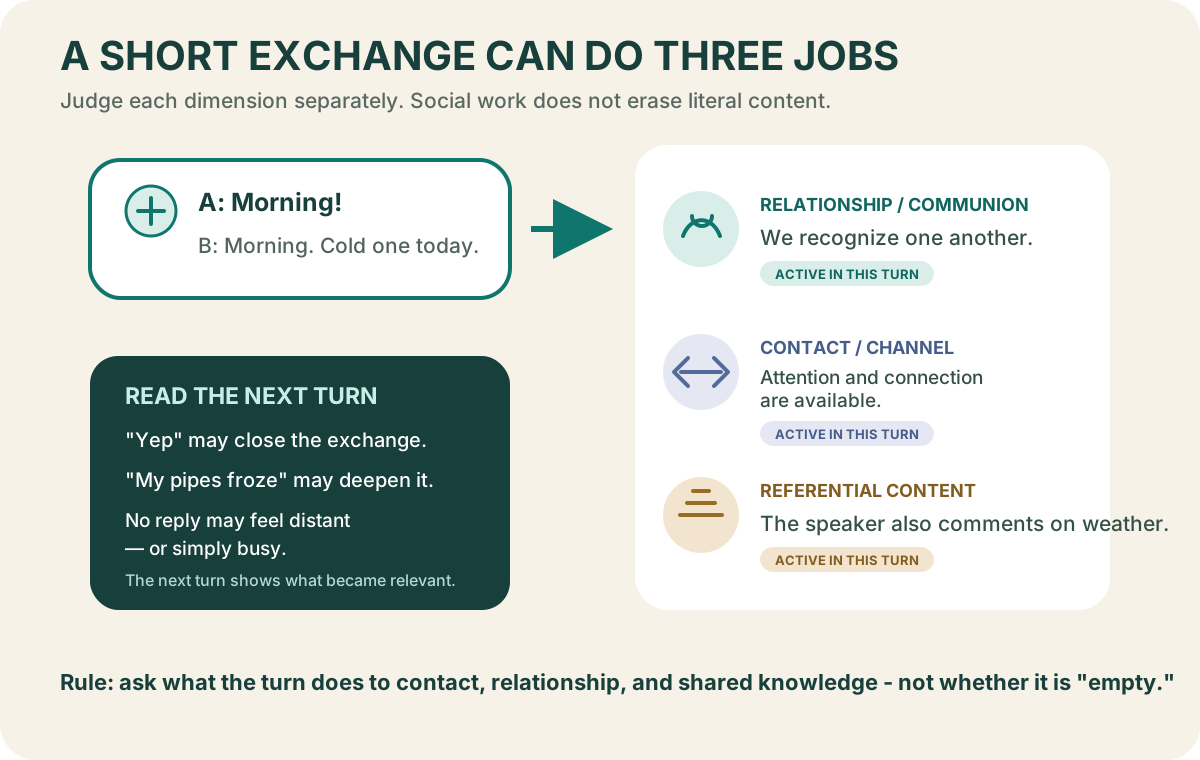
C — Content. What literal information could be at stake? Phatic and referential are not opposites. “Cold out there” can report weather while also creating a low-risk moment of affiliation.
E — Evidence in the next turn. How does the recipient answer? A returned greeting, a detailed report, a puzzled pause, or an immediate request provides evidence about the participants’ current interpretation. It does not reveal a hidden meaning with certainty, but it is stronger than an analyst’s stereotype.
Mnemonic: run the RACE before calling it filler.
Worked case 1: one question, three encounters
Compare the same wording:
- A cashier says, “How are you?” while beginning a transaction. The customer says, “Good, thanks—how about you?” and presents a card.
- A physician says, “How are you?” after a treatment change. The patient describes two symptoms.
- A close friend says, “How are you?” after noticing a withdrawn expression. The friend waits through a long silence.
The first sequence strongly displays a conventional acknowledgment intertwined with service. The second treats the words as a broad information question. The third can do both relationship work and invite disclosure. No dictionary difference caused the shift. Roles, timing, prior knowledge, gaze, setting, and the next action shaped it.
Conversation researchers studying “How are you?” found precisely this negotiability: participants can keep the exchange routine or expand it into talk about health and trouble 3. Greetings are often organized as paired actions, but their forms and expectations vary with relationship, community, and situation 4. “Literal answers are rude” is therefore a poor universal rule. Better: notice what this opening makes relevant here and leave room for another person to answer differently.
Worked case 2: keeping the line alive
Imagine a caller searching for a confirmation number. While typing, the caller murmurs “let’s see … almost … okay.” The words may not update the listener much, but the sound reassures them that the call has not dropped and that work is continuing. It manages access to the channel.
Now imagine the same person humming alone while a kettle boils. That sound may regulate mood, occupy attention, or simply feel pleasant. Without an addressed other or open exchange, labeling it phatic communication adds little. The A Way with Words waiting-noises segment is useful because it invites this contrast between self-directed vocalizing and contact-maintaining sound 5.
Even on a live call, do not treat every “um” as phatic. A hesitation can display word-search or planning. Functions may overlap: a drawn-out “so…” can hold the floor, signal a transition, and keep contact while the speaker formulates a thought.
Worked case 3: written ritual with real content
“Hope you’re well” at the start of an email is conventional. Convention does not make it insincere. The writer can genuinely wish the recipient well, acknowledge the relationship, and prepare a request in the same line. Likewise, “Take care” can close access while expressing concern.
The A Way with Words phatic-replacements game works because different formulas can occupy similar opening or closing slots 6. But substitution has limits. “What’s up?” may feel easy among friends and oddly intimate in a formal notice. A formula comfortable for one speaker can feel demanding, inaccessible, or exhausting to another. Communication styles also differ across autistic and non-autistic people, cultures, regions, languages, workplaces, families, and individuals. The goal is not to rank those styles by conformity to one script. It is to see the work participants are attempting and whether it succeeds for them.
Practice: make a contact map
Collect eight naturally occurring openings, check-ins, or closings from situations you can ethically observe. Briefly note the setting; do not record private speech without permission.
For each token:
- write the exact words or describe the gesture;
- mark R, A, and C whenever that job is plausible;
- copy the next turn as Evidence;
- name one alternative interpretation;
- move the wording to a new setting and predict what changes.
Try “How’s it going?”, “You good?”, a wave, “Hello?”, “Anyway…,” “Thanks again,” or a shared complaint about the weather. If the next turn surprises you, keep the surprise. It is evidence that phaticity is negotiated, not printed permanently on a phrase.
Rule of thumb
Do not ask only whether an utterance delivers new facts. Ask what it does to the relationship, the channel, and shared knowledge—then check the next turn. Friendly noise is often social infrastructure, but no formula carries one etiquette or one function everywhere.
Practice
Phatic talk can establish or renew social contact. Calling it meaningless misses that action, while claiming a universal script ignores context and variation.
Practice
Participants negotiate the exchange. Their uptake is evidence for the job the question is doing in that setting; it does not impose one etiquette rule.
Practice
Similar sounds can do different jobs. Phatic contact concerns communication or communion with others, not every vocalization that lacks dictionary words.
Lesson complete
Nice work.
Sources for this lesson
- 1How Are You? Is Sometimes More Than a Question. A Way with Words. 2021. verifiedSegment about ritual greetings, literal answers, and the social work often described as phatic speech. Its Walter Redfern attribution should be corrected with the modern scholarly history cited in this module. Cited at: segment and show notes.
- 2Charles H. P. Zuckerman. The Phatic: Communication and Communion. The International Encyclopedia of Linguistic Anthropology / Wiley. 2021. verifiedModern scholarly overview separating Malinowski's relationship-building communion phaticity from Jakobson's channel-oriented contact phaticity and warning against treating phatic language as an empty catch-all. Cited at: scholarly overview; communication and communion.
- 3Justine Coupland, Nikolas Coupland, Jeffrey D. Robinson. How Are You?: Negotiating Phatic Communion. Language in Society / Cambridge University Press. 1992. verifiedConversation-analytic study showing that phaticity is negotiated and multidimensional rather than a fixed class of empty utterances. Cited at: study of negotiated phatic communion.
- 4Functions of Greetings. Center for Advanced Research on Language Acquisition, University of Minnesota. verifiedTeaching-oriented research overview of greetings as ritualized adjacency pairs whose forms and expectations vary across relationships, settings, and communities. Cited at: Functions of Greetings.
- 5Noises We Sing, Hum, or Mutter While Waiting. A Way with Words. 2021. verifiedSegment distinguishing private self-directed vocalizing from sounds that maintain contact with another person on an open channel. Cited at: segment and show notes.
- 6Phatic Replacements Word Game. A Way with Words. 2013. verifiedA playful inventory of conventional conversational expressions such as greetings and leave-takings. Cited at: word game.