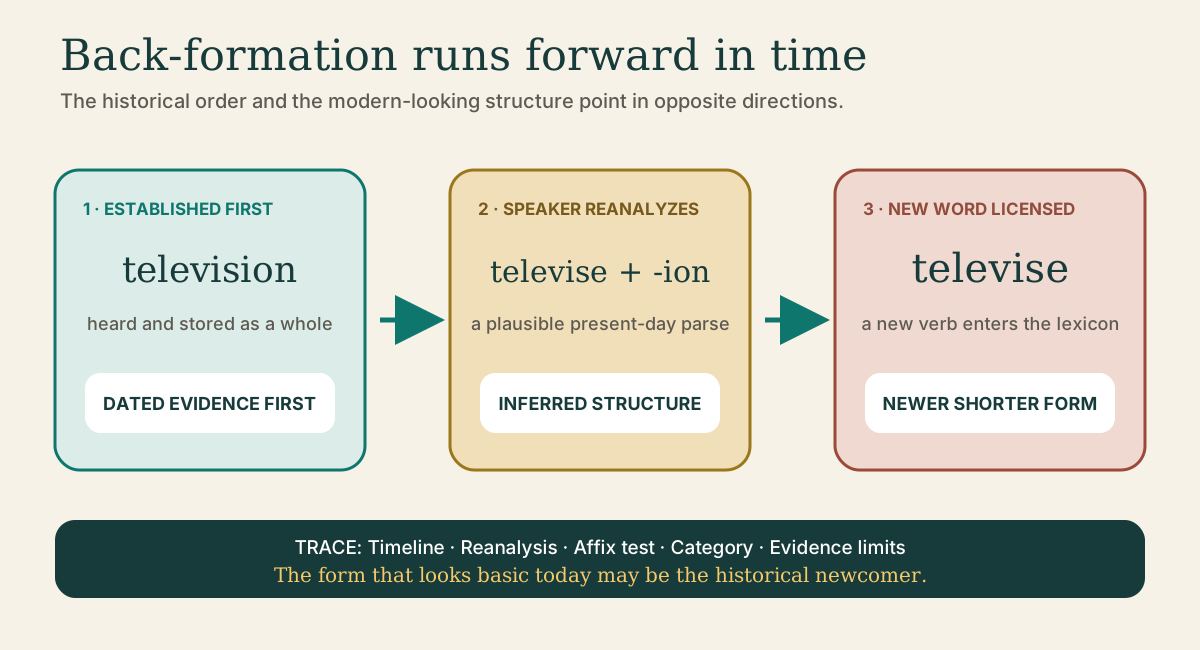
Back-Formation: The Word That Looks Subtracted
Back-formation, where a shorter word comes from a longer one: frivol, edit, burgle, and babysit, how it differs from affixation, conversion, and clipping, checking the timeline before labeling a pair, and the case of 'conversate.'
- 6 min
- 8 steps
- 3 questions
- Lesson 13 of 36
In this lesson
- Transcript lab: one tiny verb, one large inference
- Word Cabinet
- Four nearby processes that are not identical
- The TRACE test
- Worked case: conversate
- Practice: run history backward without reasoning backward
- Rule of thumb
Open alongside this lesson
-
Frivol, a Back-Formed Verb From Frivolous (opens in a new tab)
Start with the compact case, then ask what ending a speaker might believe was removed.
-
Conversate Is Different From Converse (opens in a new tab)
Watch morphology, history, register, and social judgment interact.
-
The Status of Back-Formation and Morpheme-Basedness of English Morphology (opens in a new tab)
Use this when the simple “take off a suffix” story stops being theoretically adequate.
-
Gruntle, Burgle, and Commentates (opens in a new tab)
Compare forms that now look ordinary with back-formations that still attract complaint.
Picking up where you left off.
English sometimes appears to manufacture a smaller word by taking a larger one apart. Editor seems to contain edit + -or, but the occupational noun is older in English than the verb edit. Television supplied televise. Merriam-Webster’s dated discussion places editor in 1649 and edit in 1791, and television in 1907 and televise in 1927 1. Frivolous supplied the rare but useful verb frivol. This process is called back-formation.
The name is easy to misread. A speaker does not travel backward through a word’s true history. The speaker encounters an existing form, assigns it a new internal structure, and uses that analysis to make another word. From the speaker’s perspective, the process moves forward like every other innovation.
Transcript lab: one tiny verb, one large inference
In the A Way with Words transcript about frivol, the hosts begin with familiar frivolous and identify frivol as a later verb meaning to waste time on something unimportant 2. The interesting lesson is not merely the novelty of frivol. It is the silent analysis that makes the verb feel possible:
frivolous → imagined frivol + -ous → new verb frivol
The analysis need not reproduce the word’s actual route into English. It only needs to resemble a productive pattern that current speakers know. English contains pairs such as danger/dangerous and poison/poisonous, so a speaker can treat -ous as detachable even where the history is more complicated.
Word Cabinet
| Pair | Historical direction in English | What a speaker may infer |
|---|---|---|
| editor → edit | noun before verb | -or marks a person who does the base action |
| television → televise | noun before verb | -ion marks an event or result built on a verb |
| frivolous → frivol | adjective before newer verb | -ous can be removed to reveal a base |
| burglar → burgle | agent noun before verb | -ar/-er is treated as an agent suffix |
| lens → len | standard noun before rare inferred singular | final s is heard as plural morphology |
| biceps → bicep | Latin singular in -s before English singular without it | final s is reassigned as an English plural |
The single len transcript is especially revealing because the speaker’s analysis is locally rational. English plurals often end in /z/, so an unfamiliar final /z/ is available for reinterpretation 3. The result may remain rare or socially marked, but it is not random.
Four nearby processes that are not identical
- Affixation: teach + -er → teacher. A speaker adds material.
- Conversion: to email from the noun email. The form changes word class without visible subtraction.
- Clipping: laboratory → lab. The shorter form is made by abbreviation, not by identifying a supposed suffix.
- Back-formation: babysitter → babysit. The new item arises through analysis of the longer form’s structure.
The boundaries are theoretically interesting. Nagano argues that English back-formation and conversion can be treated as related lexical processes, rather than as a machine that deletes morphemes 4. Bauer likewise warns that “back-formation” can misdescribe what users know: they are licensing a new word from a pattern, not undoing an earlier derivation 5.
The TRACE test
Use TRACE before labeling a pair.
- T — Timeline: Which form appears first in dated evidence?
- R — Reanalysis: What internal structure would make the newer form predictable?
- A — Affix test: Is the removed-looking piece a recognizable suffix elsewhere?
- C — Category: Did the innovation create a verb, noun, or adjective rather than just an abbreviation?
- E — Evidence limits: Is the history established, disputed, or merely plausible?
The timeline prevents a common error. If teach clearly predates teacher, the pair illustrates ordinary derivation, even though someone can mechanically erase -er. Back-formation is a historical claim, not a visual trick.
Worked case: conversate
The transcript caller had stopped using conversate after being told it was “not a real word.” Yet the episode documents more than two centuries of use, discusses a possible relationship to conversation, and records the caller’s distinction between formal converse and warmer, more personal conversate in Black English 6.
TRACE produces a careful result:
- Timeline: conversate is not a recent error.
- Reanalysis: conversation could support a back-formed verb, but that is not the only historical consideration.
- Affix test: speakers readily recognize -ation in event nouns.
- Category: the result is a verb with its own usage profile.
- Evidence limits: “possible back-formation” is more responsible than pretending the route is certain.
Most importantly, even a confirmed back-formation would not make the word defective. Edit and televise were innovations too. Social stigma and morphological history are different kinds of facts.
Practice: run history backward without reasoning backward
Investigate two candidates: one from edit, burgle, babysit, diagnose, or televise, and one word you have heard criticized.
For each, record:
- the earliest dated evidence you can locate for both forms;
- the structural analysis a speaker could make;
- a competing classification such as clipping or conversion;
- two present-day examples in different registers;
- a conclusion that grades confidence rather than declaring “obvious.”
Rule of thumb
The shorter-looking word is not necessarily the older word. Establish the timeline, reconstruct the speaker’s analysis, and keep “how it formed” separate from “where it belongs socially.”
Practice
Back-formation depends on a new structural analysis of an established form, not on length alone or a universal rule about endings.
Practice
The timeline is central: the form that looks basic synchronically appears later historically.
Practice
Formation, age, meaning, register, and social evaluation are separate questions that must be investigated separately.
Lesson complete
Nice work.
Sources for this lesson
- 1Gruntle, Burgle, and Commentates. Merriam-Webster. verifiedDictionary-editor overview with dated pairs including editor/edit and television/televise, plus examples of well-assimilated and still-contested back-formations. Cited at: dated examples.
- 2Frivol, a Back-Formed Verb From Frivolous. A Way with Words. 2020. verifiedFull segment transcript showing how speakers can infer a shorter verb by treating the end of a longer word as removable material. Cited at: full transcript.
- 3A Single Len. A Way with Words. 2009. verifiedFull segment transcript about speakers interpreting final s in lens or biceps as a plural ending and inferring a new singular. Cited at: full transcript.
- 4Akiko Nagano. The Status of Back-Formation and Morpheme-Basedness of English Morphology. English Linguistics / The English Linguistic Society of Japan. 2006. verifiedFree research article comparing affixation, conversion, and back-formation and arguing that back-formed items are stored lexical creations rather than words mechanically run backward. Cited at: article abstract and analysis.
- 5Laurie Bauer. Reflections on Back-Formation. Cambridge University Press. 2025. verifiedShort scholarly reassessment emphasizing that language users create a new analysis; they do not literally reverse a historical derivation. Cited at: chapter summary.
- 6Conversate Is Different From Converse. A Way with Words. 2023. verifiedFull segment transcript on back-formation, register, Black English, and the mistake of treating a socially marked word as linguistically unreal. Cited at: full transcript.