Metanalysis: When the Word Boundary Moves
When the boundary between words moves: 'a napron' becoming 'an apron,' 'an aught,' adder, and nickname, how metanalysis differs from mondegreens and eggcorns, and bracketing the sound before explaining it.
- 5 min
- 9 steps
- 3 questions
- Lesson 14 of 36
In this lesson
- Transcript lab: the traveling n
- Why the article is a boundary troublemaker
- Word Cabinet
- Nearby phenomena
- Use BRACKET
- Worked case: apron
- Practice: bracket before you explain
- Rule of thumb
Open alongside this lesson
-
Etymology of Aught (opens in a new tab)
Follow three cases where an n crosses the perceived boundary between article and noun.
-
Reanalysis (opens in a new tab)
Use the formal definition to see why a changed analysis may initially produce no changed sound.
-
Etymology FAQ (opens in a new tab)
Review what dictionary etymologies can and cannot establish before reconstructing a boundary shift.
Picking up where you left off.
Speech does not arrive with spaces. Listeners receive a changing stream of sound and infer where words and meaningful parts begin. Usually that inference is effortless. Occasionally two analyses fit the same stream, and a community gradually adopts the newer one. Metanalysis—also called misdivision, resegmentation, or a kind of rebracketing—is a change in those inferred boundaries.
Transcript lab: the traveling n
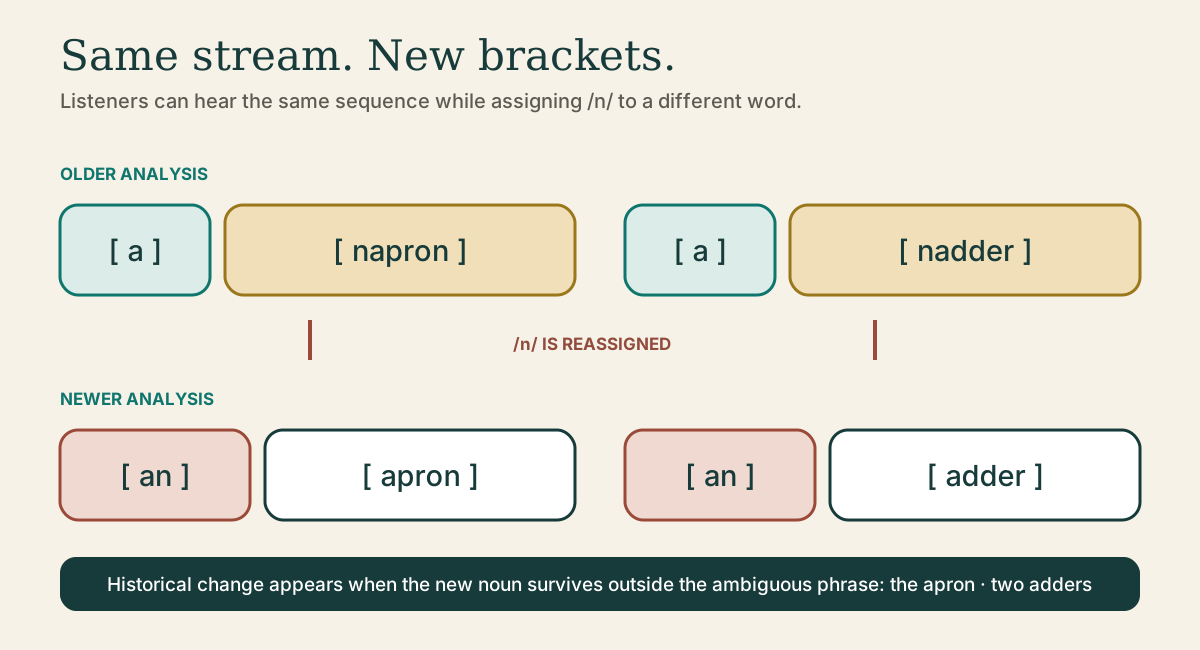
An A Way with Words caller knew aught as a word for zero but initially searched for ought. The hosts connect aught to an older naught and demonstrate the same boundary shift in apron and adder 1. The crucial strings can be heard with either set of brackets:
- a naught → an aught
- a napron → an apron
- a nadder → an adder
The first stage need not change any sound. Only the analysis changes. Harris and Campbell define reanalysis more generally as a change in underlying structure that need not immediately alter the surface form 2. Metanalysis is the pocket-sized lexical version of that larger idea.
Why the article is a boundary troublemaker
English alternates between a and an. In connected speech, a napron and an apron can be nearly indistinguishable. If learners repeatedly assign the /n/ to the article, their stored noun becomes apron. Evidence that the new analysis has stabilized appears when the noun occurs elsewhere: the apron, two aprons, my apron.
This is not carelessness. The listener solves an ambiguous segmentation problem using familiar grammar. The solution becomes historically visible only when it differs from the previous generation’s solution.
Word Cabinet
| Modern form | Older analysis | New analysis | Direction of boundary travel |
|---|---|---|---|
| an apron | a napron | an apron | n leaves the noun |
| an adder | a nadder | an adder | n leaves the noun |
| an aught | a naught | an aught | n leaves the noun |
| a nickname | an ekename | a nickname | n joins the noun |
Nickname shows that the direction can reverse. Older eke-name meant an additional name. In the recurring sequence an ekename, the /n/ could be heard as the noun’s beginning. Modern speakers inherit the result without needing to repeat the historical mistake.
Nearby phenomena
Do not use metanalysis as a label for every surprising form.
- A mondegreen is a misheard line, often preserved only in one listener’s memory.
- An eggcorn replaces an opaque expression with meaningful familiar material while approximately preserving sound.
- A back-formation infers a new shorter lexeme from a longer one.
- Metanalysis changes the location of a boundary.
- Lexicalization is the broader process by which a form or phrase becomes stored as a conventional unit.
The categories can overlap. A private mishearing can involve resegmentation, but it becomes a historical metanalysis only when the new boundary is learned and transmitted.
Use BRACKET
- B — Begin with sound. Write the continuous sequence before inserting spaces.
- R — Restore the older form. Use dated dictionary evidence, not resemblance alone.
- A — Add both bracketings. Show exactly where the boundary moved.
- C — Check other contexts. Plurals, possessives, and different determiners reveal the stored noun.
- K — Keep transmission in view. Ask whether the analysis spread beyond one token or one speaker.
- E — Exclude neighbors. Test eggcorn, clipping, folk etymology, and back-formation.
- T — Tell the direction. State which sound moved from which unit to which.
Worked case: apron
Suppose a source says “people dropped the n because English got lazy.” BRACKET replaces that moral story with a mechanism.
- Begin: /əneɪprən/ can be compatible with more than one boundary.
- Restore: historical evidence identifies a noun with initial n, related to French material for cloth.
- Add brackets: [a] [napron] → [an] [apron].
- Check: the apron confirms that the later stored noun lacks n.
- Keep transmission: the later analysis became conventional English.
- Exclude: no suffix was removed, so this is not back-formation.
- Tell direction: /n/ moved from noun onset to article coda in the listener’s analysis.
The etymology guide in Merriam-Webster is useful here because good dictionary histories distinguish inherited forms, borrowings, alterations, and unknown origins rather than treating modern spelling as a transparent fossil 3.
Practice: bracket before you explain
Draw two bracketings for an aught, an apron, an adder, and a nickname. Then invent one possible ambiguous sound stream of your own. Label the invented one as hypothetical; do not present it as a real etymology.
For one historical case, find a dictionary entry and write three sentences:
- what the older noun was;
- what recurring phrase permitted ambiguity;
- what later contexts prove the new boundary had stabilized.
Rule of thumb
If the sound stays put but the brackets move, investigate metanalysis. A clever segmentation is only a hypothesis until dated evidence and later contexts show that a community adopted it.
Practice
Reanalysis changes how material is grouped; the surface sequence may initially remain identical.
Practice
The initial n of the older noun was reassigned to the indefinite article.
Practice
Individual ambiguity supplies raw material; conventionalization and transmission turn an analysis into language change.
Lesson complete
Nice work.
Sources for this lesson
- 1Etymology of Aught. A Way with Words. 2015. verifiedFull segment transcript explaining misdivision or metanalysis in naught to aught, napron to apron, and nadder to adder. Cited at: full transcript.
- 2Alice C. Harris, Lyle Campbell. Reanalysis. Cambridge University Press. 1995. verifiedScholarly chapter defining reanalysis as a change in underlying structure that may initially leave the observable form unchanged. Cited at: chapter summary.
- 3Etymology FAQ. Merriam-Webster. verifiedConcise explanation of what dictionary etymologies report and why similar-looking forms do not prove ancestry. Cited at: etymology guide.