Semantic Bleaching: How Strong Words Fade
How strong words fade into intensifiers: 'awfully talented' and 'terribly kind,' three measurable signals from corpus research, the residue a bleached word keeps, how bleaching differs from pejoration and amelioration, and a five-column word history.
- 5 min
- 7 steps
- 3 questions
- Lesson 15 of 36
In this lesson
- Transcript lab: an awfully useful puzzle
- Three measurable signals
- Word Cabinet
- What bleaching is not
- Use SHADE
- Practice: build a five-column history
Open alongside this lesson
-
Why Awfully Is Not Necessarily Awful (opens in a new tab)
Track awe-filled description becoming a broadly compatible intensifier.
-
From Insanely Jealous to Insanely Delicious: Computational Models for the Semantic Bleaching of English Intensifiers (opens in a new tab)
See how distributional evidence turns a word-history intuition into three testable measures.
-
Regularity in Semantic Change (opens in a new tab)
Use the historical-pragmatic account to understand how repeated inferences become conventional meanings.
Picking up where you left off.
Awfully talented does not mean talented in a horrible manner. Terribly kind is not an insult. Insanely delicious need not diagnose anyone. In these uses, a vivid source meaning has faded while a more general job—turning up intensity—has grown. Linguists call this semantic bleaching or semantic weakening.
The metaphor is imperfect. A word is not washed blank. Its meaning becomes less specific in a particular construction, often allowing it to combine with a wider range of partners. Older meanings may survive beside the newer function.
Transcript lab: an awfully useful puzzle
The A Way with Words caller notices an apparent mismatch between negative awful and complimentary awfully loyal. The transcript walks through at least two historical steps: awful once related more directly to being filled with or inspiring awe; awfully developed manner and degree uses; the intensifier can now modify both positive and negative descriptions 1.
That last fact matters. Bleached awfully is not “positive.” It contributes high degree:
- awfully loyal → very loyal
- awfully careless → very careless
The evaluative direction comes from the adjective. The intensifier mainly adjusts the scale.
Three measurable signals
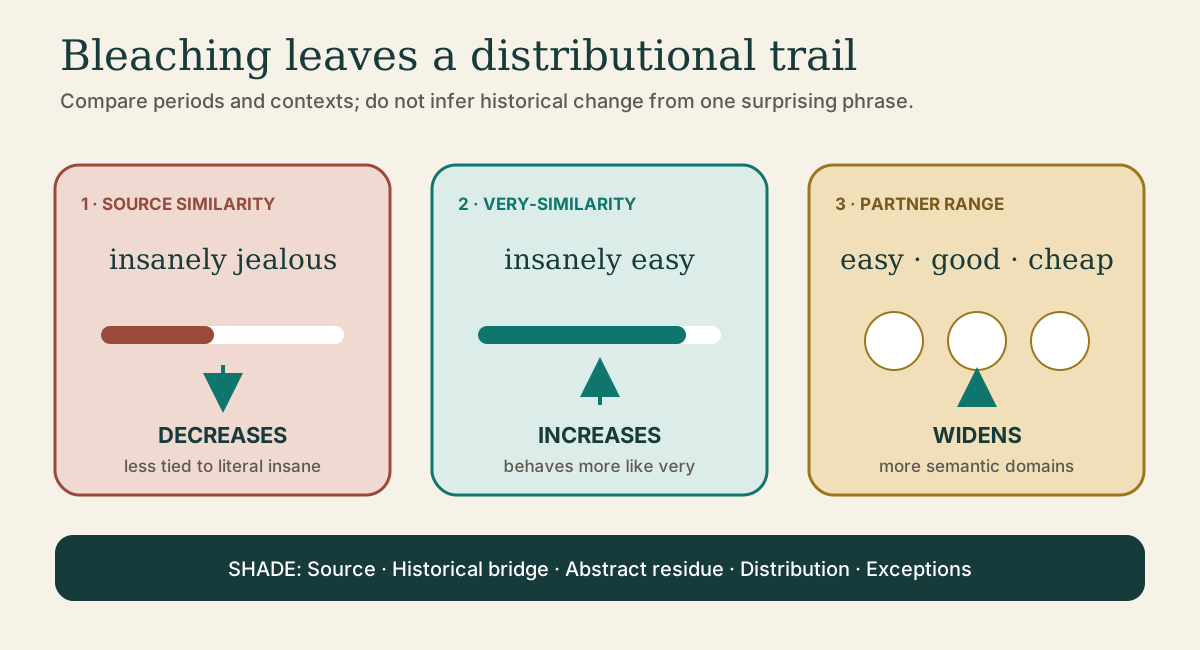
Luo, Jurafsky, and Levin model English intensifier change with three distributional signals 2:
- Source similarity falls. Intensifier insanely becomes less confined to contexts resembling literal insane.
- Prototype similarity rises. Its behavior becomes more like general-purpose very.
- Productivity rises. It modifies a broader set of adjectives.
Their proposed bridging contexts explain how reanalysis can begin. In insanely jealous, literal manner and high degree reinforce each other. A listener can understand both “in an insane way” and “extremely.” Repeated ambiguous contexts make the degree reading independently available; later insanely delicious no longer needs the original manner sense.
Word Cabinet
| Form | More source-rich use | More bleached use | Residue that remains |
|---|---|---|---|
| very | historically connected with truth | very cold | degree |
| awfully | in an awful manner | awfully nice | high degree, often stance |
| terribly | in a terror-causing or terrible way | terribly sorry | high degree |
| insanely | in an insane manner | insanely easy | extreme degree, informal stance |
| literally | in a literal rather than figurative sense | emphatic literally froze in some usage | speaker commitment or intensity in that construction |
The last item is contested and context-sensitive. Do not assume that every emphatic token has lost literal meaning, or that every use belongs to one stage. Variation is the data.
What bleaching is not
- Pejoration makes a meaning more negative; amelioration makes it more favorable. Bleaching reduces specificity or descriptive content.
- Semantic satiation is the temporary strangeness caused by repetition in an individual mind. Bleaching is a conventional change visible across speakers and time.
- Meaning loss is too absolute. Source and bleached uses commonly coexist.
- Grammaticalization is a broader pathway in which lexical material develops grammatical functions. Bleaching often accompanies it, but scholars debate whether and when bleaching is necessary.
Traugott and Dasher place semantic change in recurring speaker–listener inference: an interpretation useful in a particular context can become expected and eventually conventional 3. That makes the transcript’s puzzle a miniature of a larger process. A clever contextual inference can become part of the language.
Use SHADE
- S — Source sense: State the older concrete or descriptive meaning.
- H — Historical bridge: Find contexts where source and newer readings both make sense.
- A — Abstract residue: Identify what meaning remains—degree, aspect, stance, or another function.
- D — Distribution: Compare collocates across periods and genres.
- E — Exceptions: Preserve surviving source uses and competing analyses.
Worked case: insanely
Source: manner connected to insanity.
Bridge: insanely jealous can describe jealousy as irrational and as extreme.
Abstract residue: unusually high degree plus informal expressive stance.
Distribution: newer tokens such as insanely easy, insanely beautiful, and insanely affordable cross semantic domains that do not require mental-state content.
Exceptions: behaved insanely can retain the manner reading. Position and syntax help distinguish it from the pre-adjectival intensifier.
Practice: build a five-column history
Choose very, really, terribly, awfully, insanely, or wicked. Collect at least twelve dated examples from two periods. Record:
| Date | Full phrase | Source reading possible? | Degree paraphrase possible? | Genre |
|---|---|---|---|---|
Then answer: Did the form widen its adjective partners? Are there bridging contexts? Does an older use remain? Your conclusion should say “evidence of bleaching” only if the distribution supports it.
Rule of thumb
Do not diagnose bleaching from one surprising sentence. Look for a historical path from source-rich contexts to a broader, more abstract, more productive function.
Practice
Widening distribution and growing similarity to a general intensifier are observable diachronic signals.
Practice
The similar metaphors describe very different timescales and kinds of evidence.
Practice
Semantic change commonly produces polysemy; a bleached function can coexist with source-related uses.
Lesson complete
Nice work.
Sources for this lesson
- 1Why Awfully Is Not Necessarily Awful. A Way with Words. verifiedSegment on semantic bleaching and the development of intensifiers. Cited at: full transcript.
- 2Yiwei Luo, Dan Jurafsky, Beth Levin. From Insanely Jealous to Insanely Delicious: Computational Models for the Semantic Bleaching of English Intensifiers. Association for Computational Linguistics. 2019. verifiedOpen research paper measuring bleaching through loss of similarity to a source meaning, growing similarity to very, and widening collocational range. Cited at: paper and dataset method.
- 3Elizabeth Closs Traugott, Richard B. Dasher. Regularity in Semantic Change. Cambridge University Press. 2001. verifiedCorpus-based account of how innovative meanings arise in interaction and become conventional through recurring inferential contexts. Cited at: book description and corpus approach.
Further reading
- Semantic Change. Essentials of Linguistics 2e, eCampusOntario. verifiedOpen textbook chapter on narrowing, broadening, amelioration, pejoration, metaphor, and other paths of meaning change.