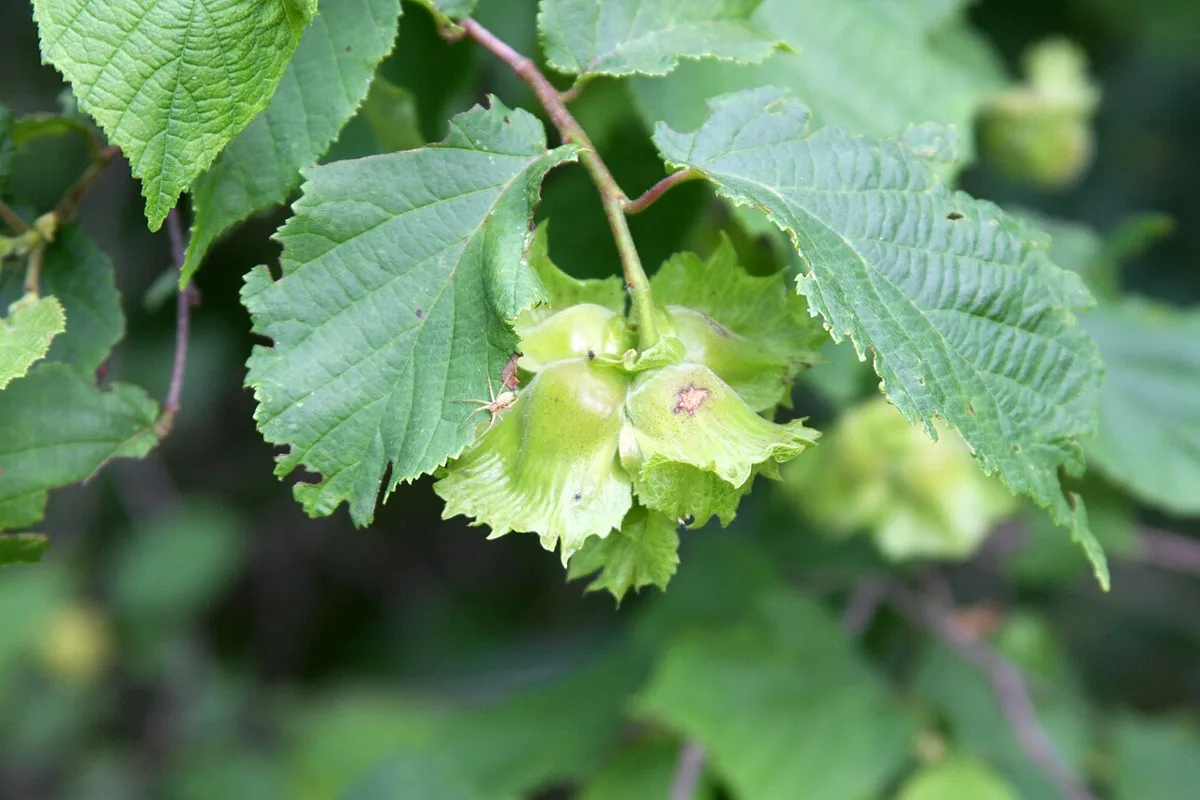
Hazelnuts
Wisconsin's two wild hazelnuts - American, with a short ruffled husk in sunny edges, and beaked, with a long bristly tube in the forest - picked in late August as the husks brown, dried, and roasted.
- 4 min
- 6 steps
- 3 questions
- Lesson 32 of 49
In this lesson
- Two hazelnuts
- Finding them
- Harvesting
- Processing
- Using them
- What to take from this
Picking up where you left off.
Two hazelnuts
Wisconsin has two native hazelnuts, both thicket-forming shrubs with doubly toothed, oval leaves and smooth, slender stems 1:
American hazelnut (Corylus americana):
- Husk: a two-part, leafy bract with ruffled edges, just long enough to enclose the nut 1.
- Habitat: sunny, drier places: woods edges, oak savannas, fencerows, and prairie edges 1. Common in southern and central Wisconsin.
- Twigs: often with stiff, glandular hairs.
Beaked hazelnut (Corylus cornuta):
- Husk: a long, tube- or trumpet-shaped bract, a “beak,” covered in fine, prickly bristles that irritate bare hands 1.
- Habitat: shaded forest understory with more moisture 1; dominant in much of the northern forest.
Both make small, round nuts that taste like a domestic hazelnut (filbert) once roasted. In late winter, both bloom early, with long dangling male catkins and tiny red female flowers.
Quick check
The husks are the giveaway: a long, bristly beak on beaked hazelnut, a leafy, frilled husk just covering the nut on American.
Finding them
Hazelnut shrubs are easy to find in summer by their leaves and catkins. Whether they bear is another matter: shaded shrubs flower and fruit poorly, so look for shrubs in sun, at woods edges, along trails and roads, and in clearings. Note productive patches in July, when the husked nuts are visible in clusters at the branch ends.

Harvesting
Both species ripen from late August to early September 1. The trick is timing:
- Pick when the husks begin to dry and fade to brown 1. The nut is mature but the squirrels, chipmunks, and blue jays haven’t stripped the patch yet; they start before you think the nuts are ripe.
- Test: open a husk; the nut should be firm and separate easily from it, with a brown-tinged shell 1.
- Wear gloves for beaked hazelnut’s bristles.
- Pick whole clusters into a bag or bucket.
Nuts are allowed on DNR land for personal use 2.
Processing
- Husk within a few days 1. Drying the clusters spread out for a few days loosens the husks; then rub, roll, or pull them off. Gloves help.
- Dry the nuts in their shells, in a single layer, for several weeks, protected from rodents 1.
- Crack with a nutcracker, and discard any that are empty, shriveled, or wormy.
- Roast the kernels at 225 °F for 30 to 35 minutes to develop the flavor 1; raw wild hazelnuts taste flat by comparison. Rub off the papery skins after roasting if you like.
Roasted hazelnuts keep longer than raw ones. Store kernels in the refrigerator or freezer.
Quick check
Pick when the husks start to brown, before squirrels and jays strip the shrubs.
Using them
- Eat roasted, plain or salted.
- Chop into cookies, granola, and salads, or crust fish and meat.
- Grind into hazelnut butter, or with chocolate for a homemade spread.
- Hazelnut and wild rice is a natural Upper Midwest pairing.
Wild hazelnut shrubs are also a good woodlot planting: the UW and Minnesota have been breeding hybrid hazelnuts for farm crops, and wild plants spread readily by suckers.
What to take from this
American hazelnut has a short, ruffled two-part husk and grows in sunny edges; beaked hazelnut has a long, bristly beak and grows in the forest understory. Both ripen late August to early September; pick when husks begin to brown, before wildlife strips the shrubs. Husk within days, dry for weeks, crack, and roast at 225 °F for half an hour.
Practice
Pick as husks begin to brown and the nut separates easily. Wait until they fall and the wildlife will have them.
Lesson complete
Nice work.
Sources for this lesson
- 1Hazelnuts. Minnesota Conservation Volunteer (Minnesota DNR). 2020. verifiedAmerican hazelnut (short two-part husk, sunny dry sites) and beaked hazelnut (long tubular husk, shaded forest); ripe late August to early September when husks begin to brown; dry for weeks; roast at 225 °F for 30-35 minutes.
- 2Wis. Admin. Code NR 45.04: Protection of natural resources (department lands). Wisconsin Legislature. verifiedNR 45.04(1)(a) bars removing natural growth from DNR lands; (1s) allows collecting edible fruits, edible nuts, wild mushrooms, wild asparagus, and watercress by hand for personal consumption, and removing listed invasive herbaceous plants. Cited at: NR 45.04(1s).