Maple Sugaring
Freezing nights and thawing days push sap from maples from late February into April. Tap trees by size, collect daily, boil 40 gallons down to one, and finish at 7 °F above boiling water - about 219 °F.
- 5 min
- 8 steps
- 3 questions
- Lesson 34 of 49
In this lesson
- Which trees
- When sap runs
- Tools
- Tapping
- Collecting
- Boiling
- Finishing
- What to take from this
Picking up where you left off.
Which trees
Every maple’s sap makes syrup. Sugar maple has the most sugar in its sap; black, red, and silver maples and box elder work too, with less sugar 1. About 40 gallons of sugar maple sap make one gallon of syrup; box elder can take close to 60 1.
Identify sugar maples before leaves fall, or in winter by their opposite branching, sharp-pointed brown buds, and gray bark that breaks into long plates on older trees. Red and silver maples have red buds and bud earlier, which ends their season sooner.
Tapping trees on DNR land or in state parks isn’t allowed without permission (sap isn’t on the gathering list); tap your own trees or a neighbor’s with permission.
When sap runs
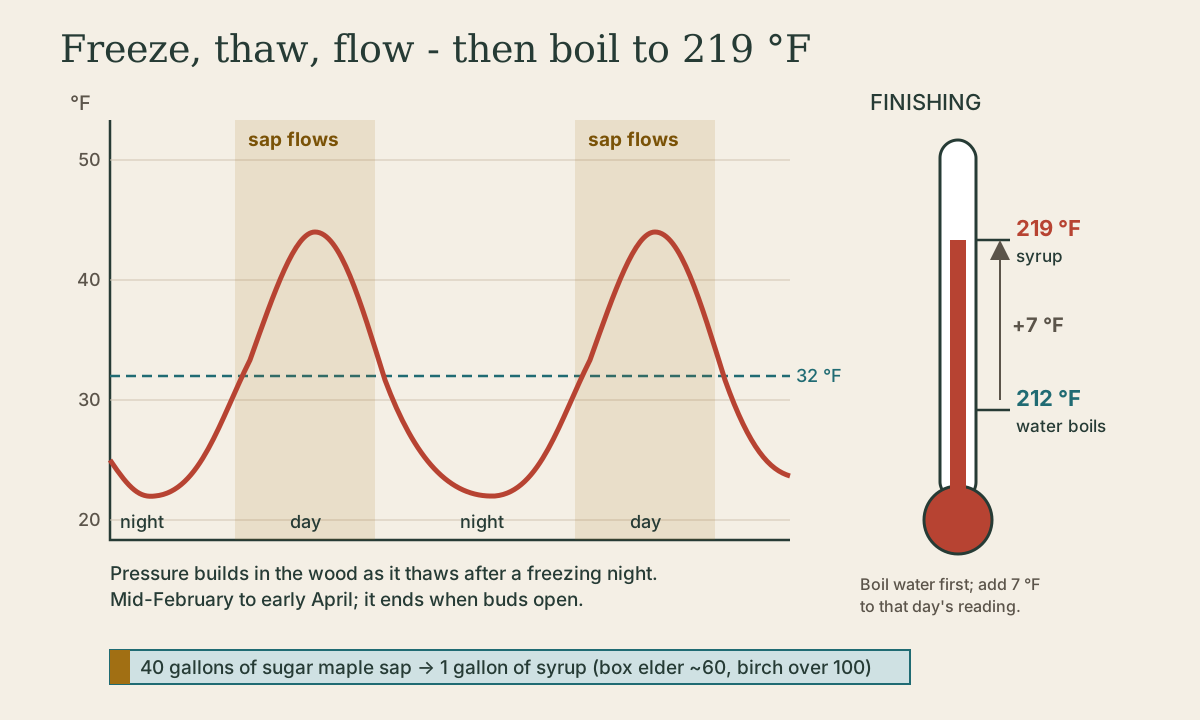
Sap runs best when nights drop below freezing and days rise into the 40s °F. In Minnesota (and Wisconsin), that’s typically mid-February to early April. Once temperatures stay above freezing and buds appear, the season is over 1; sap from budding trees makes off-flavored “buddy” syrup.
Why the cycle matters: maple sap flow is driven by pressure in the stem, not the roots. On a freezing night, gases in the wood contract and ice forms, drawing water up into the branches; when the wood thaws in the day, pressure builds and pushes sap out of any wound, including a taphole. Without a refreeze, the flow stops. Birch, by contrast, runs on root pressure only after it stays above freezing 2.
Quick check
Freeze-thaw cycles build and release pressure in the tree’s wood. In Minnesota and Wisconsin that’s mostly mid-February to early April; the season ends when buds swell and nights stay above freezing.
Tools
- A drill or brace with a 7/16-inch or 5/16-inch bit (match your spiles; 5/16 is easier on trees). The Minnesota DNR lists 7/16 or 3/8 1.
- Spiles (spouts), bought or made from 1/2-inch dowels with a hole drilled through 1.
- Covered containers: buckets, or food-grade jugs or bags.
- A big, broad, shallow pan for boiling outdoors, a smaller pan to finish, a candy thermometer, and wool felt or cheesecloth for filtering 1.
Tapping
Over-tapping damages trees. Taps by trunk diameter at chest height 1:
| Diameter | Taps |
|---|---|
| Under 10” | 0 |
| 10-14” | 1 |
| 15-19” | 2 |
| 20-24” | 3 |
| 25” or more | 4 |
- Drill 2 to 4 feet above the ground, at a slight upward angle, about 3 inches deep in Minnesota’s guidance 1; many producers now drill less (1½ to 2 inches) to limit wounding. Drill into sound, light-colored wood, away from old tapholes.
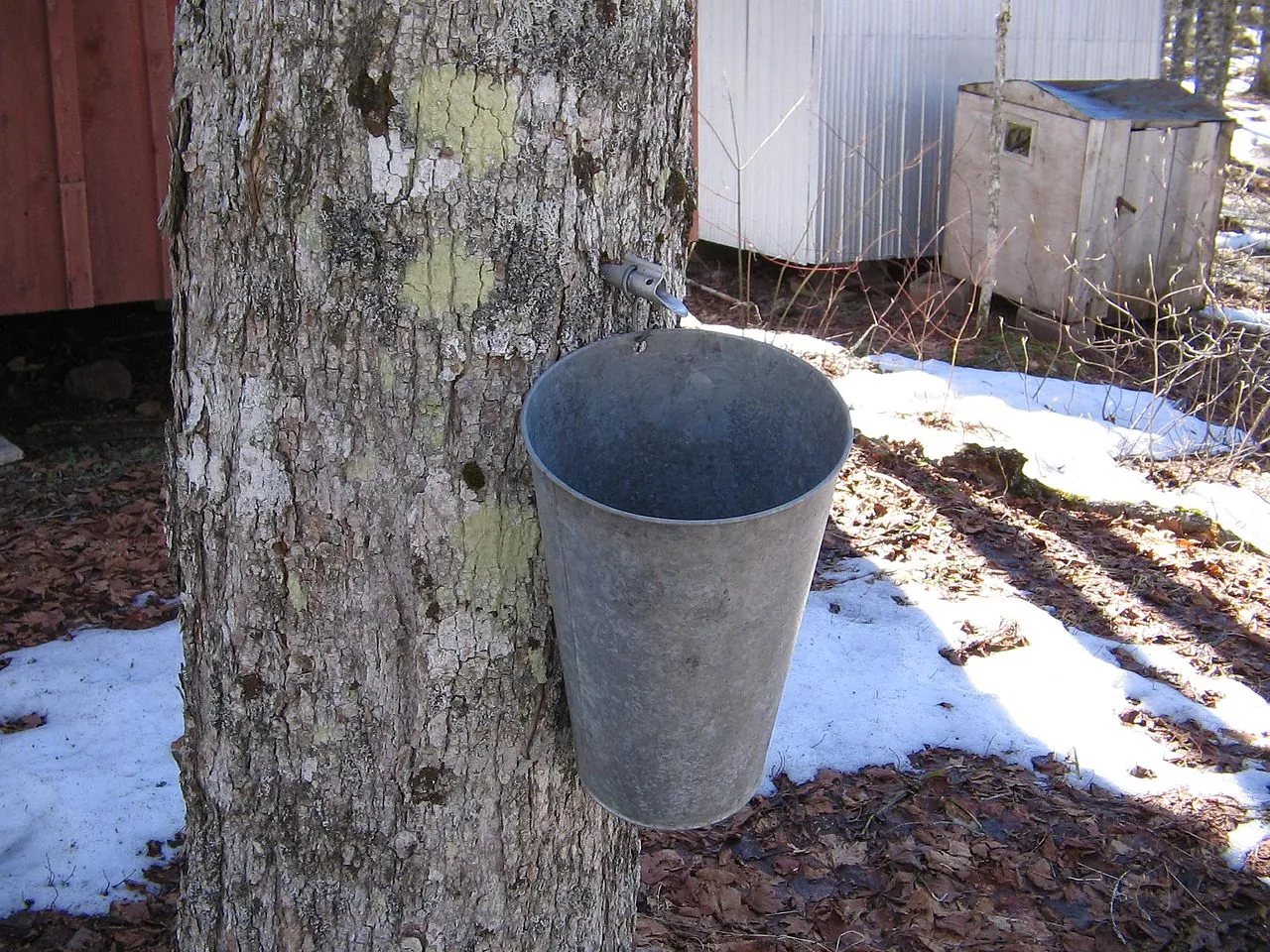
- Tap the spile in lightly with a hammer. Driving it too hard splits the bark and leaks sap 1.
- Hang a covered container.
- Pull spiles at season’s end and let the holes heal; don’t plug them.
Quick check
Minnesota DNR: no taps under 10 inches, one at 10-14, two at 15-19, three at 20-24, four at 25 and up.
Collecting
Empty containers daily and boil the sap promptly, or store it cool and out of the sun 1. Sap is mostly water with about 2 percent sugar, and it spoils like milk in warm weather, turning cloudy and sour. Pack sap containers in snow. Have at least 10 gallons before you start boiling 1.

Boiling
Making syrup is evaporation: turning 40 gallons of sap into one gallon means boiling off 39 gallons of water 1.
- Boil outdoors. That much steam will peel wallpaper and soak a house. A wood fire under a broad pan on blocks, a turkey-fryer burner, or a small evaporator all work 1.
- Add sap in small amounts to keep a rolling boil instead of killing it 1.
- Don’t let the pan run dry or scorch: keep at least an inch or two of liquid in it.
- Skim off the foam. A drop of butter or cream tames boil-overs.
As the sugar concentrates, the boiling temperature rises. When the sap darkens and the bubbles get small and foamy, move it to a smaller pan on the stove for close control 1.
Finishing
Syrup is done at 219 °F in the Minnesota DNR’s guide 1, which is 7 °F above the boiling point of water. Since water’s boiling point shifts with elevation and the barometer, boil plain water first and add 7 °F to whatever your thermometer reads. A syrup hydrometer gives a more exact finish: syrup should be about 66 to 67 percent sugar. Under-boiled syrup spoils; over-boiled syrup crystallizes in the jar.
Then:
- Filter hot through felt or several layers of cheesecloth, twice 1, to remove “sugar sand” (niter), the gritty minerals that settle out.
- Bottle: refrigerate, or fill hot canning jars with hot syrup and seal them for long-term storage 1.
Lighter, more delicate syrup usually comes early in the season and darker, stronger syrup late. Keep going past syrup for maple cream, sugar, and taffy on snow.
What to take from this
Any maple works, but sugar maple sap is sweetest: about 40 gallons per gallon of syrup. Sap runs on freezing nights and days in the 40s, mid-February into early April, until buds open. Tap only trees 10 inches and up (one tap at 10-14, adding one per 5 inches), collect daily and keep sap cold, boil outdoors, finish at 7 °F above boiling water, about 219 °F, and filter hot.
Practice
Syrup is done at about 7 °F above the boiling point of water. Check water’s boiling point on your thermometer that day, since it changes with weather and elevation.
Lesson complete
Nice work.
Sources for this lesson
- 1How to Tap Maple Trees and Make Your Own Syrup. Minnesota State Parks and Trails (Minnesota DNR). verifiedAbout 40 gallons of sugar maple sap per gallon of syrup, close to 60 for box elder; freezing nights and 40s days; taps by diameter (none under 10 in); 7/16 or 3/8 in bit about 3 in deep; finish at 219 °F.
- 2Birch Syrup: A New Spin on an Old Practice. University of Vermont College of Agriculture and Life Sciences. verifiedBirch sap runs on root pressure once it stays above freezing, after the maple season; well over 100 gallons of sap per gallon of syrup.