Phenology: Nature's Calendar
Phenology is timing nature by events instead of dates: the first robin, hepatica in bloom, lilac in early bloom. Aldo Leopold and his daughter Nina Leopold Bradley kept 61 years of spring records at the shack in Sauk County, showing spring arriving about a week earlier on average, geese a month earlier, and the bluebird not at all. Plus the gardener's version (corn when oak leaves reach a squirrel's ear, crabgrass when lilacs open), and how to keep your own calendar.
- 5 min
- 6 steps
- 4 questions
- Lesson 14 of 49
In this lesson
- What phenology is
- The shack records
- The gardener’s calendar
- Keep your own
- Try it
Picking up where you left off.
The calendar says spring starts March 20. The woods don’t care. Some years the hepatica blooms in late March; some years there’s still snow in the woods in mid-April. Phenology keeps time by the events themselves, and over enough years those records show how the seasons are changing.
What phenology is
Phenology is the study of the timing of natural events in relation to weather and season: when migratory birds return, when wildflowers and shrubs bloom, when insects emerge, when lakes freeze and thaw 1. Wisconsin has a long tradition of it. Increase Lapham and Aldo Leopold kept detailed records, and the Wisconsin Phenological Society, founded in 1961, had volunteers across the state watching common lilacs, the emergence of the promethea silkmoth, and lake ice 1.
_-_Guelph,_Ontario_03.jpg)
Quick check
It’s a calendar kept by events rather than by dates.
The shack records
Aldo Leopold kept notes on spring events at his worn-out farm and shack in Fairfield Township, Sauk County, from 1936 to 1947. After his death there was a gap, and then his daughter Nina Leopold Bradley kept the same kind of records at the same farm from 1976 to 1998: 61 years in all, covering 74 events, mostly bird arrivals and first blooms 2.
In 1999 she and her colleagues analyzed the 55 spring events with enough years of data. On average, they came 0.12 day earlier per year, about a week over the record 2. But the average hides a lot:
| Event | Average date | Change over 61 years |
|---|---|---|
| Cardinal first song | Feb 15 | ~22 days earlier |
| Canada geese arrive | Mar 9 | ~29 days earlier |
| Bluebird arrives | Mar 14 | no change |
| Robin arrives | Mar 15 | ~10 days earlier |
| Woodcock first “peent” | Mar 21 | ~10 days earlier |
| Phoebe arrives | Mar 29 | ~18 days earlier |
| Hepatica first bloom | Apr 11 | ~10 days earlier |
| House wren arrives | Apr 26 | ~18 days earlier |
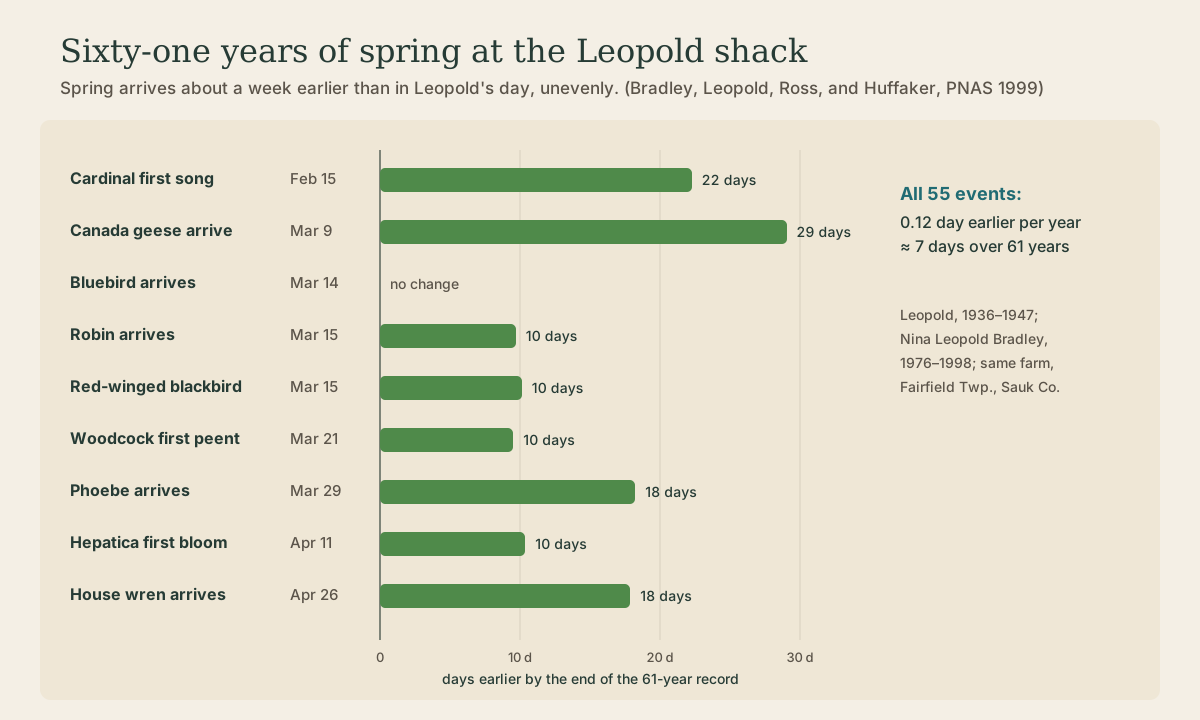
Events that respond to local temperature (resident cardinals starting to sing, geese following the open water north, flowers blooming) moved earlier. Some didn’t move at all, as you’d expect for events triggered by day length or other cues that don’t change with the weather 2. That mismatch is part of what makes phenology important: a bird that times its return by day length can arrive to find the insects it feeds its young already past their peak.
Playback is optional. If the player is unavailable, open the video at its source.
Quick check
Some shifted a lot (geese about 29 days), some not at all (bluebird).
Quick check
Day length is the same every year; temperature isn’t.
The gardener’s calendar
Plants add up the season’s warmth better than any single date, which makes them good indicators 1:
- “Plant corn when oak leaves are the size of a squirrel’s ear.” By then the soil is warm enough for corn and other warm-season seeds to germinate without rotting.
- Crabgrass germinates once the soil 4 inches down holds at 55 °F, roughly when the common lilac is in early bloom. That’s the window for a pre-emergent treatment, if you use one.
- Eastern tent caterpillar eggs hatch at bud break on flowering crabapple and wild plum, the best time to deal with them.
- Allergy season follows the same logic: tree pollen in May, grass in June, ragweed in August, all shifting with a warm or cold spring.
Quick check
Plants integrate the season’s warmth; that’s what makes them good calendars.
Keep your own
A phenology record needs nothing but a notebook and repetition. Pick a dozen things you’ll see every year: first red-winged blackbird, first spring peeper calling, first hepatica, lilac first bloom, first morel, first frost, ice-out on the nearest lake. Write the date each year. After a few years you’ll have your own calendar, and after many you’ll have the kind of record the Leopolds left. The USA National Phenology Network takes volunteer observations if you want yours to count toward the bigger picture 1.
Try it
Start a list this week with fall events: first frost, peak color on a particular maple, the last hummingbird, first juncos at the feeder. Put the notebook somewhere you’ll see it every day, and next March, start the spring list.
Lesson complete
Nice work.
Sources for this lesson
- 1Phenology and Gardening. University of Wisconsin-Madison, Wisconsin Master Gardener (Susan Mahr). 2013. verifiedPhenology is the timing of natural events in relation to weather. Increase Lapham and Aldo Leopold kept Wisconsin records; the Wisconsin Phenological Society formed in 1961 (lilac observations, promethea moth emergence, lake freeze and thaw). Indicators: 'plant corn when oak leaves are the size of a squirrel's ear' (soil warm enough); crabgrass germinates when 4-inch soil stabilizes at 55 F, roughly when common lilac is in early bloom; eastern tent caterpillar egg hatch coincides with bud break on crabapple and wild plum. Tree pollen in May, grasses June, ragweed August. USA National Phenology Network takes observations.
- 2Phenological changes reflect climate change in Wisconsin. Proceedings of the National Academy of Sciences (Bradley, Leopold, Ross, Huffaker). 1999. verifiedSpring records at the Leopold farm in Fairfield Township, Sauk County: Aldo Leopold 1936-1947, Nina Leopold Bradley 1976-1998; 74 phenophases, 55 analyzed; mean regression -0.12 day per year. Examples (avg date, slope days/yr): cardinal first song Feb 15, -0.365; Canada geese arrival Mar 9, -0.476; bluebird Mar 14, +0.024 (no change); red-winged blackbird Mar 15, -0.166; robin Mar 15, -0.159; woodcock first peent Mar 21, -0.156; phoebe Mar 29, -0.299; hepatica bloom Apr 11, -0.170; house wren Apr 26, -0.293. Some phenophases didn't shift, as expected for those regulated by photoperiod.