The Northern Forest
North of the tension zone, the forest of sugar maple, hemlock, yellow birch, and white pine, how it was logged from the 1850s to the 1920s, burned at Peshtigo in 1871, failed as farmland, and regrew as today's maple-dominated second growth and CCC pine plantations in the Chequamegon-Nicolet. What's changed (hemlock and pine nearly gone, yew stripped by deer, earthworms in the duff) and the Menominee Forest, cut twice since 1854 and fuller than ever.
- 5 min
- 7 steps
- 3 questions
- Lesson 5 of 49
In this lesson
- The forest north of the tension zone
- The pinery
- The lands nobody wanted
- What’s different now
- The Menominee Forest
- Try it
- What to take from this
Picking up where you left off.
The forest north of the tension zone
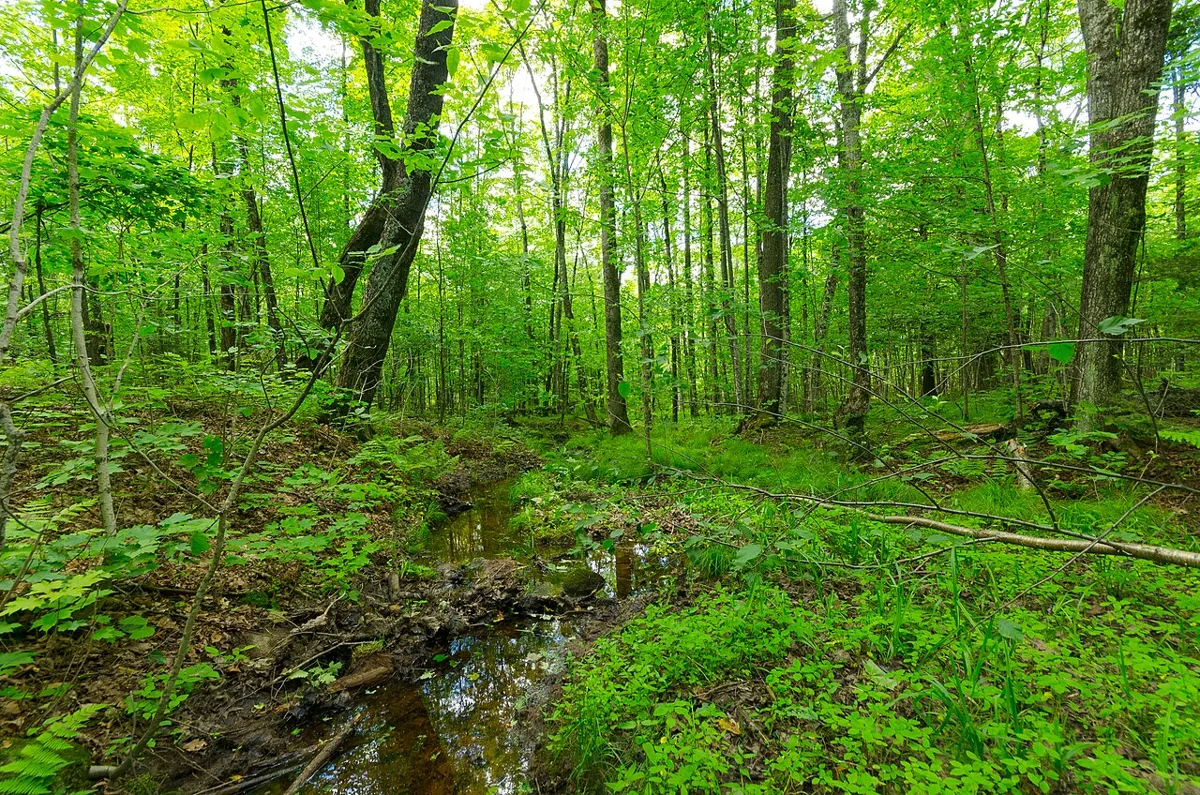
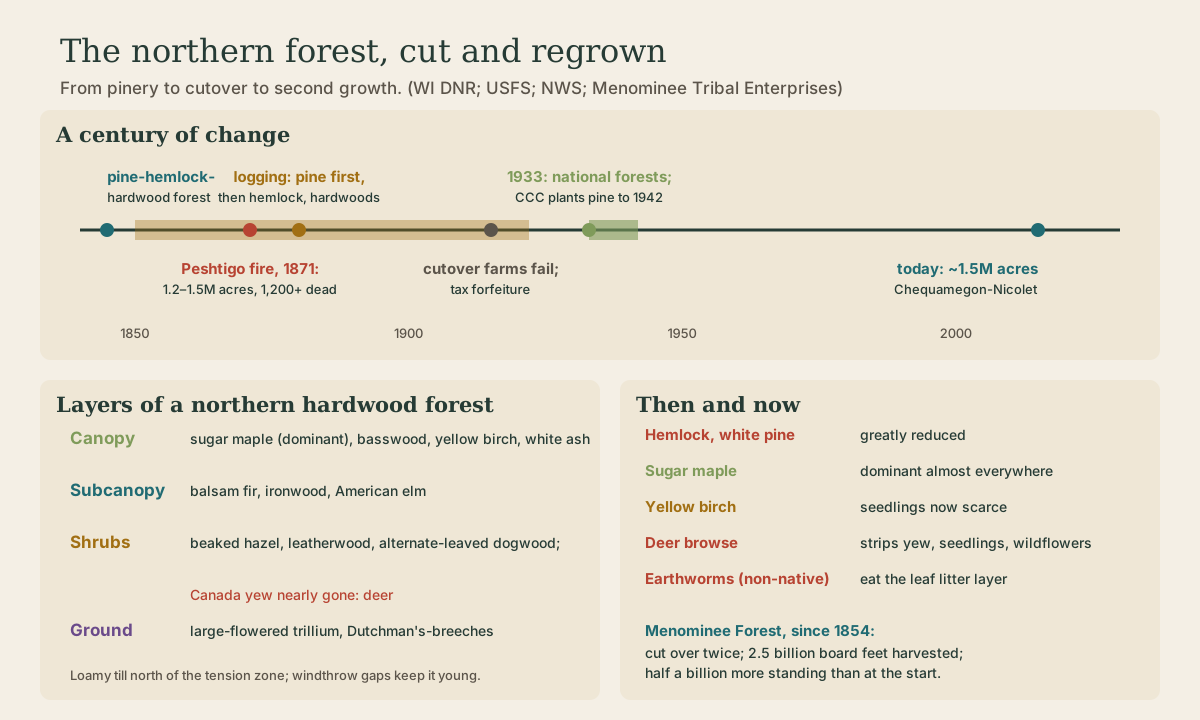
North of the tension zone, the diagonal band that divides Wisconsin’s prairie-and-oak southwest from its northern hardwoods 1, the land was forest: sugar maple with hemlock and white pine, plus yellow birch, basswood, and white ash, on loamy glacial till. The DNR calls it northern mesic forest 2.
A walk through a mature stand goes through layers 2:
- Canopy: sugar maple dominant or co-dominant, with basswood, yellow birch, and white ash.
- Subcanopy: balsam fir, ironwood, American elm.
- Shrubs: alternate-leaved dogwood, beaked hazelnut, leatherwood, and once Canada yew.
- Ground: lush in spring with large-flowered trillium, Dutchman’s-breeches, and other ephemerals that bloom before the canopy leafs out, or nearly bare under dense hemlock.
The main natural disturbance was wind: windthrow regularly opened small gaps, and occasional big storms flattened larger patches 2. Unlike the oak savannas, this forest wasn’t shaped by frequent fire.

Quick check
Hemlock was historically second; both hemlock and white pine are greatly reduced in today’s forests.
The pinery
From the 1850s on, the north woods became Wisconsin’s great lumber industry. Loggers cut the white pine first, the most valuable and the easiest to float down rivers, then hemlock and hardwoods. By the late 1800s and early 1900s the cutting was so complete that the Forest Service says the Great North Woods were “virtually non-existent” 3.
What was left was slash: piles of branches and tops, drying in the sun. On October 8, 1871, after an unusually dry summer, fires started by land clearing for railroads merged into the Peshtigo fire, which burned 1.2 to 1.5 million acres of northeastern Wisconsin and killed more than 1,200 people, about 800 in Peshtigo alone. It remains the deadliest wildfire in American history 4. It happened the same night as the Great Chicago Fire.

The lands nobody wanted
Land companies sold the cutover to settlers as farmland. Stumps, thin sandy soils, short seasons, and frost made most of those farms fail. During the hard years of the 1920s and 1930s, farmers who couldn’t pay their taxes forfeited or abandoned their land to the counties 3.
In 1933, the Chequamegon and Nicolet National Forests were created from these over-cut, burned-over, farmed-out lands. Civilian Conservation Corps crews did massive reforestation, and their red and jack pine plantations, in straight rows, are now 70 or more years old 3. Together the two forests cover about 1.5 million acres today: about 858,400 acres on the Chequamegon side and 661,400 on the Nicolet 3. Wisconsin’s county forests grew from the same tax-forfeited land.
Quick check
Farmers who couldn’t pay taxes forfeited land to counties, which sold it to the federal government; CCC crews then planted pine.
What’s different now
The forest came back, but not the same forest 2:
- Hemlock and white pine are greatly reduced. Hemlock, once the second most important tree, regenerates poorly, and the giant pines are gone except in a few remnants.
- Sugar maple dominates, in nearly every stand regardless of age.
- Yellow birch reproduction has become scarce.
- Deer browse seedlings, wildflowers, and shrubs; Canada yew is now absent from nearly all its former range.
- Non-native earthworms, arriving with fishing bait and road fill, eat the layer of leaf litter that spring wildflowers and seedlings depend on.
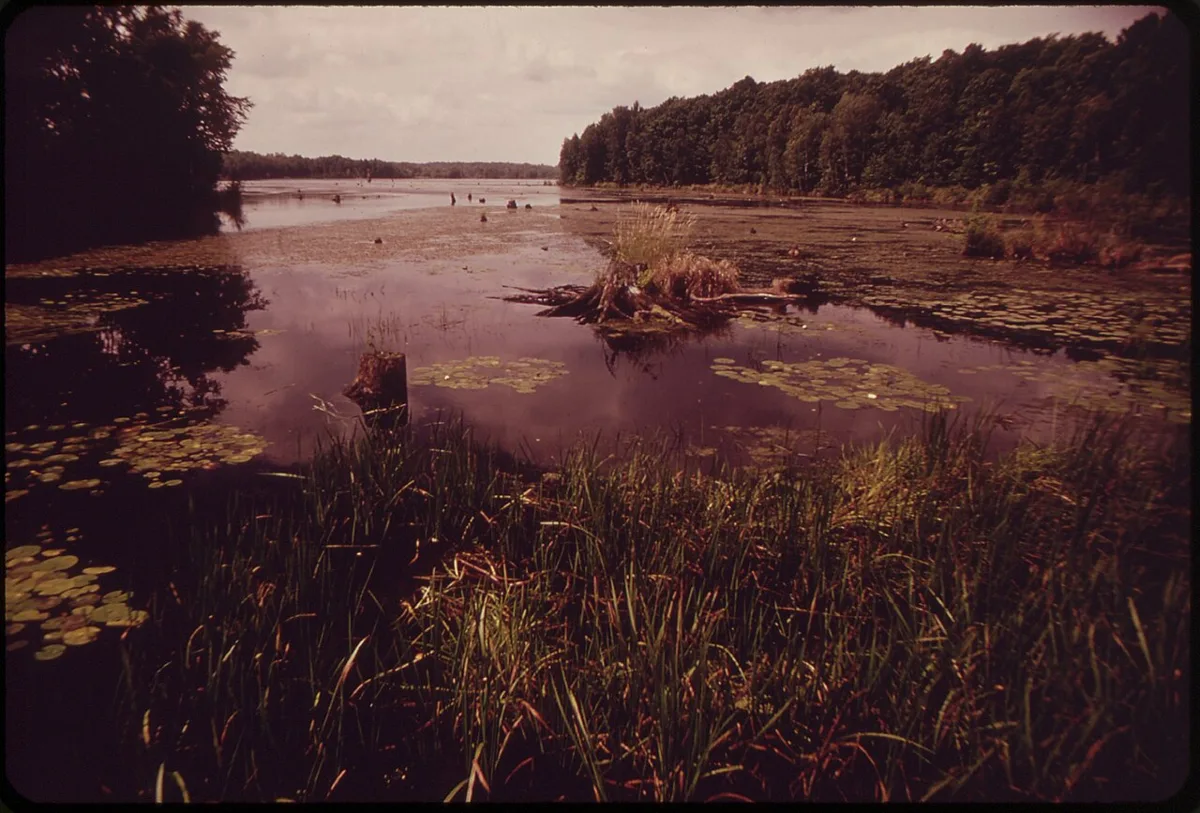
Old stumps of the original pines still stand in flowages and woods, some showing the springboard notches lumberjacks cut to stand on above the pitchy base.
The Menominee Forest
There’s one place where the north woods never fell. The Menominee Forest, on the Menominee Reservation established in 1854, has been managed by the tribe under sustained-yield principles ever since. Menominee Tribal Enterprises has harvested more than 2.5 billion board feet, cutting over the entire reservation twice, and today has more than half a billion board feet more standing timber than when it started 5. From space, the reservation boundary shows as a sharp line of dense forest against the farmland and cutover around it 5.
It’s the clearest proof in Wisconsin that the pinery didn’t have to end the way it did.
Playback is optional. If the player is unavailable, open the video at its source.
Playback is optional. If the player is unavailable, open the video at its source.
Quick check
Menominee Tribal Enterprises has cut over the whole reservation twice and harvested more than 2.5 billion board feet.
Try it
In a northern woodlot, look for old pine stumps, wide and flat-topped, sometimes charred, sometimes with notches cut in the sides. Count what’s growing around them: if it’s all sugar maple, you’re looking at the classic second-growth story. Then drive Highway 47 through the Menominee Forest and notice where the trees stop at the reservation line.
What to take from this
Wisconsin’s northern forest, north of the tension zone, was sugar maple with hemlock, white pine, yellow birch, basswood, and ash, renewed by windthrow gaps. Logging from the 1850s to the 1920s took the pine first and left slash; the 1871 Peshtigo fire burned 1.2 to 1.5 million acres and killed more than 1,200. Failed cutover farms were forfeited for taxes and became the Chequamegon and Nicolet National Forests in 1933, replanted by the CCC. Today’s forest is maple-dominated, short of hemlock, pine, yellow birch, and yew, and stressed by deer and earthworms. The Menominee Forest, cut twice since 1854, holds more timber than ever.
Lesson complete
Nice work.
Sources for this lesson
- 1William K. Volkert. The Occurrence and Distribution of Prairie-Associated Plants and Remnant Prairie Communities in the Northern Kettle Moraine State Forest. UW-Milwaukee Field Station Bulletin 17(1). 1984. verifiedPrairies in Wisconsin occur mainly south of Curtis's (1959) tension zone, the boundary between the prairie-forest province to the southwest and the northern hardwoods province to the northeast; from an estimated two million acres of presettlement prairie, Wisconsin had little more than 2,000 acres left (DNR 1983); Fond du Lac County once had about 25,000 acres of prairie and 110,000 of savanna, with probably under ten acres of prairie left, lost to farming and development.
- 2Northern Mesic Forest (Wisconsin Natural Communities). Wisconsin Department of Natural Resources. verifiedFound mainly north of the Tension Zone on loamy glacial till; sugar maple dominant or co-dominant; hemlock historically second, with white pine, both greatly reduced; yellow birch, basswood, and white ash important, though yellow birch reproduction is now scarce; subcanopy of balsam fir, ironwood, American elm; shrubs include alternate-leaved dogwood, beaked hazelnut, leatherwood; Canada yew now absent from most of its range due to deer browse; rich spring ephemerals such as large-flowered trillium and Dutchman's-breeches; windthrow gaps; threats from non-native earthworms and deer.
- 3History and Culture, Chequamegon-Nicolet National Forest. USDA Forest Service. verifiedBy the late 1800s and early 1900s intensive logging left the Great North Woods virtually non-existent; struggling farmers forfeited or abandoned land to counties for taxes; the Chequamegon and Nicolet National Forests were born in the 1930s from over-cut, burned-over, farmed-out land; CCC crews did massive reforestation, and their pine plantations are now 70 or more years old; the forest covers about 858,400 acres on the Chequamegon side and nearly 661,400 on the Nicolet.
- 4The Peshtigo Fire of 1871. National Weather Service, Green Bay. verifiedOn October 8, 1871, the most devastating forest fire in American history swept northeast Wisconsin, killing more than 1,200 people (about 800 in Peshtigo) and scorching 1.2 to 1.5 million acres after an unusually dry summer; land clearing for railroads started brush fires.
- 5Adrian Miller. Forest Management, the Menominee Tribe, Culture, and Traditional Knowledge. Proceedings of the 1st Northern Hardwood Conference 2021, USDA Forest Service GTR-NRS-P-211. 2022. verifiedSince 1854 Menominee Tribal Enterprises has harvested more than 2.5 billion board feet, cutting standing timber over the whole reservation twice, yet has more than half a billion board feet more standing timber than at the start; the forest is held in trust and managed under sustained-yield principles; its boundary is visible from space.