Mushroom Anatomy and Spore Prints
A mushroom is the fruit of a fungus living in soil or wood. Learn its parts - cap, gills or pores, stem, ring, volva - what to record in the field, and how a spore print settles identifications.
- 5 min
- 6 steps
- 3 questions
- Lesson 18 of 49
In this lesson
- What a mushroom is
- The parts
- What to record
- Making a spore print
- Cooking and eating
- What to take from this
Picking up where you left off.
What a mushroom is
A mushroom is the fruiting body of a fungus. The fungus itself is a web of fine threads, the mycelium, living for years in soil, wood, or roots. It sends up mushrooms when conditions are right, mostly after rain, to release spores. That’s why a good spot produces year after year, and why picking mushrooms doesn’t harm the fungus.
Fungi live in three main ways, and knowing which tells you where to look:
- Mycorrhizal fungi partner with living tree roots, trading minerals for sugar. Chanterelles, destroying angels, and many boletes grow on the ground near particular trees, often oaks.
- Saprobic fungi decompose dead wood or leaves. Oyster mushrooms, most shelf fungi, and Galerina grow on dead wood.
- Parasitic fungi attack living trees, such as honey mushrooms and some chicken of the woods.
The parts
The features you’ll use again and again:
- Cap: shape, color, texture (smooth, scaly, sticky, warty), and whether it has patches left from a veil.
- Underside: gills (thin blades), pores (a spongy surface of tiny holes, as in boletes and polypores), teeth, or false gills (blunt, forked ridges, as in chanterelles).
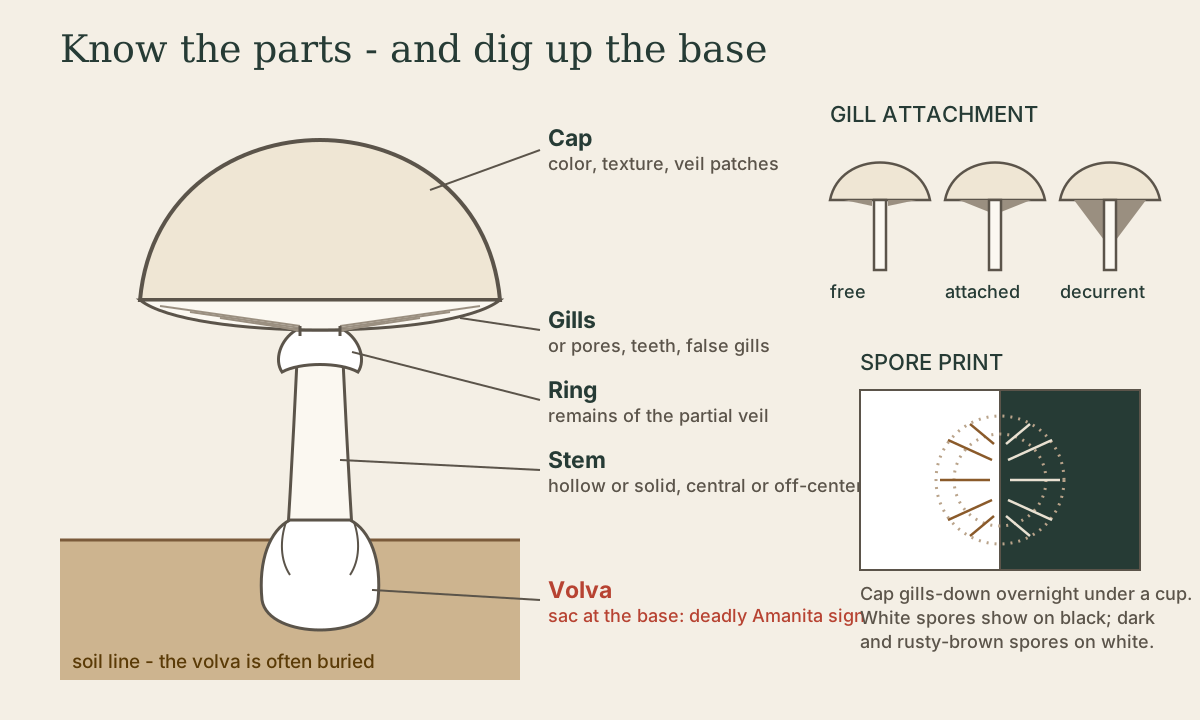
- Gill attachment: free from the stem, attached, or decurrent (running down the stem, as in oysters) 1.
- Stem: central, off-center, or absent; solid or hollow; smooth or scaly.
- Ring: a skirt on the stem, the remains of a veil that covered the young gills.
- Volva: a cup or sac at the base, the remains of a veil that enclosed the whole young mushroom. A white sac-like volva, often buried, together with a ring and free white gills, marks the deadly Amanitas 2.
So dig up the whole base. Never cut a gilled mushroom off at the ground until you know what it is.
Quick check
Destroying angels have a white sac-like volva at the base that is often buried. Cut at ground level and you’ve cut off the most important feature.
What to record
Note these in the field, before you open a book, so the book doesn’t talk you into a match 3:
- Substrate: soil, wood (dead or living, which tree), buried roots, moss, leaves.
- Nearby trees, especially for ground-growing species.
- Growth habit: alone, scattered, in clusters from a single base, or in shelves.
- Base, ring, and gill attachment.
- Smell: mealy, fruity, anise, radish.
- Changes: bruising colors, latex or juice when cut.
Photograph the top, the underside, the stem, the base, and a cross-section.
Making a spore print
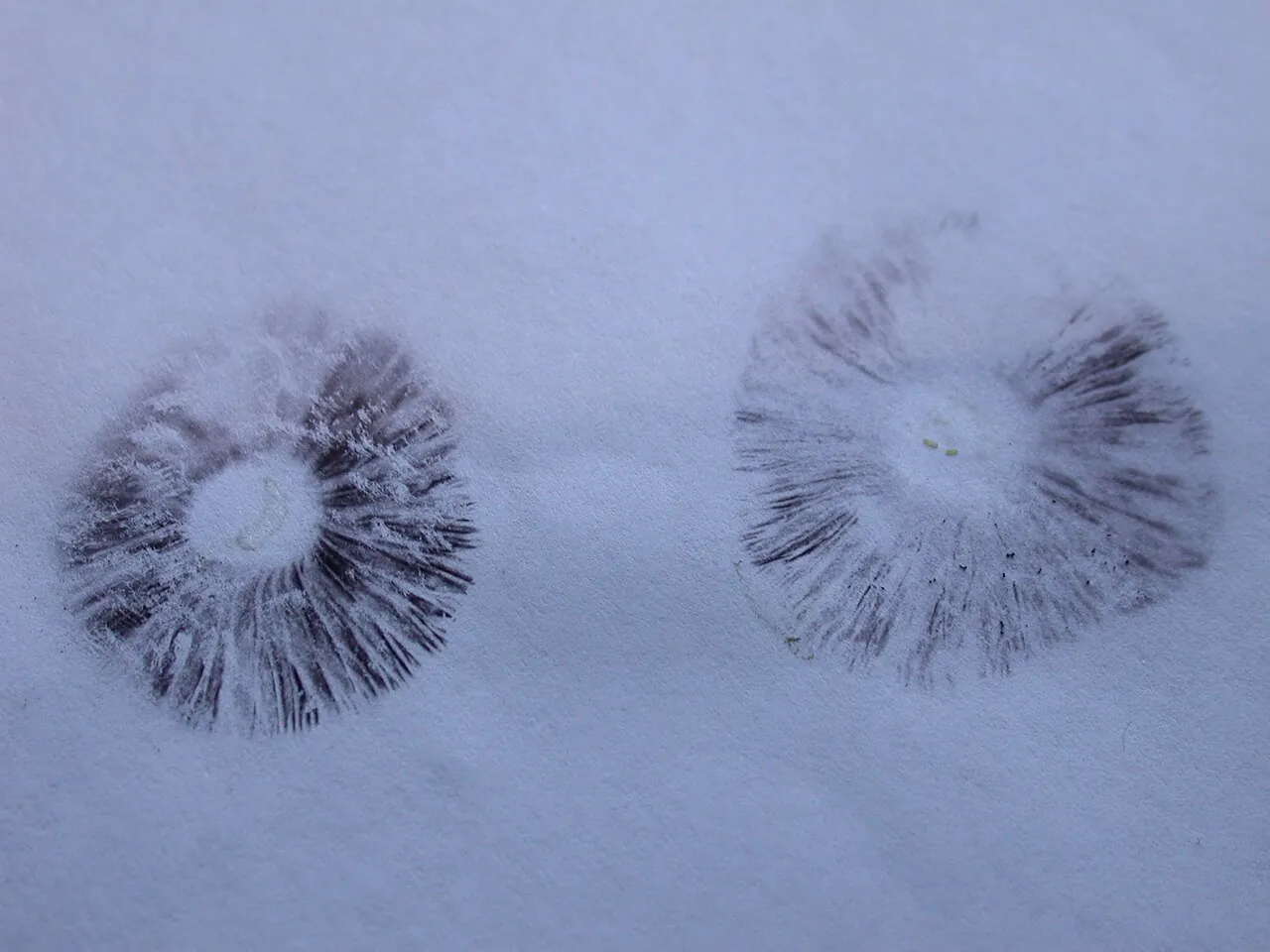
A spore print is the color of the spores in mass, and it splits mushrooms into groups that look alike otherwise. To make one 3:
_Gillet_354026.jpg)
- Cut off the stem and set the cap, gills or pores down, on paper or glass. For a big mushroom, slice off a piece of cap.
- Use half white and half black paper, or glass, so both light and dark spores show.
- Cover it with a cup or bowl to stop drafts and drying.
- Wait several hours; overnight is surest.
Common results: white (Amanitas, oysters, honey mushrooms in a pale cream), pink to salmon (some chanterelles, Entoloma), rusty brown (Galerina, Cortinarius), chocolate brown to purple-brown (Agaricus, the meadow mushroom group), black (inky caps).
The print can be decisive. Galerina, which has killed people who mistook it for honey mushrooms, gives a rusty-brown print, while honey mushrooms give a white one 4.
Quick check
White spores vanish on white paper. Use black paper or glass, or half-and-half, so any color shows.
Quick check
Use half-white, half-black paper so any color shows.
Cooking and eating
- Cook all wild mushrooms. Several common edibles, morels included, cause illness raw.
- Eat a small amount the first time you try a species, and keep an uncooked sample in the fridge.
- Eat only fresh, firm specimens. Old, wet, or buggy mushrooms spoil and cause food poisoning that has nothing to do with the species.
What to take from this
A mushroom is the fruit of a long-lived fungus that grows with tree roots, on dead wood, or as a parasite. Learn the cap, underside, gill attachment, stem, ring, and volva, and dig up the whole base. Record substrate, trees, habit, smell, and changes before opening a book. Make spore prints on half-white, half-black paper; a rusty-brown print separates deadly Galerina from honey mushrooms. Cook every wild mushroom and try small amounts first.
Lesson complete
Nice work.
Sources for this lesson
- 1Michael Kuo. Pleurotus ostreatus (The Oyster Mushroom). MushroomExpert.com. verifiedShelving clusters on dead hardwood, October to early April; decurrent gills; white to lilac spore print; P. pulmonarius in warm weather, P. populinus on aspen.
- 2Michael Kuo. Amanita bisporigera (Eastern North American Destroying Angel). MushroomExpert.com. verifiedWhite cap, free white gills, high skirt-like ring, white sac-like volva often buried; white spore print; mycorrhizal with oaks; summer and fall, common across eastern North America.
- 3Michael Kuo. Studying Mushrooms. MushroomExpert.com. verifiedHow to make a spore print on paper or glass and what to record - substrate, nearby trees, base, ring, gill attachment, odor.
- 4Brandon Landry, Jeannette Whitton, Anna L. Bazzicalupo, Oldriska Ceska, Mary L. Berbee. Phylogenetic analysis of the distribution of deadly amatoxins among the little brown mushrooms of the genus Galerina. PLoS One. 2021. verifiedEvery Galerina marginata sample carried amatoxins; poisonings from mistaking it for honey mushrooms; grows on rotting wood, moss, and turf.