Wild Plums, Grapes, and Cranberries
Late-season fruit for jelly and sauce: American plums in thickets, riverbank grapes (checked against toxic moonseed), highbush cranberry, and true cranberries in northern bogs.
- 5 min
- 6 steps
- 3 questions
- Lesson 33 of 49
In this lesson
- Wild plums
- Wild grapes
- Moonseed
- Highbush cranberry
- True cranberries
- What to take from this
Picking up where you left off.
Wild plums
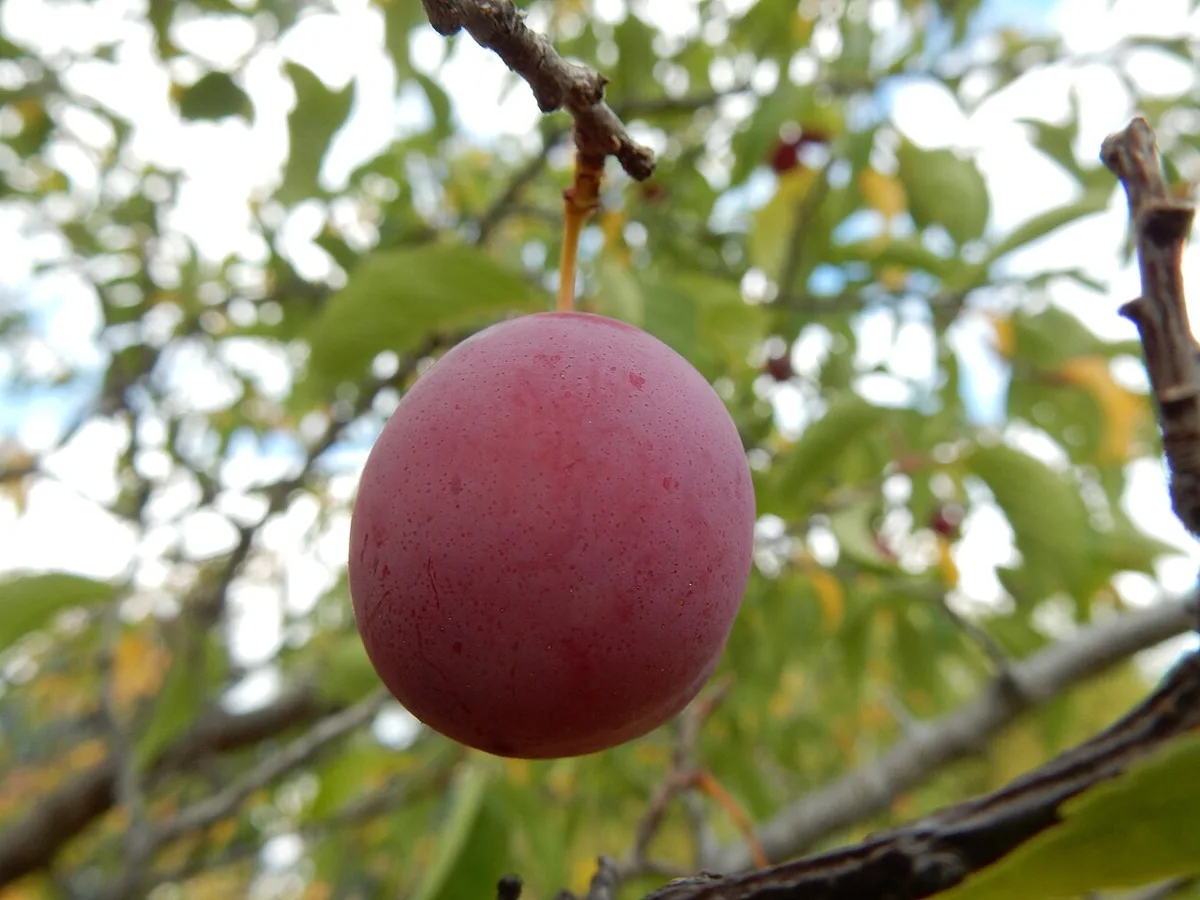
American plum (Prunus americana) forms thorny thickets along woods edges, fencerows, and stream banks across southern and central Wisconsin; Canada plum (Prunus nigra) is similar and more northern.
- Spring: masses of white, fragrant blossoms in early May, before the leaves.
- Fruit: round plums about an inch across, ripening red to yellow-orange in late August and September.
- Flavor: sweet, juicy flesh under a tart, astringent skin.
Shake the trees over a tarp when the plums are soft, or pick up windfalls daily. They’re superb in jam, jelly, and plum butter, where the skins give tartness and color, and in sauces for pork and game. Cook them and push them through a food mill to remove the pits and skins.
Plum pits, like cherry pits, contain cyanogenic compounds. Don’t crack and eat them.
_plum_-_Flickr_-_Matt_Lavin.jpg)
Wild grapes
Riverbank grape (Vitis riparia) is the common wild grape in Wisconsin, climbing over trees and fences along rivers, woods edges, and roadsides.
- Vine: woody, with forked tendrils that coil around supports; bark shreds in long strips on old vines.
- Leaves: large, toothed, heart-shaped, often with three shallow lobes.
- Fruit: small, blue-black grapes with a waxy bloom, in clusters, ripening in September. They’re intensely sour and seedy; they sweeten a little after frost.
Wild grapes make excellent jelly and juice. Simmer them, strain, and let the juice settle overnight so tartrate crystals drop out. Young leaves can be used for stuffed grape leaves.
Quick check
Moonseed fruit looks like a small grape and is highly toxic. Check for tendrils on the vine and cut a berry open: one crescent seed means moonseed.
Moonseed
Common moonseed (Menispermum canadense) grows in the same places and has fruit that looks like a wild grape. It’s highly toxic: its alkaloids cause convulsions and can be fatal 1. Learn the differences 1:
| Wild grape | Moonseed | |
|---|---|---|
| Climbing | Tendrils | Twining stem, no tendrils |
| Leaf edge | Toothed | Smooth, with 3 to 7 shallow lobes |
| Seeds | 2 to 4 round or teardrop seeds | One crescent-shaped seed |
| Fruit | Clusters, bloom-covered | Clusters, bloom-covered, look very similar |
Cut a berry open before picking a vine you’re not certain of. One flat, crescent-shaped seed means moonseed. Also check for tendrils.
Virginia creeper’s dark blue berries on red stalks are also toxic; its leaves have five leaflets.
Highbush cranberry
Highbush cranberry isn’t a cranberry; it’s a viburnum. The native American highbush cranberry (Viburnum trilobum, or V. opulus var. americanum) grows in moist woods, swamp edges, and thickets across Wisconsin.
- Leaves: opposite, three-lobed like a maple.
- Flowers: flat white clusters in June, ringed with large sterile flowers.
- Fruit: translucent scarlet berries in drooping clusters in September, staying on the shrub into winter.
The berries are tart and musky, with a large flat seed; cook them into jelly or sauce for game. Their smell while cooking is strong; many people find the jelly far better than the kitchen smells suggest.
The catch: European highbush cranberry (V. opulus), widely planted in yards and parks, is very hard to tell from the native plant, and the two hybridize. Its fruit is intensely bitter, while the American plant’s is tart but edible 2. Taste a berry; if it’s unpleasantly bitter, try another shrub.
True cranberries
Large cranberry (Vaccinium macrocarpon) and small cranberry (Vaccinium oxycoccos) are low, creeping evergreen shrubs of sphagnum bogs in northern and central Wisconsin, the wild relatives of the state’s big cranberry crop.
- Plants: thin, trailing stems with tiny, leathery, evergreen leaves, running over moss.
- Fruit: red berries in late September and October, staying through winter.
Walking a bog is its own adventure: the mat is floating moss, so step carefully near open water and wear waterproof boots. Use wild cranberries as you would cultivated ones.
Wild fruits are allowed on DNR land for personal use 3.
Quick check
Highbush cranberry is a viburnum shrub, not a true cranberry.
What to take from this
American plums ripen red to orange in late summer, tart-skinned and best as jam and plum butter. Riverbank grapes climb with tendrils and have round seeds; moonseed twines without tendrils and has one crescent seed and is deadly, so cut a berry open. Highbush cranberry is a three-lobed viburnum with scarlet berries for jelly; the European kind is bitter. True cranberries trail over northern sphagnum bogs.
Practice
European highbush cranberry was widely planted and hybridizes with the native species. The American plant’s fruit is tart but good; the European’s is very bitter.
Lesson complete
Nice work.
Sources for this lesson
- 1Menispermum canadense (Common Moonseed). NC State Extension Gardener Plant Toolbox. verifiedHighly toxic grape-like fruit with a single crescent-shaped seed; twining vine without tendrils.
- 2European Highbush Cranberry (Guelder Rose). UW-Madison CIAS, Uncommon Fruits. verifiedEuropean and American highbush cranberry are very hard to tell apart and hybridize; the European fruit is intensely bitter, the American tart but good.
- 3Wis. Admin. Code NR 45.04: Protection of natural resources (department lands). Wisconsin Legislature. verifiedNR 45.04(1)(a) bars removing natural growth from DNR lands; (1s) allows collecting edible fruits, edible nuts, wild mushrooms, wild asparagus, and watercress by hand for personal consumption, and removing listed invasive herbaceous plants. Cited at: NR 45.04(1s).