Essential Knots
The few knots that cover most jobs: the parts of a rope and whipping an end, stopper knots, the square knot and why the granny fails, the sheet bend for unequal ropes, two half hitches, clove and timber hitches, the rolling hitch, and the bowline.
- 5 min
- 7 steps
- 3 questions
- Lesson 43 of 49
In this lesson
- Parts of a rope
- Stopper knots
- Joining two ropes
- Hitches: tying to things
- The bowline
- Try it
- What to take from this
Picking up where you left off.
Parts of a rope
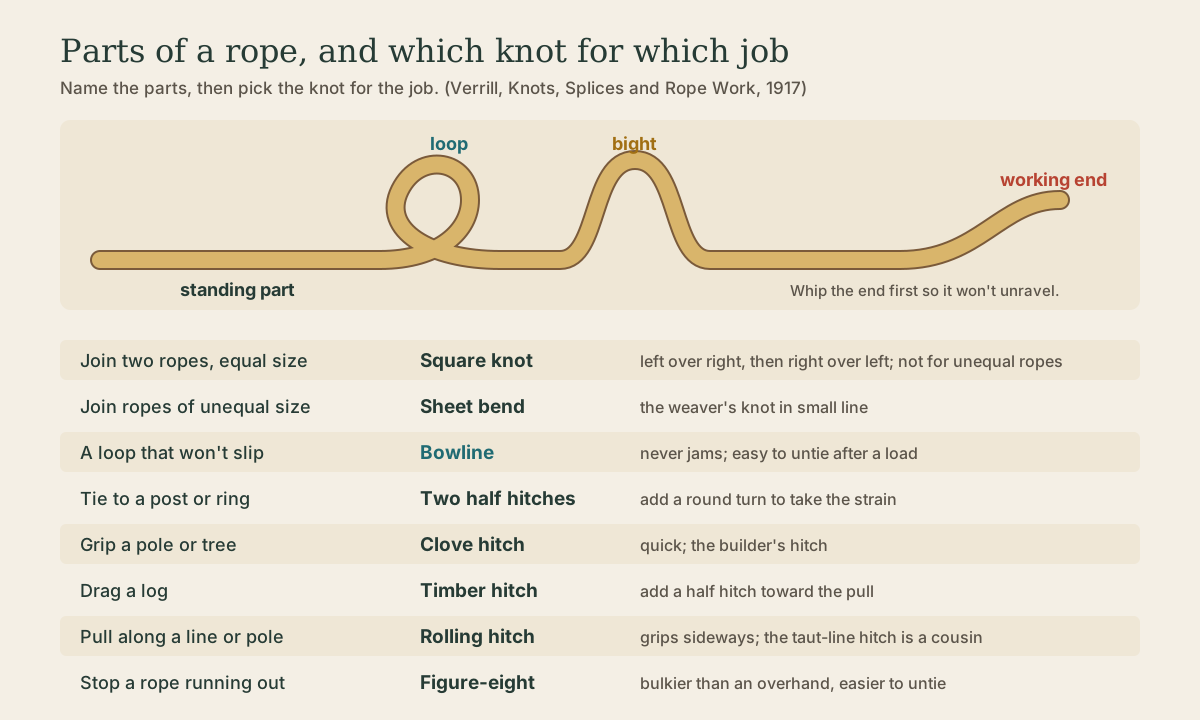
Three words make every knot description readable 1:
- Standing part: the long, main part of the rope.
- Bight: a U-shaped bend in the rope (a “bight” doesn’t cross itself).
- End (working end): the part you tie with.
When the rope crosses itself it makes a loop. Before working a rope, whip the end (wrap it tightly with twine) or tape it so it won’t unravel 1. Synthetic rope can be melted instead.
A knot that’s correctly tied and drawn up snug sits neatly and does its job; one that’s dressed sloppily slips or jams.
Stopper knots
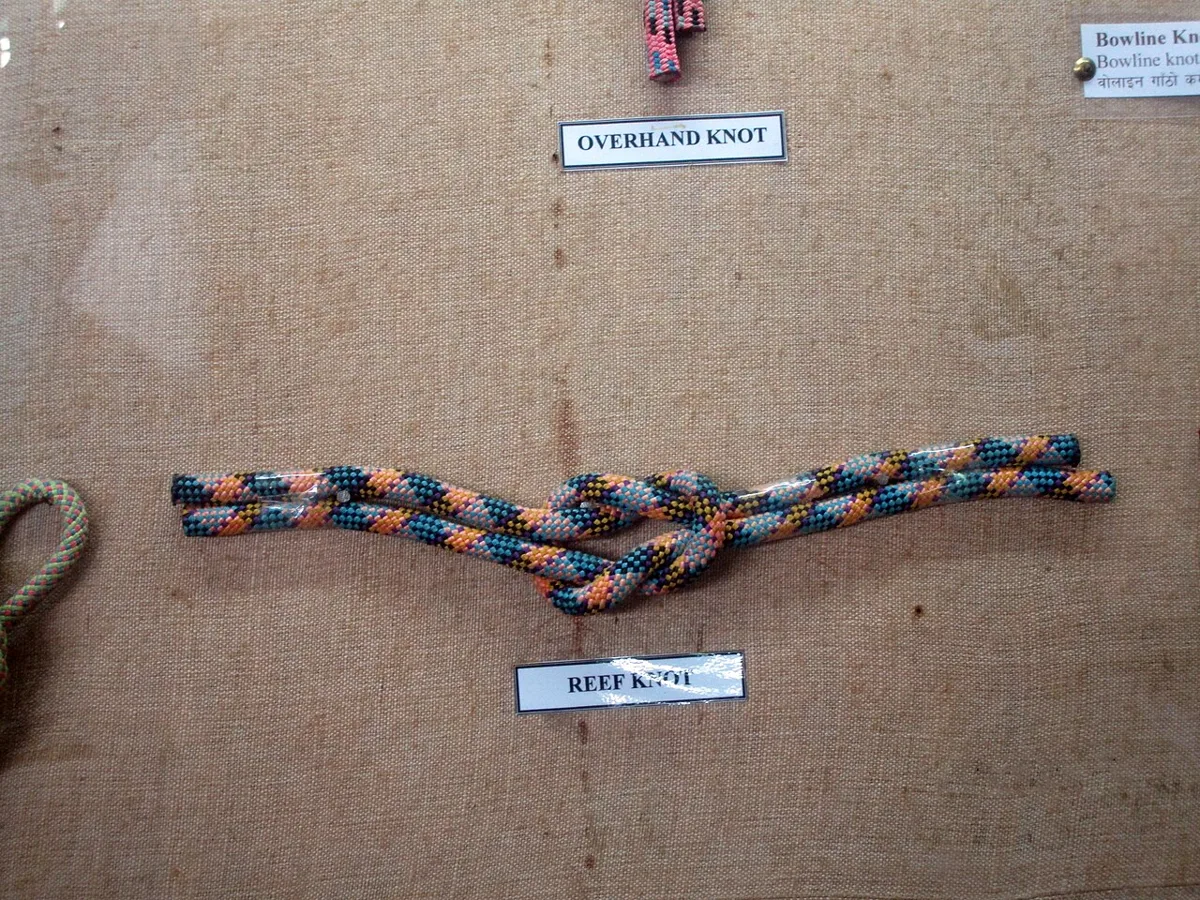
The overhand knot is the simplest of all: pass the end around and through a loop. The figure-eight goes around one more half turn before tucking 1. Both stop a rope from running out through a hole, a pulley, or a grommet; the figure-eight is bulkier and much easier to untie after a load.
Joining two ropes
- Square knot: “Left over, right over.” Pass the left end over and under the right, then the right over and under the left 1. Cross the same way twice and you get the granny, which Verrill calls “a most useless, bothersome, and deceptive makeshift.” Check it: in a square knot, each rope’s two parts lie side by side through the same loop.
- The square knot is for binding (reefing a sail, tying a bundle or a bandage) with ropes of the same size. Between ropes of unequal size it slips and eventually pulls apart 1. Don’t trust it for anything that matters if it comes loose.
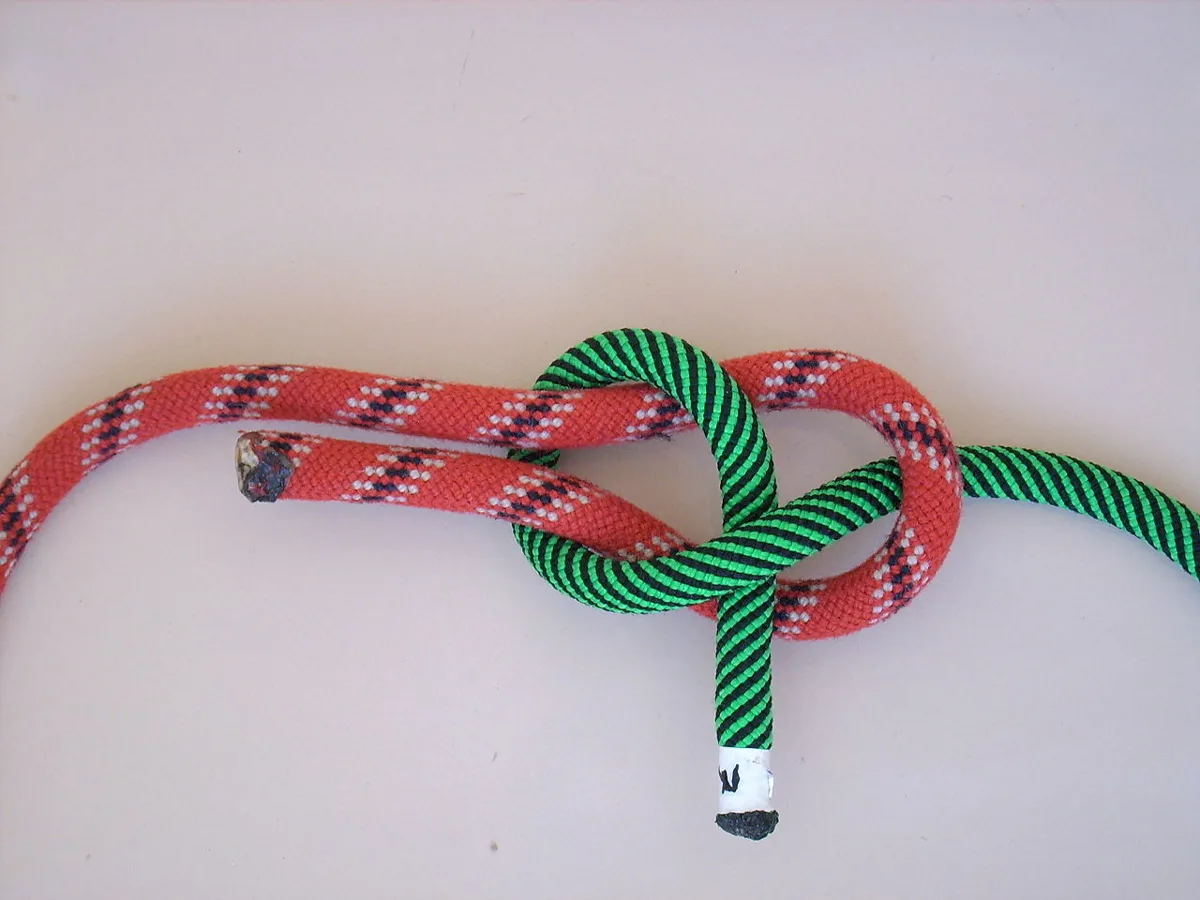
- Sheet bend: make a bight in the thicker rope; bring the other end up through the bight, around both legs, and tuck it under itself. Verrill describes this as the weaver’s knot for small lines and thread 1. Tuck it around twice (a double sheet bend) for slippery or very unequal ropes.


Quick check
Repeating the same crossing makes the granny, which Verrill calls useless and deceptive.
Quick check
Square and reef knots slip and pull apart between ropes of unequal size.
Hitches: tying to things
A hitch ties a rope to an object 1:
- Two half hitches: pass the end around a post or ring, then around the standing part twice, each turn going the same way. Quick and secure 1. A round turn first (a full wrap around the post) takes the strain while you tie, and it’s what the Army manual uses to tie a tarp’s lines to trees 2.
- Clove hitch: two turns around a pole with the end tucked under the second. Verrill calls it the builder’s hitch; it holds on a smooth timber and is quick to adjust 1. It can slip if the pole rotates or the load shifts, so finish it with a half hitch for anything left for long.
- Timber hitch: the end wrapped around its own standing part several times, so it bites when pulled. It’s better than the clove hitch for logs, and a half hitch farther along toward the pull keeps a log from swinging 1.
- Rolling hitch: a clove hitch with an extra turn on the side the pull comes from, so it grips a pole or another rope sideways 1. The taut-line hitch used on tent guylines is a close cousin: it slides to adjust and holds under load.
The bowline
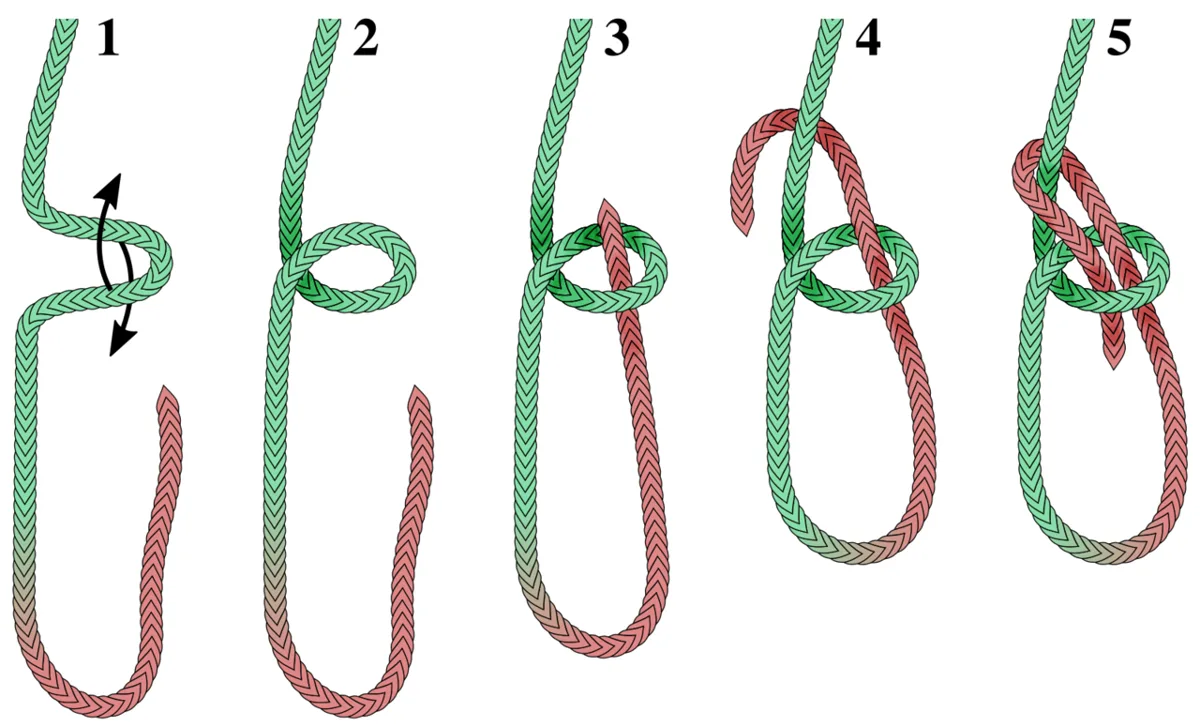
The bowline makes a fixed loop at the end of a rope. Verrill calls it “the sailor’s knot par excellence”: it never slips or jams and is easy to untie, even after a heavy load 1.
- Make a small loop in the standing part with the end side on top.
- Bring the end up through the loop (“the rabbit comes out of the hole”),
- around behind the standing part (“around the tree”),
- and back down through the small loop (“back into the hole”).
- Hold the end and the loop’s side together and pull the standing part to snug it.
Leave a tail several rope-diameters long. A bowline on a bight, tied in the middle of a rope, makes a loop that can’t slip, once used as a seat to lower a person 1.

Playback is optional. If the player is unavailable, open the video at its source.
Quick check
Verrill calls it the sailor’s knot par excellence.
Try it
Cut a 6-foot length of 3/8-inch rope and whip both ends. Tie each knot in the chart five times, then tie them with your eyes closed. Then use them: pitch a tarp with round turns and two half hitches, haul a log on a timber hitch, and tie your canoe painter to a dock post with a clove hitch finished with a half hitch.
What to take from this
Know the standing part, bight, and end, and whip rope ends. Figure-eights stop a rope running out. A square knot is left over right, then right over left, only for ropes of equal size; the granny is useless. A sheet bend joins unequal ropes. Two half hitches tie to a post; the clove hitch grips a pole, the timber hitch a log, and the rolling hitch pulls sideways. The bowline makes a fixed loop that won’t slip or jam.
Lesson complete
Nice work.
Sources for this lesson
- 1A. Hyatt Verrill. Knots, Splices and Rope Work. Norman W. Henley (Project Gutenberg edition). 1917. verifiedFibers twist into yarns, yarns into strands the opposite way, strands into rope opposite again, so each layer's tendency to untwist binds the whole; standing part, bight, and end; whip rope ends; overhand and figure-eight knots; square knot tied left over, right over, versus the granny; square and reef knots slip between ropes of unequal size; weaver's knot for small line; two half hitches; clove (builder's) hitch; timber hitch; rolling hitch; the bowline, which never slips or jams and is easily untied; bowline on a bight.
- 2Department of the Army. FM 21-76 Survival. U.S. Department of the Army. 1992. verifiedFirecraft: fire triangle of air, heat, and fuel; clear a circle at least 1 m across; no wet or porous rocks (they can explode); green-log platform on snow; tinder, kindling, fuel; char cloth; tepee, lean-to (green stick at 30 degrees pointed into the wind), cross-ditch (about 30 cm across, 7.5 cm deep), and pyramid lays; light from the upwind side; metal match, flint and steel with carbon steel; bow drill dimensions; bank the fire overnight. Shelters: most common error is building too big; avoid dead trees and sites below the high-water mark; poncho lean-to with drip sticks, back to the wind, round turn and two half hitches; up to 80 percent of body heat lost to the ground at rest; field-expedient lean-to with a fire reflector wall; debris hut with at least 1 m of debris and a 30 cm bed.