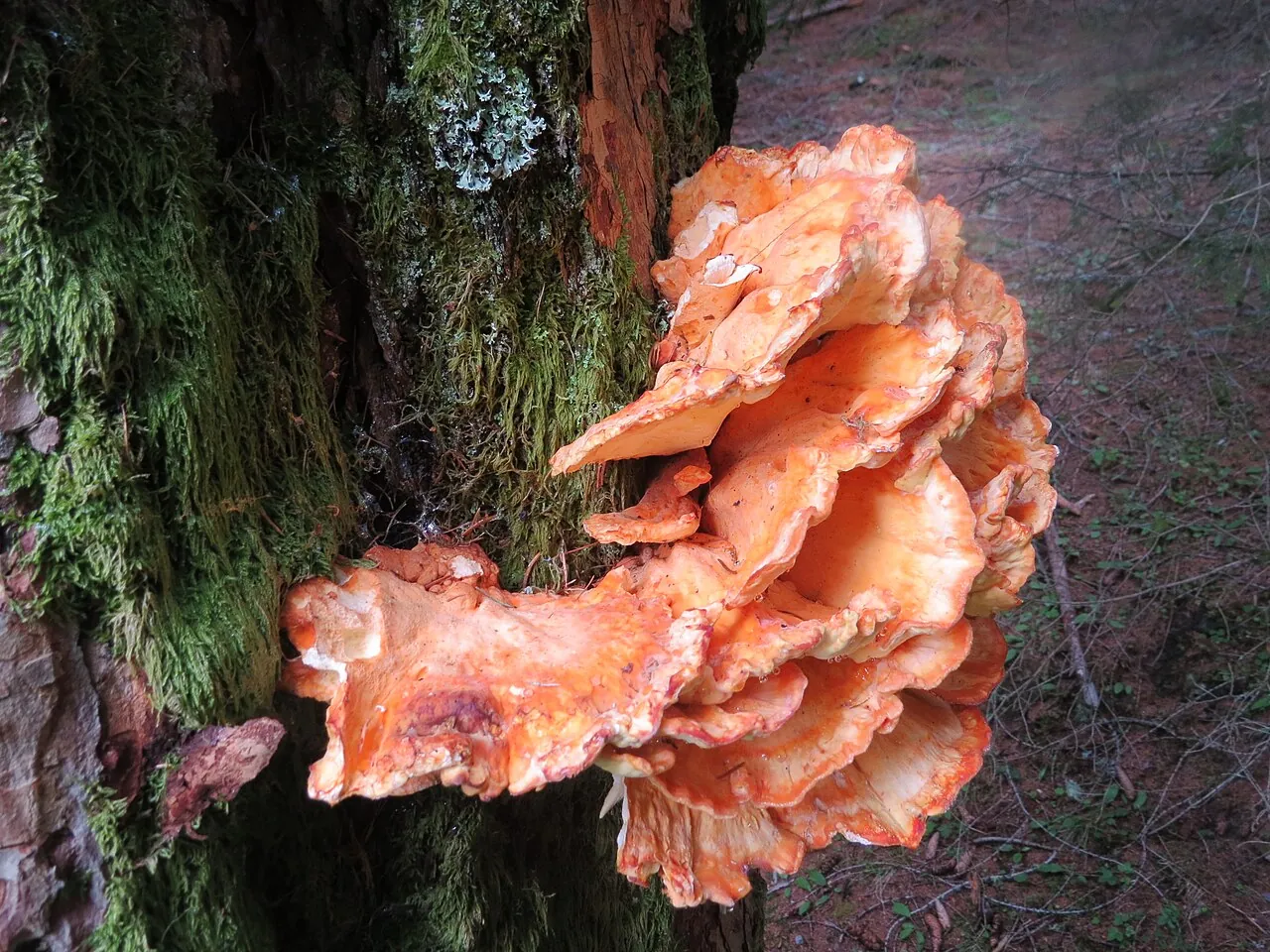
Chanterelles and Chicken of the Woods
Summer's two great beginner mushrooms: golden chanterelles on the ground near oaks, with blunt false gills, against the clustered, true-gilled jack-o'-lantern; and bright chicken of the woods shelves on hardwood.
- 5 min
- 5 steps
- 3 questions
- Lesson 28 of 49
In this lesson
- Chanterelles
- The jack-o’-lantern
- Chicken of the woods
- Picking on public land
- What to take from this
Picking up where you left off.
Chanterelles
Golden chanterelles (Cantharellus) are one of the best wild mushrooms, and common in Wisconsin from July through September after summer rain, especially in oak woods.
What used to be called Cantharellus cibarius in North America is really several species; true C. cibarius is European, and some of the eastern North American species were described from Wisconsin 1. For the table they’re all the same: golden chanterelles.
Identification 1:
- Color: egg-yolk yellow to orange-gold.
- Shape: a cap that’s convex, then flat or shallowly vase-shaped, with a wavy margin, on a central, solid stem.
- Underside: false gills, blunt, shallow, vein-like ridges that fork and cross-connect and run down the stem. You can’t peel them off; they’re folds of the cap’s flesh.
- Flesh: white to pale yellow inside, firm, peeling in strings like string cheese.
- Smell: fruity, like apricots.
- Habitat: on the ground, singly or scattered, near hardwoods (especially oaks) and sometimes conifers. They’re mycorrhizal, never on wood.
Smaller chanterelles, such as the red cinnabar chanterelle and the tiny smooth chanterelles, and the related black trumpets (Craterellus), are also excellent and also have no false-gill look-alikes among dangerous mushrooms.
Quick check
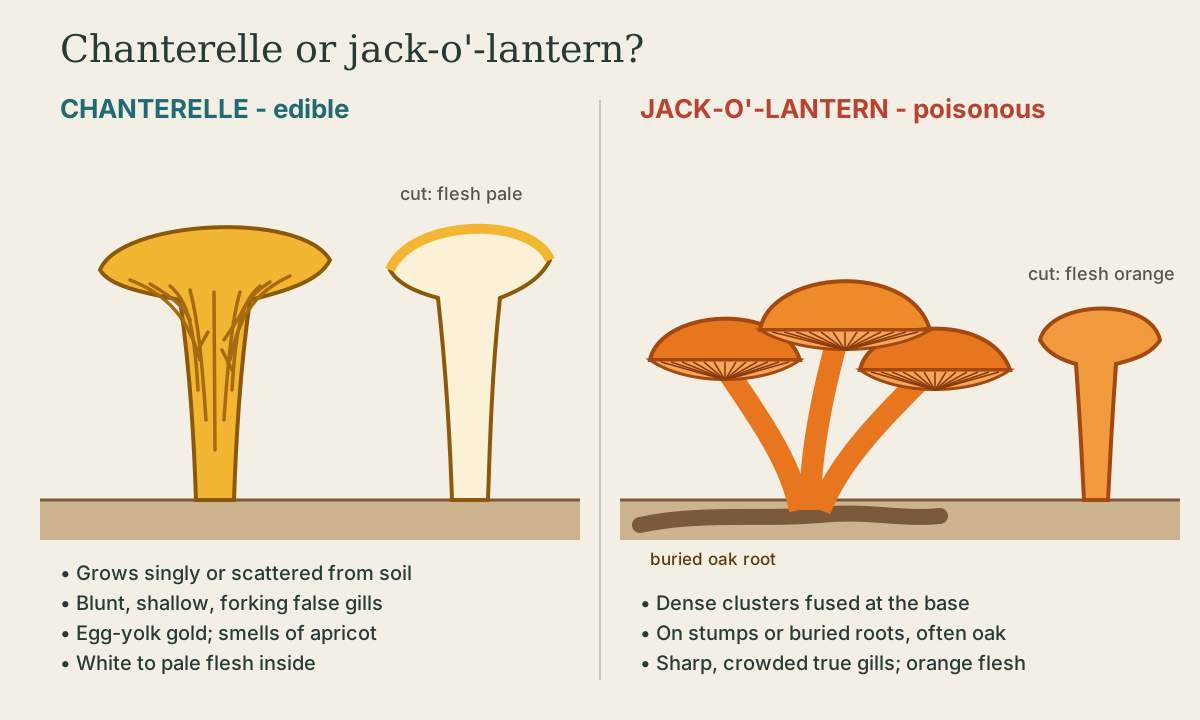
Chanterelle ridges are shallow, blunt folds that fork and can’t be peeled away. Jack-o’-lantern gills are knife-like blades, in dense clusters from stumps or buried roots.
The jack-o’-lantern
The jack-o’-lantern (Omphalotus illudens) is orange too, and grows in the same oak woods in late summer and fall. It causes severe vomiting and diarrhea, though not death. The differences 2:
| Chanterelle | Jack-o’-lantern | |
|---|---|---|
| Growth | Singly or scattered on soil | Dense clusters from stumps or buried roots of hardwoods, especially oak |
| Underside | Blunt, forked false gills | Sharp, crowded true gills, knife-edged blades |
| Flesh | White to pale inside | Orange inside |
| Color | Egg-yolk gold | Bright pumpkin orange |
A cluster of orange mushrooms fused at the base is never chanterelles. A jack-o’-lantern growing from a buried root can look like it’s on the ground, so dig at the base, and check the gills and flesh.
False chanterelle (Hygrophoropsis aurantiaca), on conifer debris and rotten wood, has thin, true, repeatedly forked gills and orange flesh; it’s not worth eating either.
Quick check
Chanterelles have pale flesh, grow singly on the ground, and have blunt forking ridges.
Chicken of the woods
Chicken of the woods is a polypore: a shelf mushroom with pores instead of gills. Two species are common in Wisconsin in summer and fall 3:
_Laetiporus_sulphureus_(crab-of-the-woods)_in_Zedlacher_Paradies.jpg)
- Sulphur shelf (Laetiporus sulphureus): overlapping shelves, bright orange on top with a sulfur-yellow pore surface, growing on trunks and logs of hardwoods, often oak, sometimes high up the tree.
- White-pored chicken (Laetiporus cincinnatus): pinkish-orange rosettes with a white pore surface, at the base of a tree or on the ground from its roots.
Both are soft and moist when young. There’s nothing dangerous that looks like a bright orange-and-yellow pored shelf on hardwood.
Harvesting: cut the tender outer edges, the last inch or few inches of each shelf, which squeeze like a firm, moist sponge. The base and older parts turn tough and chalky. Young, fresh specimens are best; an old, faded, crumbly one isn’t worth taking.
Cautions:
- Cook thoroughly. Some people react to chicken of the woods with nausea or vomiting, even cooked. Eat a small amount the first time.
- Many foragers avoid specimens from conifers, yew, black locust, and eucalyptus, which may cause more reactions. In Wisconsin, stick to oak and other hardwoods.
Cooking: it really does have a chicken-like texture. Slice and sauté until browned, bread and fry it, or use it in place of chicken in tacos, soups, and casseroles. It freezes better after cooking.
Picking on public land
Wild mushrooms are on the DNR’s list of foods you may gather by hand for personal use 4, so chanterelles and chicken of the woods are fair game in state parks and forests.
What to take from this
Chanterelles are egg-yolk gold, smell of apricots, grow singly on the ground near oaks in summer, and have blunt, forking false gills and pale flesh. Jack-o’-lanterns grow in dense clusters from stumps or buried roots with sharp true gills and orange flesh. Chicken of the woods forms orange shelves with yellow pores on hardwood, or white-pored rosettes at the base; harvest the tender edges, cook well, and try a little first.
Practice
Chicken of the woods forms overlapping orange shelves with a sulfur-yellow pore surface on hardwood. Its whitish-pored relative grows in rosettes at the base of trees.
Lesson complete
Nice work.
Sources for this lesson
- 1Michael Kuo. Cantharellus 'cibarius' (Golden Chanterelles). MushroomExpert.com. verifiedFalse gills, central stem, apricot odor; the North American golden chanterelle is several species, including some described from Wisconsin.
- 2Michael Kuo. Omphalotus illudens (Jack O'Lantern). MushroomExpert.com. verifiedLarge clusters on stumps or buried roots of hardwoods, especially oak; orange true gills running down the stem; pale orange flesh.
- 3Michael Kuo. Laetiporus sulphureus (Chicken of the Woods). MushroomExpert.com. verifiedYellow-pored shelves on hardwood trunks; L. cincinnatus has a white pore surface and grows in rosettes at the base or from roots; summer and fall.
- 4Wis. Admin. Code NR 45.04: Protection of natural resources (department lands). Wisconsin Legislature. verifiedNR 45.04(1)(a) bars removing natural growth from DNR lands; (1s) allows collecting edible fruits, edible nuts, wild mushrooms, wild asparagus, and watercress by hand for personal consumption, and removing listed invasive herbaceous plants. Cited at: NR 45.04(1s).