Morels and False Morels
Wisconsin's favorite mushroom: pitted caps, hollow from tip to base in one chamber, under dying elms, ash, aspen, and old apple trees in May. Slice every one to rule out false morels and Verpa, and always cook them.
- 5 min
- 7 steps
- 3 questions
- Lesson 23 of 49
In this lesson
- Where and when
- The true morels
- The look-alikes
- Slice every one
- Harvesting
- Cleaning and cooking
- What to take from this
Picking up where you left off.
Where and when
Morels (Morchella) come up for a few weeks in spring, from late April through May in southern Minnesota and Wisconsin and into June farther north, depending on rain and temperature 1. Common signals among hunters: when lilacs bloom, when oak leaves are the size of a squirrel’s ear, when the soil warms into the 50s °F.
Morels grow on the ground, alone or scattered, often around particular trees 1:
- Dying and recently dead elms, the classic Midwest morel tree, with bark just starting to slough off.
- Ash, increasingly dead from emerald ash borer.
- Aspen and poplar, especially in the north.
- Old apple trees in abandoned orchards.
- Burned and logged woods, disturbed ground, and south-facing slopes early in the season.
In Wisconsin, the Driftless river bluffs and bottomlands are famous morel country. Morels are wild mushrooms, so you may gather them on DNR land for personal use 2 and on the Chequamegon-Nicolet without a permit 3.
Quick check
Also in burned or disturbed ground, late April into June.
The true morels
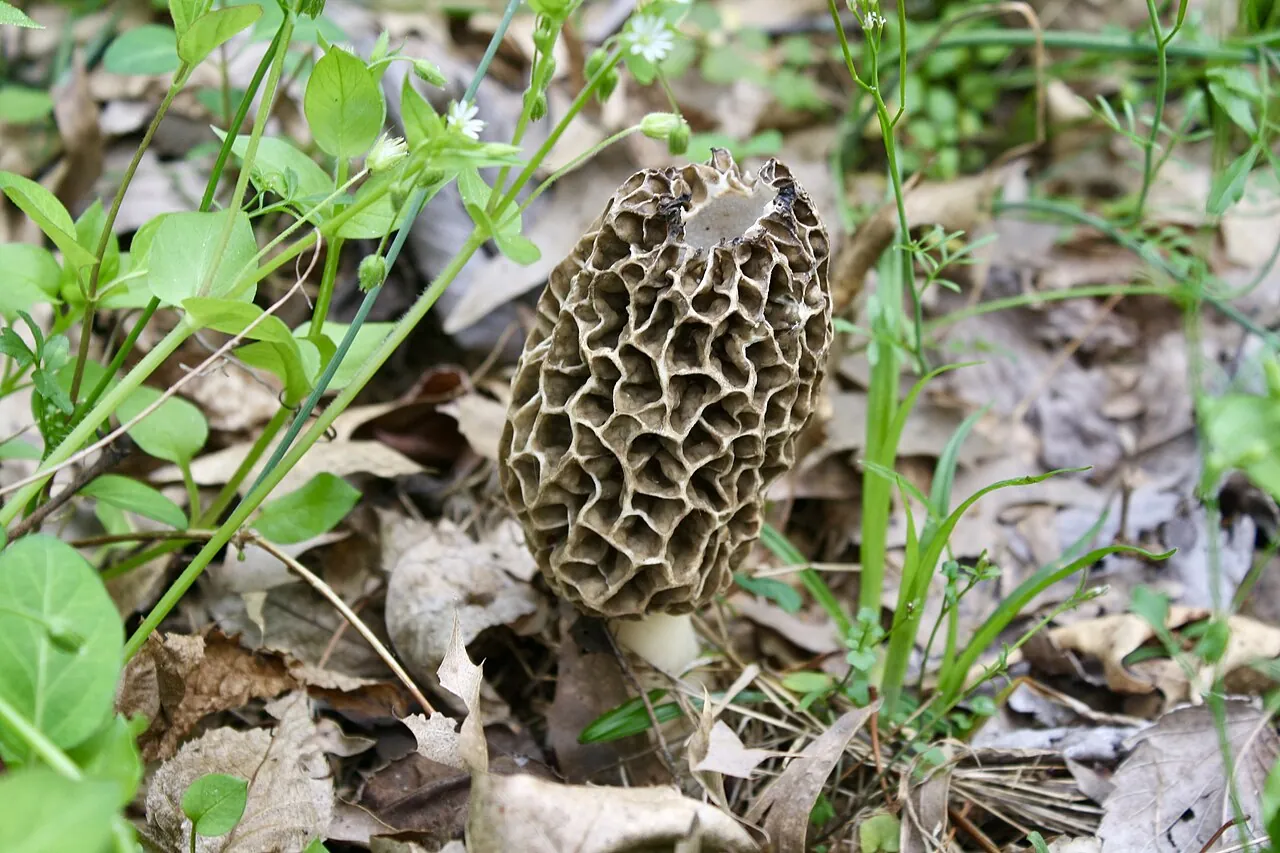
- Cap: a honeycomb of pits and ridges, conical to egg-shaped.
- Attachment: the cap’s lower edge is fused to the stem; there’s no skirt hanging free.
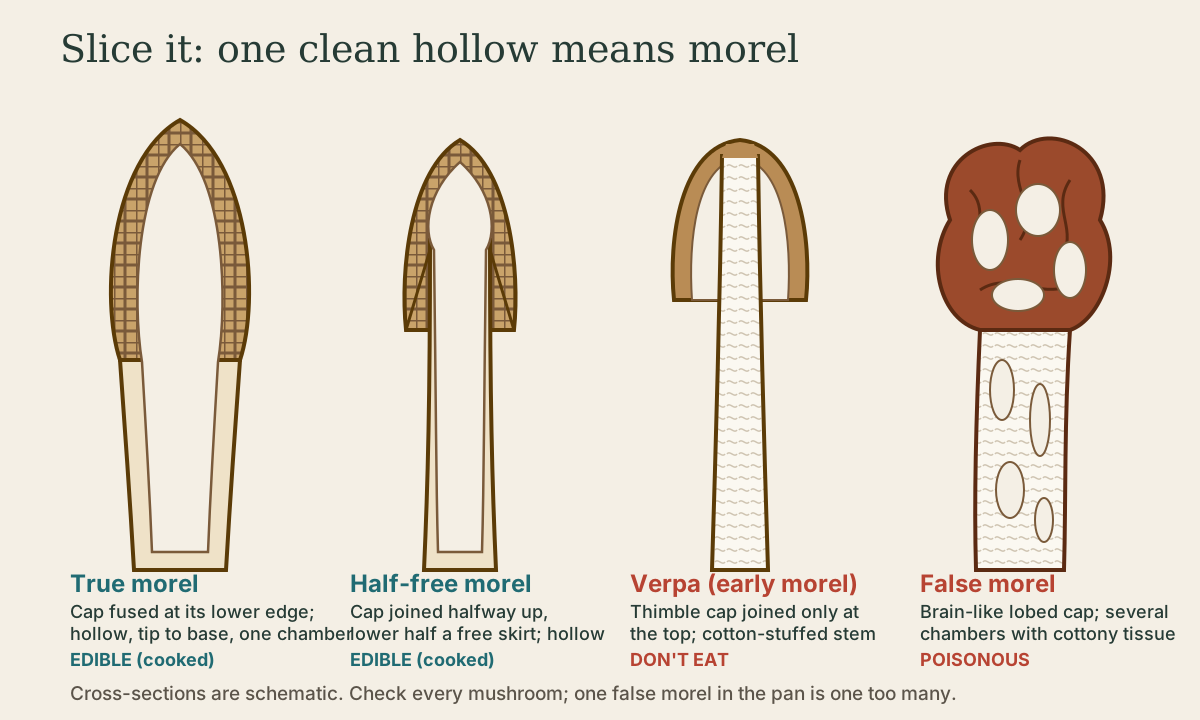
- Inside: hollow in one continuous chamber from the cap’s tip to the stem’s base, with no cottony stuffing.
- Kinds: yellow morels (gray when young, ripening yellow-tan, often under elm, ash, and apple) and black morels (dark ridges, earlier, often with aspen and in the north).

Half-free morels (Morchella punctipes) are edible too: the cap is joined to the stem about halfway up, leaving the lower half of the cap hanging free like a short skirt, but the inside is still one hollow.
The look-alikes
False morels (Gyromitra), including the species called Gyromitra esculenta, come up in spring, often under conifers and aspen in the north:
- Cap brain-like, wrinkled, and lobed, not pitted, often reddish-brown.
- Inside, several chambers filled with white, cottony tissue.
False morels contain gyromitrin, which breaks down into monomethylhydrazine, a rocket fuel component. Symptoms start 6 to 12 hours after eating, with cramps, vomiting, and watery diarrhea, and can progress to liver and kidney damage, seizures, coma, and occasionally death. Boiling twice and discarding the water removes much of the toxin, but the toxin goes into the steam, which is itself a hazard 4. Don’t eat them.
Early morels (Verpa bohemica) come up earlier in spring, often under aspen and cottonwood:
- A thimble-like cap attached only at the very top of the stem, hanging free all around.
- Stem stuffed with cottony fibers, not hollow.
Verpas cause gut upset and loss of coordination in some people. Leave them.
Slice every one
Slice every mushroom lengthwise, in the field or before cooking. You’re checking for:
- One continuous hollow, cap to base.
- Cap fused to the stem at its lower edge (or halfway up for half-frees).
- No cotton in the stem.
This also turns out the slugs and bugs hiding inside.
Quick check
True morels are completely hollow in one chamber. Verpa has a stuffed stem and a cap attached only at the top; false morels are chambered and brain-like.
Cleaning and cooking
- Slice lengthwise, check the interior, and shake out insects.
- Swish briefly in cold water if gritty, and dry on towels. Some cooks soak them in salt water to drive out bugs; it works but waterlogs them a little.
- Cook thoroughly. Raw or undercooked morels make many people sick. Eat a modest amount the first time, and some people react even to cooked morels, especially with alcohol.
Morels are best simply cooked: sautéed in butter until browned, floured and fried, with ramps and eggs, or in a cream sauce over pasta or chicken.
To preserve, dry them whole or halved on screens or a dehydrator, and rehydrate in warm water, saving the soaking liquid for sauce. Or sauté and freeze them.
What to take from this
Morels come up late April into June under dying elms, ash, aspen, and old apples, and in burned or disturbed ground. True morels have pitted caps fused to the stem and are hollow in one chamber; half-frees are joined halfway up and also hollow. False morels are brain-like and chambered with cotton, Verpas hang from the top over a stuffed stem; leave both. Slice every one, and always cook morels.
Practice
Morels contain heat-sensitive compounds that cause stomach upset raw. Cook them thoroughly. Cooking does not make false morels safe.
Lesson complete
Nice work.
Sources for this lesson
- 1Harvesting morel mushrooms. University of Minnesota Extension. verifiedLate April through May in southern Minnesota, into June farther north; under decaying elm, ash, poplar, and apple; pinch or cut above the soil; mesh bag; Poison Control 1-800-222-1222 and save an uncooked sample.
- 2Wis. Admin. Code NR 45.04: Protection of natural resources (department lands). Wisconsin Legislature. verifiedNR 45.04(1)(a) bars removing natural growth from DNR lands; (1s) allows collecting edible fruits, edible nuts, wild mushrooms, wild asparagus, and watercress by hand for personal consumption, and removing listed invasive herbaceous plants. Cited at: NR 45.04(1s).
- 3Chequamegon-Nicolet National Forest: Permits. USDA Forest Service. verifiedNo permit needed to gather edible material such as morels for your own consumption; boughs, firewood, birch bark, and other forest products need a permit.
- 4Gyromitra esculenta - False morel, brain mushroom. Beaty Biodiversity Museum, Mushrooms Up!. verifiedGyromitrin and monomethylhydrazine; onset 6-12 hours with cramps, vomiting, and diarrhea, sometimes liver and kidney damage, seizures, coma, and death; boiling releases toxic fumes; brain-like lobed cap with internal chambers.