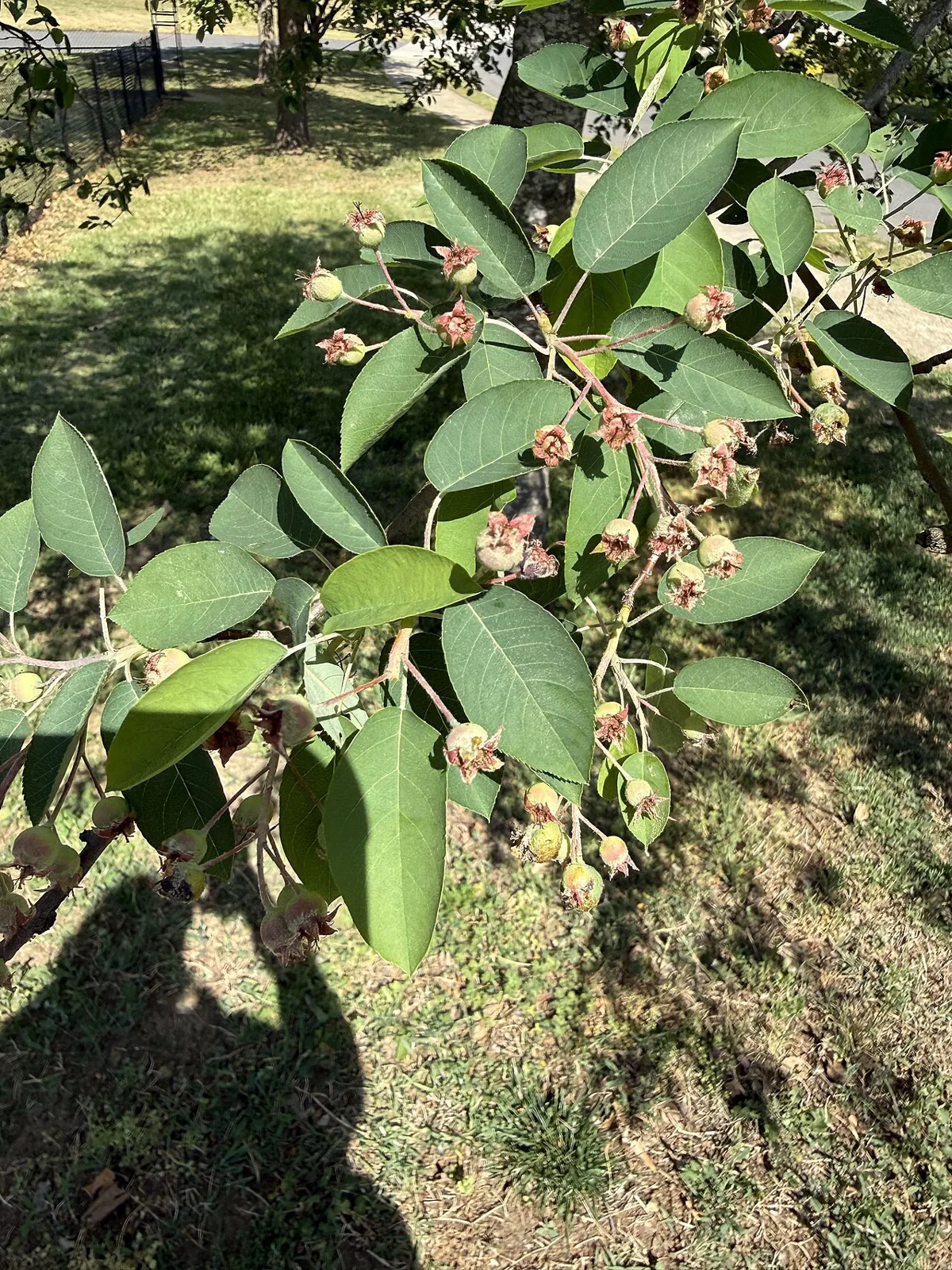
Serviceberry and Mulberry
Two early-summer tree fruits: serviceberries (Juneberries), dark purple and almond-flavored in June, and mulberries, mostly the invasive white mulberry with fruit from white to black.
- 4 min
- 3 steps
- 3 questions
- Lesson 26 of 49
In this lesson
- Serviceberry
- Mulberry
- What to take from this
Picking up where you left off.
Serviceberry
Serviceberries (Amelanchier), also called Juneberries, shadbush, or saskatoons, are small native trees and shrubs of woods edges, rocky slopes, lake shores, and yards. Several species grow in Wisconsin, and they hybridize, but they all have good fruit.
- Flowers: clusters of white, five-petaled, strap-like petals in late April or May, among the first trees to bloom, before or as the leaves come out 1.
- Bark: smooth and gray, often with faint vertical stripes.
- Leaves: alternate, oval, finely toothed.
- Fruit: small round berries in hanging clusters, ripening from red to dark purple in June 1. Each has a little crown, the remains of the flower, at the end opposite the stem, like a blueberry.
They taste like a sweet blueberry with a hint of almond from the soft seeds. Of the native species, the western Saskatoon serviceberry has the best fruit 1, but Wisconsin’s are good, especially from shrubs in full sun.
Look-alikes: none dangerous in fruit. The crowned berry, June ripening, and white spring flowers on a smooth gray-barked tree are distinctive.
Picking: birds, especially cedar waxwings and robins, strip serviceberries the day they ripen. Watch your trees and pick when the first fruits turn dark. A tarp under a shrub and a gentle shake helps on tall trees.
Using them: eat fresh, or bake them in pies, muffins, and crisps (they’re good with a little lemon or rhubarb for tartness), or make jam and syrup 1. They freeze well.

Quick check
That’s why they’re called Juneberries. White flowers in late April or May, dark purple fruit in June.
Mulberry
Most mulberries in Wisconsin are white mulberry (Morus alba), an Asian tree brought for silkworms, now widespread in southern and central Wisconsin along fencerows, alleys, and woods edges. The DNR lists it as a Restricted invasive: it outcompetes and hybridizes with the native red mulberry (Morus rubra), replacing it 2.
- Leaves: alternate, glossy, and variable on the same tree, from unlobed hearts to mitten shapes and deeply lobed 2.
- Fruit: like a narrow blackberry, an inch or so long, ripening from white to red to black, and edible 2. Some trees bear fruit that stays white or pink when ripe.
- Season: late June and July, ripening over several weeks.
Native red mulberry, now uncommon in southern Wisconsin, tends to be more of a shrub, with simple leaves 2.
Picking: ripe mulberries fall when the branch is shaken. Spread a clean tarp or sheet under the tree and shake the branches. Pick out stems and leaves; the little green stems stay on the fruit but are harmless.
Using them: fresh, in pies (mixed with tart fruit like rhubarb, since mulberries are sweet and low in acid), jam, and juice. Unripe mulberries and the leaves contain a milky sap that can upset your stomach, so eat only ripe fruit. Mulberries stain hands, clothes, and sidewalks purple.
Since white mulberry is invasive, harvest freely. Wild fruits are allowed on DNR land for personal use 3.
Quick check
Most Wisconsin mulberries are white mulberry, ripening white to red to black.
What to take from this
Serviceberries bloom white in late April and May and ripen dark purple, crowned berries in June; pick before the birds do and use them like blueberries. Most Wisconsin mulberries are invasive white mulberry, with glossy, variable leaves and fruit ripening white to red to black in late June and July; shake them onto a tarp and eat only ripe ones.
Practice
White mulberry is widespread in southern Wisconsin. Its fruit ripens white, red, or black and is edible. The native red mulberry is a different species.
Lesson complete
Nice work.
Sources for this lesson
- 1Serviceberry. University of Minnesota Extension. verifiedWhite flowers late April or May; fruit ripens dark purple in June, eaten fresh or in pies and jams; Saskatoon serviceberry has the best fruit.
- 2White mulberry (Morus alba). Wisconsin Department of Natural Resources. verifiedGlossy leaves, lobed or unlobed on the same tree; fruit white to red to black, edible; hybridizes with and displaces native red mulberry; Restricted invasive.
- 3Wis. Admin. Code NR 45.04: Protection of natural resources (department lands). Wisconsin Legislature. verifiedNR 45.04(1)(a) bars removing natural growth from DNR lands; (1s) allows collecting edible fruits, edible nuts, wild mushrooms, wild asparagus, and watercress by hand for personal consumption, and removing listed invasive herbaceous plants. Cited at: NR 45.04(1s).