Hen of the Woods and Oyster Mushrooms
Fall's big mushrooms: hen of the woods, a gray-brown rosette at the base of old oaks that returns every year, and oyster mushrooms, shelving on dead hardwood from October through winter thaws.
- 5 min
- 4 steps
- 3 questions
- Lesson 29 of 49
In this lesson
- Hen of the woods
- Oyster mushrooms
- Make a habit of spore prints
- What to take from this
Picking up where you left off.
Hen of the woods
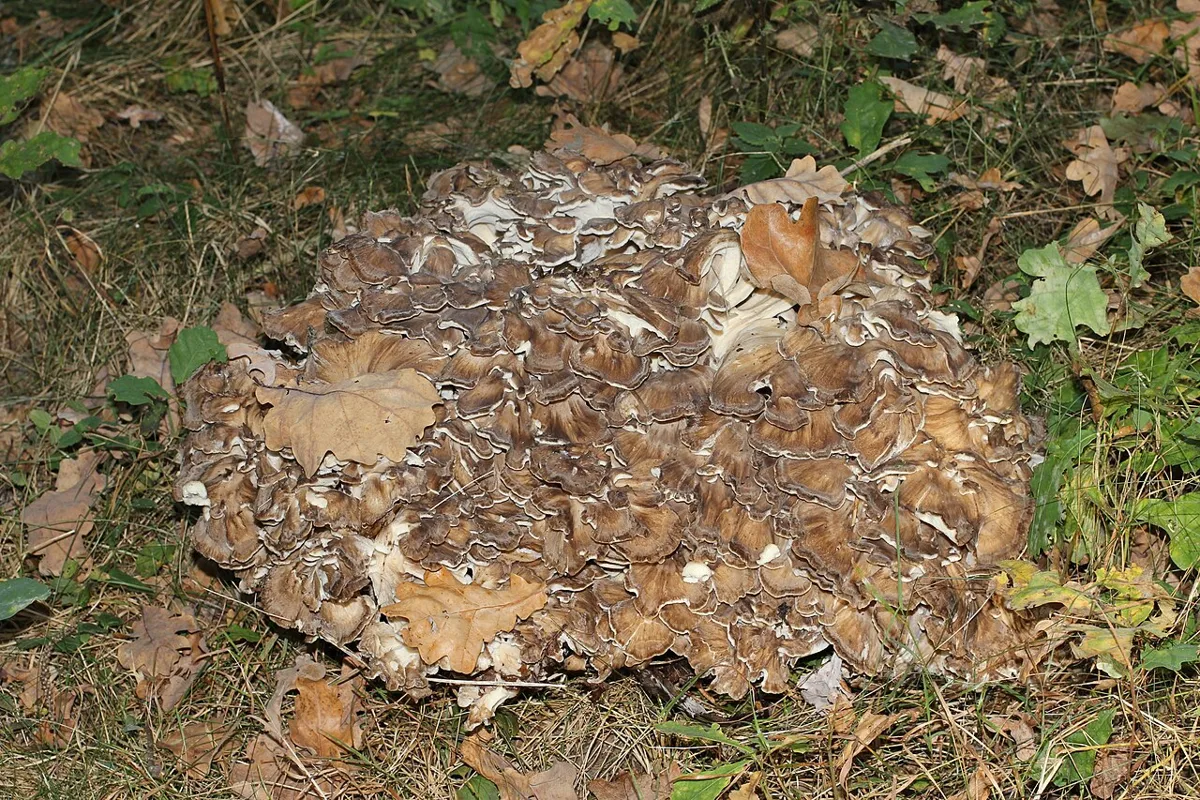
Hen of the woods, or maitake (Grifola frondosa), is one of the most prized fall mushrooms. It grows near the bases of oaks, where it rots the heartwood of the butt, and it often reappears in the same place year after year 1. Find one, and you have a spot for life; old oaks in Driftless woodlots, parks, and cemeteries are prime.
Season: late summer and fall; in Wisconsin, September and October after rain.
Identification 1:
- A big rosette of many overlapping, fan- or spoon-shaped caps, each 1 to 5 inches across, from a single branched base.
- Caps gray-brown, dark to pale, with wavy margins.
- Underside: pores, fine and white (lavender-gray when young), running down the short stems.
- Overall 6 to 16 inches across and often several pounds; big ones top 20 pounds.
Look-alikes:
- Black-staining polypore (Meripilus sumstinei) also grows at the base of hardwoods but has larger caps and bruises black when handled 1. It’s edible but tough, not dangerous.
- Umbrella polypore (Polyporus umbellatus) has more distinct round caps on individual stems 1, and is edible too.
- Berkeley’s polypore forms a few large, thick, cream caps at oak bases.
None of the look-alikes are dangerous, which makes hen a good beginner mushroom.
Harvesting: cut it off at the base with a knife. It’s full of forest debris, so trim and brush in the field. Leave the base in the ground. Young, firm hens are best; old ones turn tough and buggy.
Cleaning and cooking: pull the rosette apart into clusters, rinse quickly if gritty, and dry. The thick core is tougher; slice it thin. Roast or sauté until the edges crisp, simmer in soups, or cook into rice and noodles. Hen freezes well after sautéing, and dries well.

Quick check
Grifola frondosa causes a butt rot in oaks and fruits at the base of the same trees year after year in early fall.
Oyster mushrooms
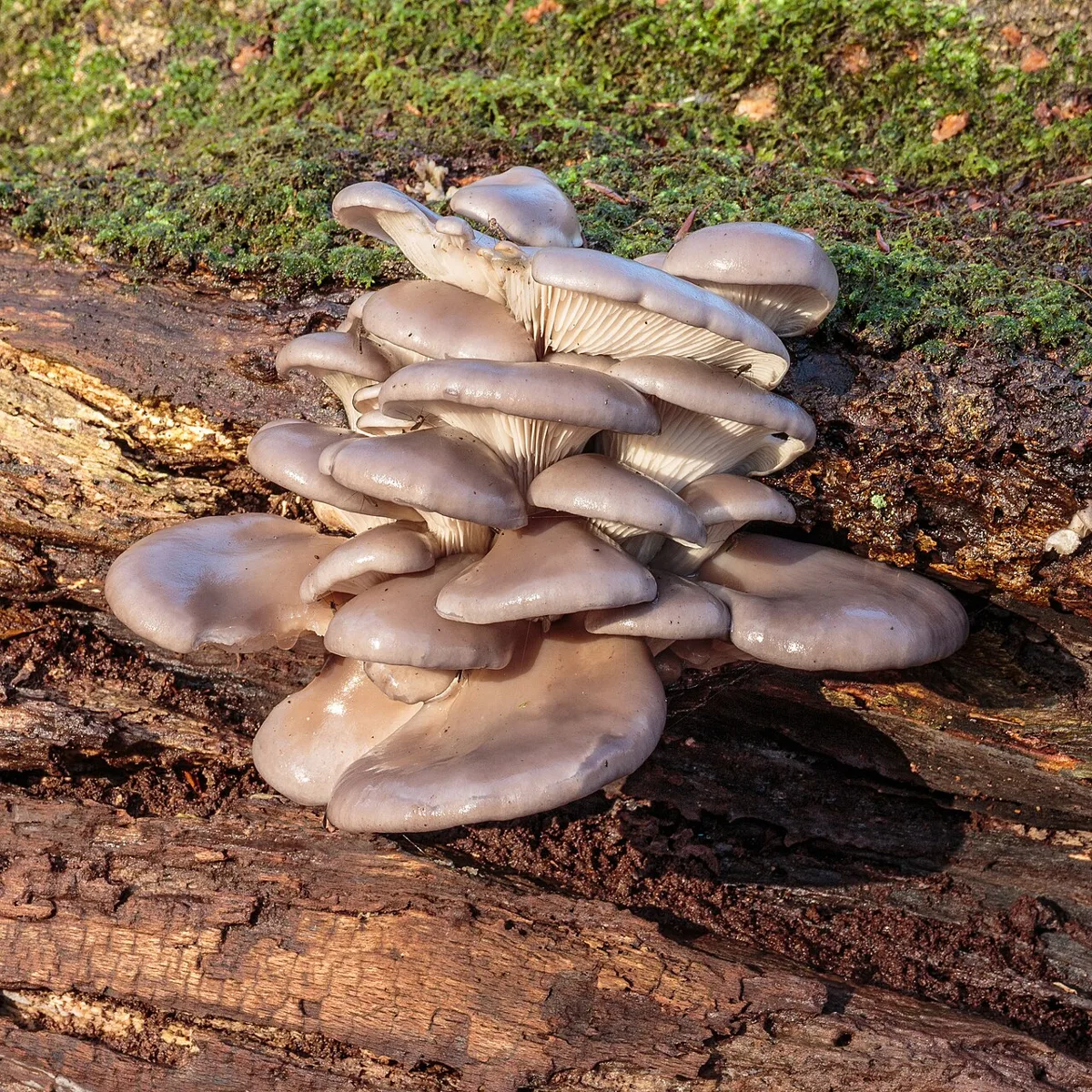
Oyster mushrooms (Pleurotus) grow on dead logs and standing trees, mostly hardwoods, in shelving clusters 2. In Wisconsin they’re common on dead aspen, cottonwood, maple, and elm.
Season: Pleurotus ostreatus fruits in cool weather, roughly October to early April, including during winter thaws. Pleurotus pulmonarius is paler and fruits in late spring and summer, and P. populinus grows on aspen 2. All three are edible.
Identification 2:
- Caps: shell- or oyster-shaped, 2 to 8 inches, white to tan, gray, or brown, smooth.
- Gills: white to grayish, decurrent (running down the stem), close together.
- Stem: short, off-center, or almost absent, where the cap attaches to the log.
- Spore print: white to faintly lilac. Make one: in a dense cluster you can often see a dusting of spores on the caps below.
- Habitat: on wood, in overlapping shelves.
Look-alikes:
- Angel wings (Pleurocybella) are thin, white, and on conifer wood; they’ve been linked to poisonings in people with kidney disease, and are best skipped.
- Late oyster (Sarcomyxa serotina) has a greenish cap and yellowish gills in late fall; it’s bitter but not dangerous.
- Crepidotus species are small, brown-spored shelves on wood; a spore print separates them.
A shelving mushroom on dead hardwood with decurrent gills and a white to lilac spore print is an oyster.
Harvesting and cooking: cut the clusters off the log, trim the tough base, and shake out beetles, which love oysters. Cook soon; they don’t keep long. Sauté until browned, or use them in stir-fries and soups.
Winter oysters are a reason to walk the woods in a January thaw: frozen and thawed oysters are often still good if they’re firm.
_25-12-2020_(d.j.b.)_01.jpg)
Make a habit of spore prints
Both mushrooms in this lesson are safe to learn, but practice the routine on them: record the substrate and nearby trees, note the growth habit, and make a spore print 3. It’s the habit that keeps you safe with harder species.
Wild mushrooms may be gathered on DNR land for personal use 4.
Quick check
Make prints a habit, even on mushrooms you know.
What to take from this
Hen of the woods is a gray-brown rosette of spoon-shaped, pored caps at the base of old oaks in September and October, returning to the same trees each year, with no dangerous look-alikes. Oyster mushrooms shelve on dead hardwood in cool weather, from October through winter thaws, with decurrent gills and a white to lilac spore print. Cut both cleanly, trim the bases, and cook them well.
Practice
Oysters grow in shelves on dead logs and trees, with decurrent gills and little or no stem, in cool weather.
Lesson complete
Nice work.
Sources for this lesson
- 1Michael Kuo. Grifola frondosa (Hen of the Woods). MushroomExpert.com. verifiedClusters of gray-brown fan-shaped caps from a branched base near oaks, often returning yearly; Meripilus sumstinei is larger and bruises black.
- 2Michael Kuo. Pleurotus ostreatus (The Oyster Mushroom). MushroomExpert.com. verifiedShelving clusters on dead hardwood, October to early April; decurrent gills; white to lilac spore print; P. pulmonarius in warm weather, P. populinus on aspen.
- 3Michael Kuo. Studying Mushrooms. MushroomExpert.com. verifiedHow to make a spore print on paper or glass and what to record - substrate, nearby trees, base, ring, gill attachment, odor.
- 4Wis. Admin. Code NR 45.04: Protection of natural resources (department lands). Wisconsin Legislature. verifiedNR 45.04(1)(a) bars removing natural growth from DNR lands; (1s) allows collecting edible fruits, edible nuts, wild mushrooms, wild asparagus, and watercress by hand for personal consumption, and removing listed invasive herbaceous plants. Cited at: NR 45.04(1s).