Deadly Amanitas and Galerina
The eastern destroying angel and deadly Galerina carry amatoxins that destroy the liver after a symptom-free delay. Learn their features cold, know what poisoning looks like, and know what to do.
- 5 min
- 7 steps
- 3 questions
- Lesson 19 of 49
In this lesson
- Why these two
- The destroying angel
- Deadly Galerina
- What poisoning looks like
- What to do
- Rules that keep you safe
- What to take from this
Picking up where you left off.
Why these two
Of the thousands of mushrooms in Wisconsin, a few cause nearly all deaths, and they share a toxin: amatoxins. Amatoxins stop cells from making proteins, and the liver, which absorbs them first and keeps re-absorbing them, takes the most damage 1. Cooking, drying, and freezing don’t destroy them.
Learn these two groups before you eat any mushroom with gills.
The destroying angel
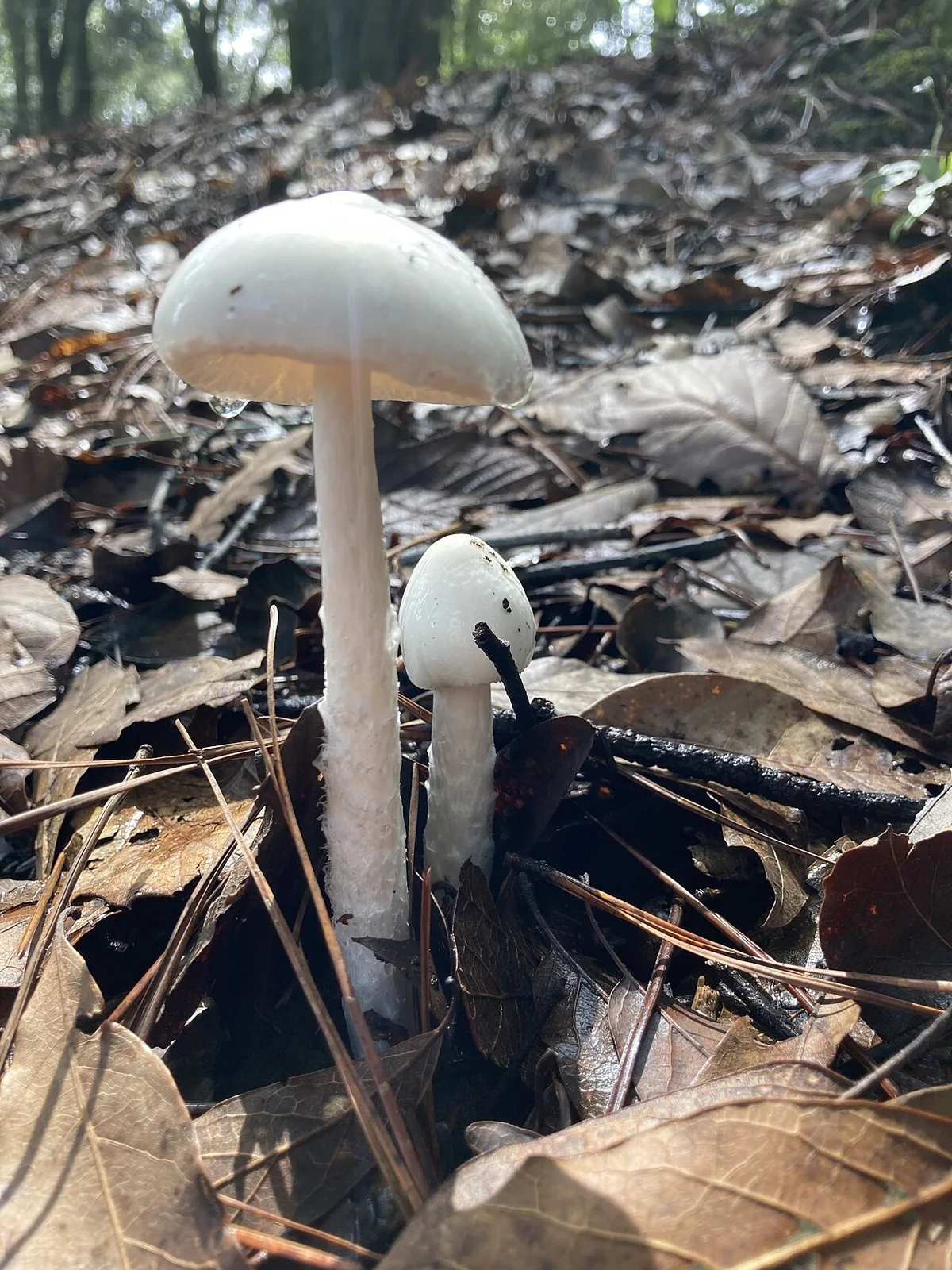
The eastern destroying angel (Amanita bisporigera) is common across eastern North America and the north woods, on the ground under oaks and other hardwoods in summer and fall 2. It’s a beautiful mushroom, which is part of the danger:
- Pure white cap, smooth, oval at first, then convex to flat.
- White gills, free from the stem and crowded.
- A thin, skirt-like ring high on the stem.
- A white, sac-like volva at the base, often underground or broken up.
- White spore print.
- Grows singly or scattered on the ground, never on wood 2.
Young destroying angels still enclosed in their veil look like white puffballs, so slice every “puffball” top to bottom: a true puffball is uniform white flesh inside, while an egg-stage Amanita shows the outline of a cap and gills. They are also mistaken for meadow mushrooms and other white gilled mushrooms, which is why beginners skip white gilled mushrooms altogether.
Related Amanitas, including the death cap (Amanita phalloides) that has spread on the West Coast, carry the same toxins. The features to fear are the same: white gills, a ring, and a cup or sac at the base.

Quick check
Amanita bisporigera is white all over, with free gills, a high ring, and a white sac at the base that’s often underground. It grows on the ground near oaks in summer and fall.
Deadly Galerina
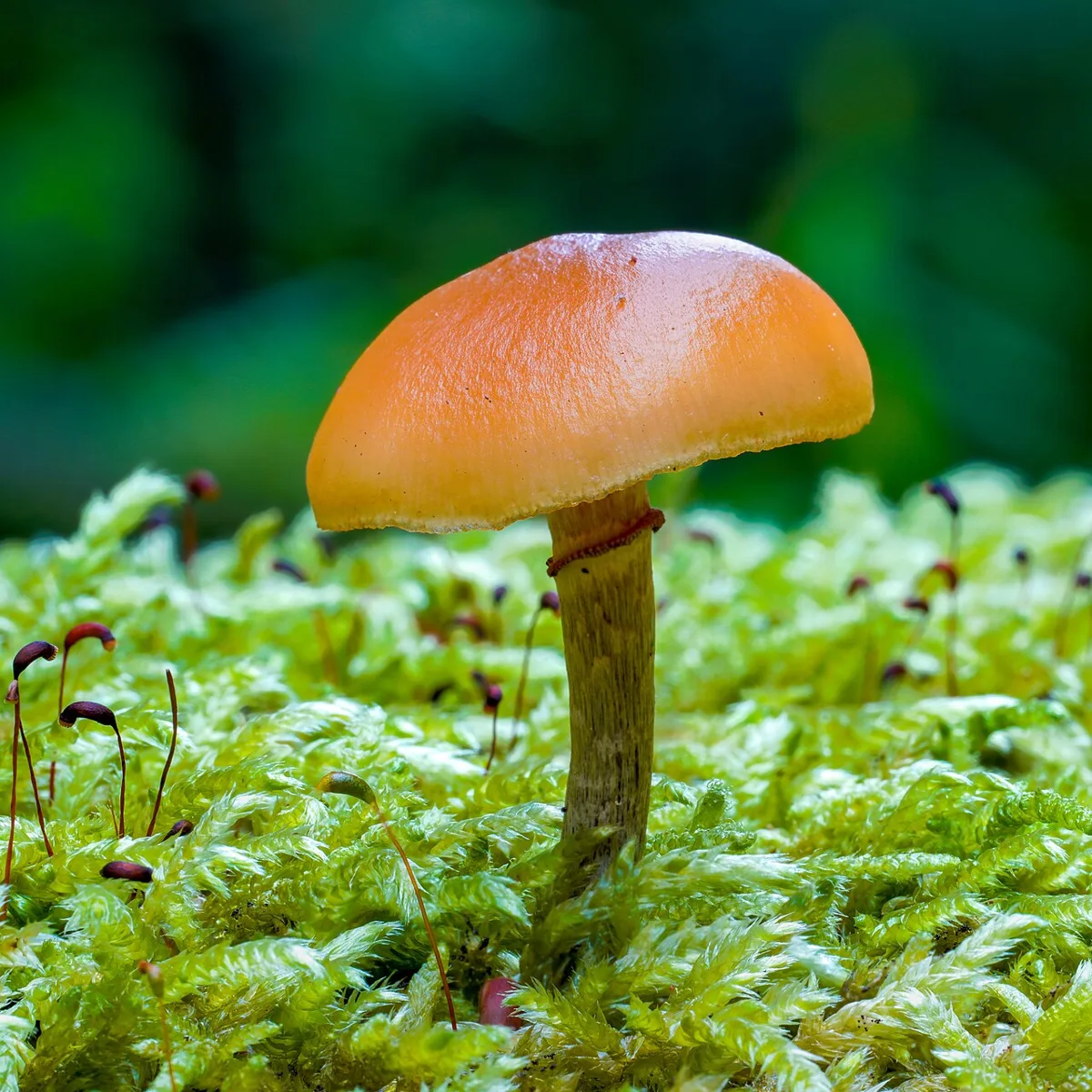
Deadly Galerina (Galerina marginata) is a small brown mushroom on rotting wood, sometimes on moss or buried wood, in spring and fall, often in cool weather 3:
- Small, brown to tawny cap, sticky when wet, drying paler.
- Brownish gills, attached.
- A thin ring or ring zone on the stem, which may disappear.
- Rusty-brown spore print.
Every sample of G. marginata tested in a 2021 study carried amatoxins in significant amounts, and poisonings have come from people who mistook it for honey mushrooms 3. It also grows alongside winter mushrooms like velvet foot (Flammulina). Any small brown mushroom on wood needs a spore print; Galerina’s is rusty brown.

What poisoning looks like
Amatoxin poisoning runs in three phases 1:
- 6 to 24 hours after eating: severe nausea, vomiting, cramps, and watery diarrhea.
- 24 to 48 hours: a false recovery. The person feels better while liver damage progresses.
- After 48 hours: liver failure, with bleeding problems and confusion, and kidney damage; death or a liver transplant without treatment.
There is no specific antidote; hospitals use supportive care and several treatments, and early care improves the odds 1. The key signal is the delay: most mushrooms that cause stomach upset do it within a few hours, while gut symptoms starting six or more hours after a meal of wild mushrooms suggest amatoxins.
Quick check
No preparation removes amatoxins; identification is the only protection.
What to do
If anyone may have eaten one of these, or has delayed symptoms after wild mushrooms:
- Call Poison Control at 1-800-222-1222 and go to an emergency room. Don’t wait for symptoms.
- Bring the mushrooms, raw leftovers, or photos; save an uncooked sample 4.
- Tell everyone who shared the meal.
Rules that keep you safe
- Don’t eat any white gilled mushroom until you’re experienced, and never one with a ring and a volva.
- Dig up the base of every gilled mushroom.
- Spore print small brown mushrooms on wood, and anything new.
- Slice every puffball top to bottom.
- Start with mushrooms that have no deadly look-alikes in the region: morels (sliced to check), chicken of the woods, hen of the woods, chanterelles checked against jack-o’-lanterns, and oysters.
What to take from this
Destroying angels (all white, free gills, ring, buried sac at the base, white print, on the ground near oaks) and deadly Galerina (small, brown, on wood, ring, rusty-brown print) carry amatoxins that cooking can’t destroy. Symptoms start 6 to 24 hours later, then a false recovery hides liver failure. Delayed symptoms after wild mushrooms mean Poison Control and the ER at once, with the mushrooms in hand.
Practice
Amatoxin poisoning starts 6 to 24 hours after eating, then a false recovery hides progressing liver failure. Delayed symptoms after wild mushrooms are an emergency.
Lesson complete
Nice work.
Sources for this lesson
- 1Corey M. Stein, Peter E. Wu, James A. Scott, Adina S. Weinerman. Fulminant hepatic failure following ingestion of wild mushrooms. CMAJ 187(11). 2015. verifiedAmatoxin poisoning runs in three phases - gut symptoms at 6-24 h, a false recovery at 24-48 h while the liver fails, then liver failure; no specific antidote.
- 2Michael Kuo. Amanita bisporigera (Eastern North American Destroying Angel). MushroomExpert.com. verifiedWhite cap, free white gills, high skirt-like ring, white sac-like volva often buried; white spore print; mycorrhizal with oaks; summer and fall, common across eastern North America.
- 3Brandon Landry, Jeannette Whitton, Anna L. Bazzicalupo, Oldriska Ceska, Mary L. Berbee. Phylogenetic analysis of the distribution of deadly amatoxins among the little brown mushrooms of the genus Galerina. PLoS One. 2021. verifiedEvery Galerina marginata sample carried amatoxins; poisonings from mistaking it for honey mushrooms; grows on rotting wood, moss, and turf.
- 4Harvesting morel mushrooms. University of Minnesota Extension. verifiedLate April through May in southern Minnesota, into June farther north; under decaying elm, ash, poplar, and apple; pinch or cut above the soil; mesh bag; Poison Control 1-800-222-1222 and save an uncooked sample.