Positive Identification and Deadly Look-Alikes
Eat only what you've identified by every feature, not by a resemblance - and learn the handful of Wisconsin plants and mushrooms that kill, because every good wild food has one.
- 5 min
- 6 steps
- 3 questions
- Lesson 15 of 49
In this lesson
- What positive identification means
- The rules
- The killers
- Things that hurt
- Look-alike pairs
- What to take from this
Picking up where you left off.
What positive identification means
Foraging safety comes down to one habit: you eat a plant or mushroom only after you’ve identified it positively. That means every key feature in a trustworthy description matches - the habitat, the season, the leaf arrangement, the stem, the smell, the inside of the stem or mushroom - and you can name the look-alikes and say why it isn’t any of them 1.
A resemblance is not an identification. “It looks like the picture” is how people get hurt, because the dangerous plants look like the picture too. Apps that identify from a photo are useful for a first guess and to suggest where to look, but they routinely miss the features that separate an edible from its toxic twin: a chambered root, a sac at the base of a mushroom, a smell.
Build identification the way you learned trees: meet the plant in all seasons. Ramps are easy in April when nothing else is green; a plant you’ve watched sprout, flower, and fruit for a year is one you won’t mistake.
Quick check
A resemblance is not an identification. You confirm every feature in the description - habitat, season, structure, smell - and rule out the dangerous look-alikes by name.
The rules
- Learn one species at a time, with its look-alikes, from at least two good sources.
- Use every feature. If one doesn’t match, it’s not the plant.
- Know the season and habitat. A “morel” in August or a “ramp” in a sunny ditch is something else.
- Check every piece. A single toxic mushroom or plant in a basket of good ones can poison the meal. Sort in the field and again in the kitchen.
- Try a small amount of a new wild food the first time, cooked if it’s normally cooked, and keep a sample. Individual reactions happen even with safe species.
- When in doubt, throw it out 2.
The killers
Most toxic plants make you sick. A few kill, and those are worth learning before anything else. In Wisconsin:
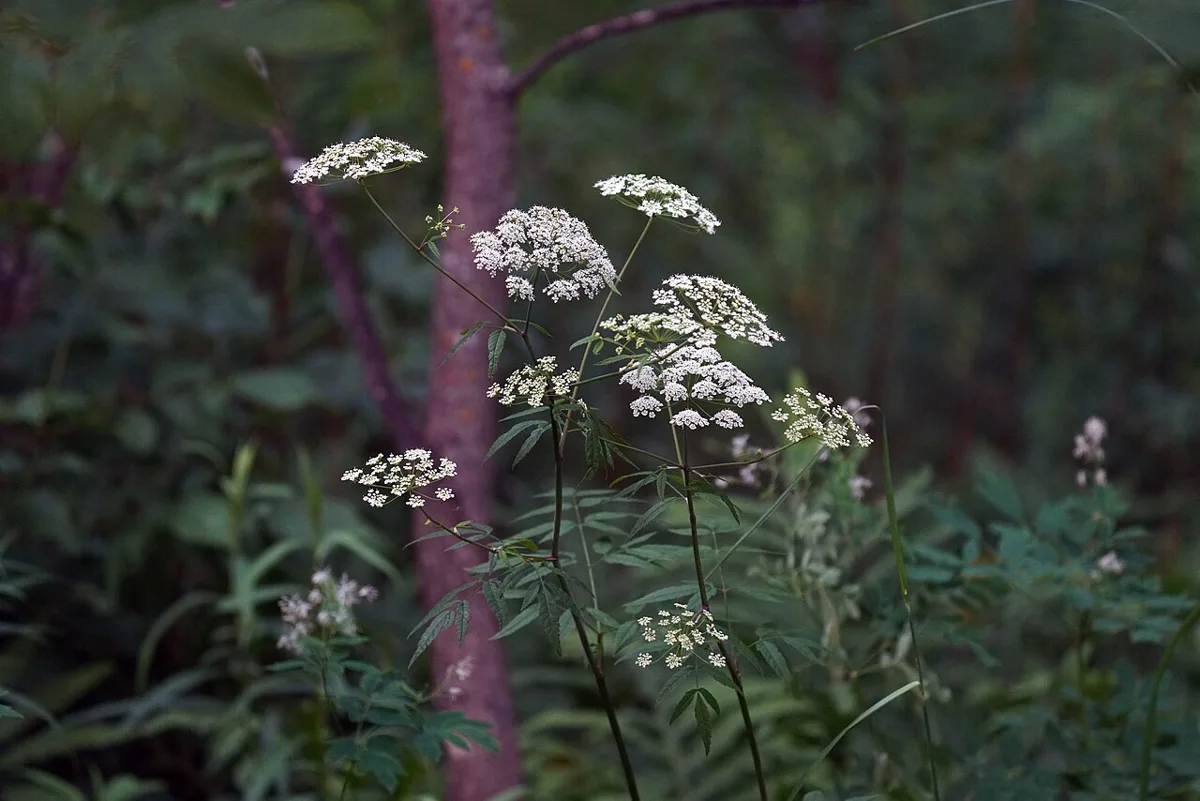
Water hemlock (Cicuta maculata) is regarded as the most poisonous plant in the North Temperate Zone. It grows in wet ground - ditches, stream banks, pond margins, marshes - with umbels of small white flowers and twice- or thrice-divided leaves. Two features separate it: the leaflet veins run to the notches between the teeth rather than to the tips, and the root is chambered inside, with hollow cross-walls when sliced lengthwise. Its toxin, cicutoxin, causes vomiting and convulsions within an hour and is often fatal; the root is the most poisonous part 3.
.jpg)
Poison hemlock (Conium maculatum) is a tall carrot-family plant with finely cut, fern-like leaves and a smooth stem blotched purple. It’s common along roadsides and field edges in southern Wisconsin.
Both belong to the carrot family (Apiaceae), which also holds wild carrot, wild parsnip, and several edible plants. Until you know the family well, leave white umbels alone.
Destroying angels (Amanita bisporigera and kin) and deadly Galerina cause most mushroom deaths. Their amatoxins produce no symptoms for 6 to 24 hours, then severe vomiting and diarrhea, then a false recovery while the liver fails 4. The Mushroom Skills module covers them in detail. They are why you never eat a mushroom on a guess.
Quick check
The carrot family has good foods and deadly plants that look alike. Skip white umbels until you know the family well; water hemlock grows in wet ground and kills within hours.
Things that hurt
- Wild parsnip (Pastinaca sativa): yellow umbels on roadsides and old fields from late spring to midsummer. Sap on skin in sunlight causes blistering burns that can scar for months 5. Wear gloves and long sleeves around it.
- Poison ivy: leaves of three, often climbing trees with hairy vines; common in woods and along trails.
- Stinging nettle: painful but harmless, and a good food once cooked.
Look-alike pairs
Every good wild food in this course has a dangerous double, and each lesson names it. A preview:
| Wild food | Dangerous look-alike | The difference |
|---|---|---|
| Ramps | Lily of the valley | Ramps smell of onion; lily of the valley doesn’t |
| Morels | False morels | Morels are hollow in one chamber, cap fused to stem |
| Chanterelles | Jack-o’-lantern | Chanterelles have blunt false gills; jacks have true gills, in clusters on wood |
| Wild grapes | Moonseed | Grapes have tendrils and round seeds; moonseed has one crescent seed |
| Elderberry | Water hemlock | Elder is a woody shrub; hemlock is a herb with chambered roots |
| Honey mushroom | Deadly Galerina | Galerina has a rusty-brown spore print |
What to take from this
Positive identification means every feature matches and you’ve ruled out the look-alikes by name. Learn one species at a time, in all seasons, and check every piece. Learn the killers first: water hemlock (veins to the notches, chambered root, wet ground), poison hemlock, destroying angels, and Galerina, whose poison hides for a day. Gloves for wild parsnip, and when in doubt, throw it out.
Practice
Destroying angels and Galerina cause no symptoms for 6 to 24 hours, then gut illness, then an apparent recovery while the liver fails.
Lesson complete
Nice work.
Sources for this lesson
- 1Samuel Thayer. The Forager's Harvest: A Guide to Identifying, Harvesting, and Preparing Edible Wild Plants. Forager's Harvest Press. 2006. verifiedWisconsin forager's in-depth plant chapters, with sections on identification, safety, conservation, and harvest methods. Cited at: Plant Identification and Foraging Safety.
- 2Harvesting morel mushrooms. University of Minnesota Extension. verifiedLate April through May in southern Minnesota, into June farther north; under decaying elm, ash, poplar, and apple; pinch or cut above the soil; mesh bag; Poison Control 1-800-222-1222 and save an uncooked sample.
- 3Plant of the Week: Spotted Water Hemlock (Cicuta maculata). USDA Forest Service. verifiedLeaf veins end in the notches between teeth; chambered roots; wet ditches, stream banks, and marshes; cicutoxin causes convulsions within an hour; considered the most poisonous plant in the North Temperate Zone.
- 4Corey M. Stein, Peter E. Wu, James A. Scott, Adina S. Weinerman. Fulminant hepatic failure following ingestion of wild mushrooms. CMAJ 187(11). 2015. verifiedAmatoxin poisoning runs in three phases - gut symptoms at 6-24 h, a false recovery at 24-48 h while the liver fails, then liver failure; no specific antidote.
- 5Wild parsnip (Pastinaca sativa). Wisconsin Department of Natural Resources. verifiedYellow umbels late spring to midsummer on roadsides, old fields, and prairies; sap on skin in sunlight causes burns and blisters (phytophotodermatitis); Restricted invasive.