Early Greens
Dandelion, garlic mustard, wild asparagus, and watercress: abundant spring greens to pick young, with the safety notes each needs - from asparagus on DNR land to watercress in clean water.
- 5 min
- 7 steps
- 3 questions
- Lesson 24 of 49
In this lesson
- Pick young
- Dandelion
- Garlic mustard
- Wild asparagus
- Watercress
- Others
- What to take from this
Picking up where you left off.
Pick young
Spring greens are best young, before they flower, when they’re tender and mild. As days lengthen and heat arrives, most turn bitter and tough. The plants in this lesson are abundant, and several are invasive, so harvest freely.
Dandelion
Dandelion (Taraxacum officinale) is everywhere, from lawns to roadsides, and every part is edible.
- Leaves: a basal rosette of deeply toothed, hairless leaves, each with a single flower on a hollow stalk that bleeds white latex. Look-alikes like cat’s ear and chicory have hairy leaves or branched flower stalks, and none is dangerous.
- When: the youngest leaves in early spring, before flowering, are mildest. Leaves that grow under a board or deep grass are paler and less bitter.
- Use: raw in salad when very young, otherwise wilted with bacon, garlic, and vinegar, or boiled and dressed. Crowns, the white hearts just below ground, are tender and sweet. Flowers go into fritters, wine, and jelly.
Pick where nobody sprays lawn chemicals.
Garlic mustard
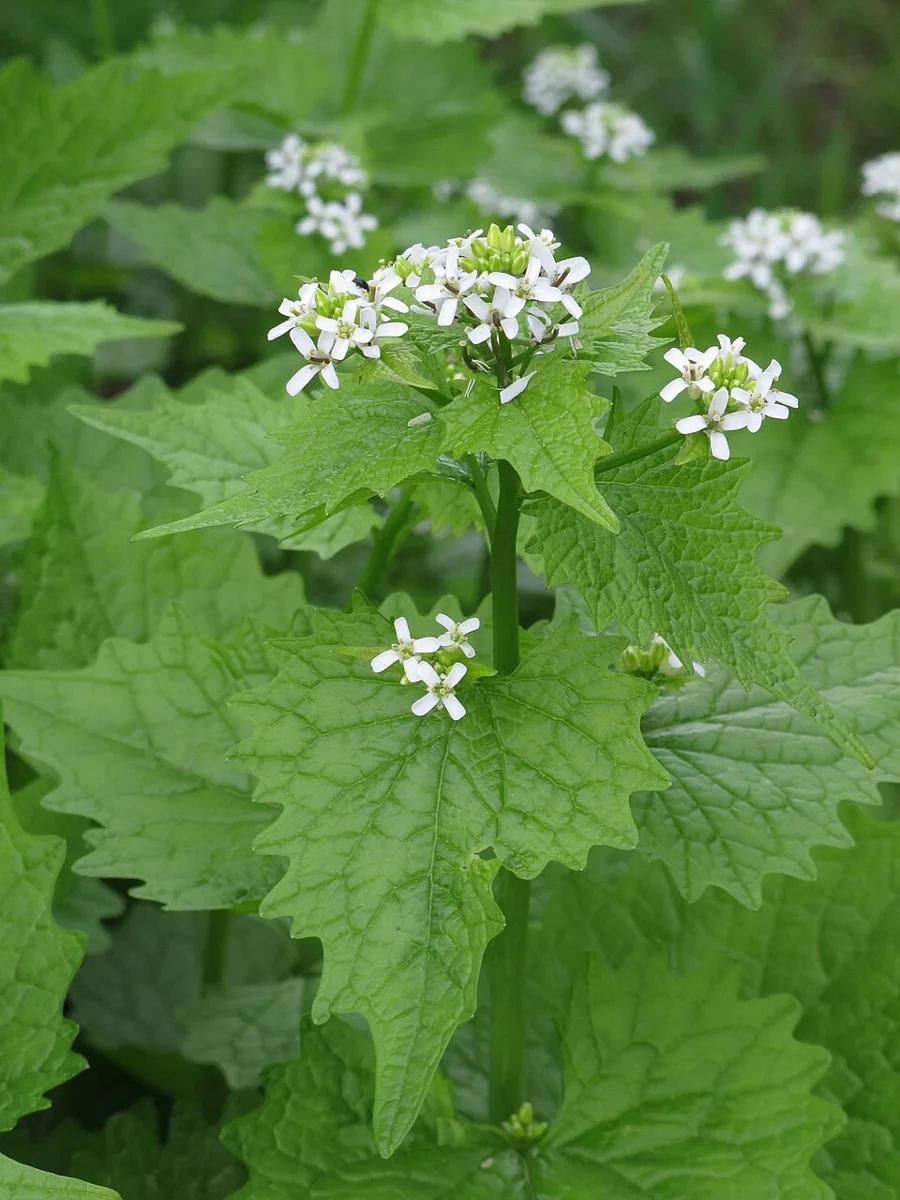
Garlic mustard (Alliaria petiolata) is an invasive European plant that carpets Wisconsin’s woods and crowds out wildflowers. Pull all you want; on DNR land, invasive herbaceous plants may be removed without permission 1.
- First year: a low rosette of rounded, kidney-shaped, scalloped leaves.
- Second year: a flower stalk 1 to 3 feet tall with triangular, toothed leaves and small white four-petaled flowers in April and May.
- Smell: crushed leaves smell of garlic.
- Use: young leaves and unopened flower tops, raw or cooked. It’s strongly mustardy and bitter when older; it makes good pesto blended with nuts and cheese.
Pull the whole plant, roots included, before it sets seed, and bag it rather than leaving it to drop seeds.

Wild asparagus
Wild asparagus (Asparagus officinalis) is garden asparagus gone wild along fencerows, field edges, ditches, and railroad lines. It’s one of the five foods named in NR 45.04 that you may gather by hand on DNR land 1.
- Find it the year before: in summer and fall, look for the feathery, 3- to 5-foot fronds, which turn golden yellow in fall and stand as dead brown stalks in winter and early spring. Next year’s spears come up at their base.
- Harvest spears in May and early June, snapping them where they break easily, when 6 to 10 inches tall and still tight at the tip. Leave some spears in each clump to grow into fronds and feed the roots.
- Caution: asparagus loves roadsides and ditches, which may be sprayed and grow wild parsnip, whose sap burns skin in sunlight 2. Pick in long sleeves and gloves.
Quick check
NR 45.04 lists wild asparagus and watercress among the foods you may gather, and listed invasive herbaceous plants like garlic mustard may be removed.
Quick check
Roadsides may also be sprayed; pick where you know the history.
Watercress
Watercress (Nasturtium officinale) grows in cold, clear, flowing springs and spring-fed streams, which the Driftless has in abundance. It’s also on the DNR land list 1.
- Leaves: compound, with three to nine roundish leaflets, the end leaflet largest; stems hollow, floating or creeping, rooting at the joints.
- Flowers: small white four-petaled clusters in summer.
- Taste: peppery, like a mild radish.
Water quality is the hazard: watercress downstream of pasture, feedlots, septic systems, or towns can carry bacteria and parasites, including liver fluke where cattle or sheep graze. Pick it at or near the spring source, away from livestock, and cook it (soup, wilted greens) if you’re not certain of the water. Make sure you’re picking watercress and not the toxic water hemlock or poison hemlock that sometimes grow along the same streams.
Others
- Wild leek and nettles have their own lessons.
- Violets (leaves and flowers) are mild and good in salads.
- Lamb’s quarters and purslane follow in early summer, both excellent cooked greens.
- Marsh marigold is toxic raw; skip it.
What to take from this
Pick spring greens young. Dandelion leaves are mildest before flowering; garlic mustard is invasive, garlicky, and free to pull; wild asparagus is found by last year’s golden fronds and may be gathered on DNR land; watercress belongs to clean, cold springs and should be cooked if the water is doubtful. Watch for wild parsnip and the hemlocks in the same places.
Practice
Dandelion leaves are mildest when young, before flowering and before hot weather. Blanching (covering) or cooking reduces bitterness.
Lesson complete
Nice work.
Sources for this lesson
- 1Wis. Admin. Code NR 45.04: Protection of natural resources (department lands). Wisconsin Legislature. verifiedNR 45.04(1)(a) bars removing natural growth from DNR lands; (1s) allows collecting edible fruits, edible nuts, wild mushrooms, wild asparagus, and watercress by hand for personal consumption, and removing listed invasive herbaceous plants. Cited at: NR 45.04(1s).
- 2Wild parsnip (Pastinaca sativa). Wisconsin Department of Natural Resources. verifiedYellow umbels late spring to midsummer on roadsides, old fields, and prairies; sap on skin in sunlight causes burns and blisters (phytophotodermatitis); Restricted invasive.
Further reading
- Samuel Thayer. The Forager's Harvest: A Guide to Identifying, Harvesting, and Preparing Edible Wild Plants. Forager's Harvest Press. 2006. verifiedWisconsin forager's in-depth plant chapters, with sections on identification, safety, conservation, and harvest methods.