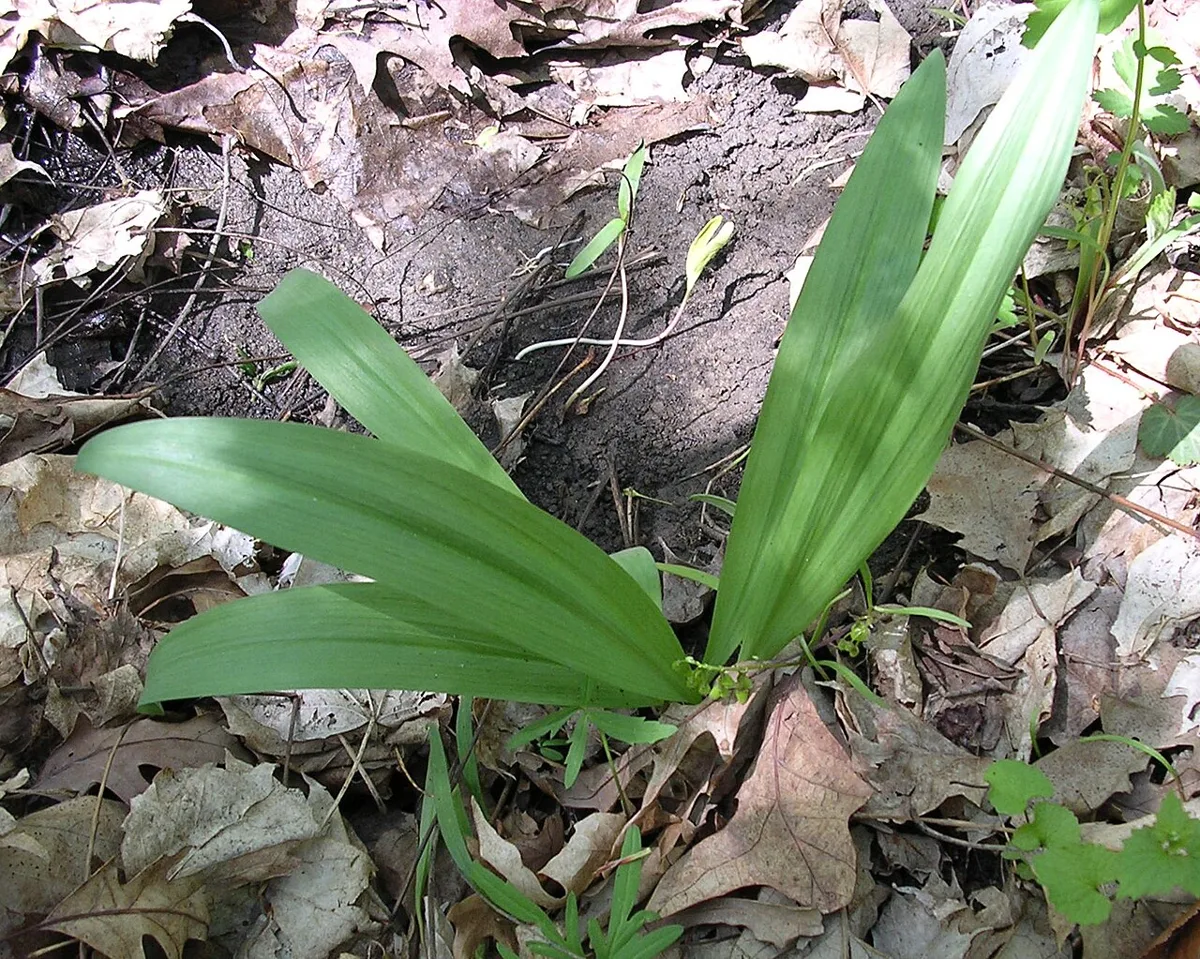
Ramps (Wild Leeks)
The first green in the April woods: broad leaves that smell of garlic and onion, in rich hardwood forest. Identify by smell against lily of the valley, and harvest a leaf, not the bulb.
- 4 min
- 6 steps
- 3 questions
- Lesson 20 of 49
In this lesson
- The plant
- Identification
- Look-alikes
- Harvesting
- Eating
- What to take from this
Picking up where you left off.
The plant
Ramps, or wild leeks (Allium tricoccum), are a woodland onion of rich, moist hardwood forest: sugar maple, basswood, and beech woods, often on slopes and in ravines. They grow throughout Wisconsin and are common in the Driftless and the northern hardwoods.
Ramps have an unusual schedule 1:
- Leaves in early spring, from April into May, before the trees leaf out. Two or three broad leaves rise from each bulb and soak up sun on the open forest floor.
- The leaves die back by early summer, when the canopy closes.
- A flower stalk comes up in summer with a round cluster of white flowers, then hard black seeds on a bare stalk into fall.
They grow slowly. A ramp can take up to seven years from seed to maturity, and patches spread mainly by dividing bulbs 2.
Quick check
They flower after the leaves are gone.
Identification
- Leaves: smooth, broad, elliptical, about 1 to 2½ inches wide and 4 to 10 inches long, with a reddish or purplish lower stalk on most plants.
- Bulb: small, white, tapering, wrapped in a thin skin.
- Smell: crush a leaf, and it smells strongly of onion and garlic. This is the key test.
- Habitat: dense colonies on rich, shaded forest floor, emerging in early spring.
_-_Flickr_-_Jay_Sturner.jpg)
Quick check
Both have smooth broad leaves in spring woods. Ramp leaves reek of onion when crushed, and each leaf rises from its own bulb on a reddish stalk.
Look-alikes
- Lily of the valley (Convallaria), escaped from gardens into woods, is poisonous. Its leaves come in pairs, wrapped around each other at the base, and have no onion smell.
- False hellebore (Veratrum), highly toxic, has pleated, strongly ribbed leaves along a stout stalk, and grows in wet ground. It has no onion smell either.
- Wild leek’s own relatives, such as wild garlic and wild onion, are edible and smell of onion too.
The rule: every leaf must smell of onion. If your hands already smell of ramps, the smell test fails, so check each leaf you’re unsure of on its own and look for the single leaf rising from its own bulb.
Harvesting
Ramps became a restaurant fad, and digging has wiped out patches. Harvest gently 2:
- Cut one leaf per plant, with scissors or a knife, and leave the bulb. The leaves carry the flavor, and the plant keeps growing.
- If you take bulbs, take a few from a large patch, slice above the root plate so it stays in the ground, and take 10 percent or less.
- Don’t harvest the same patch every year.
- On DNR land, ramps need written permission; they aren’t on the list of foods you may gather 3. Ask a landowner, or pick on the national forest for personal use.
Eating
Ramp leaves taste like a cross between garlic and green onion, strong when raw and sweet when cooked:
- Wilted in butter with morels, eggs, or potatoes.
- Ramp pesto or compound butter, which freezes well.
- Pickled stalks and bulbs.
- Dried and ground into ramp salt or powder.
The leaves wilt quickly; keep them cool and use them within a few days.
What to take from this
Ramps are broad, smooth, onion-scented leaves on reddish stalks in rich spring hardwood forest, up in April and gone by early summer. Every leaf must smell of onion, which rules out poisonous lily of the valley. They take years to grow, so cut one leaf per plant and leave the bulb, and remember ramps need permission on DNR land.
Practice
DNR land allows edible fruits, nuts, mushrooms, wild asparagus, and watercress. Ramps take the property manager’s written permission.
Lesson complete
Nice work.
Sources for this lesson
- 1Samuel Thayer. The Forager's Harvest: A Guide to Identifying, Harvesting, and Preparing Edible Wild Plants. Forager's Harvest Press. 2006. verifiedWisconsin forager's in-depth plant chapters, with sections on identification, safety, conservation, and harvest methods.
- 2WVU experts encourage sustainable wild leek harvesting. West Virginia University. 2023. verifiedUp to seven years from seed to maturity; cut one leaf and leave the bulb, or leave the root plate; take about 10 percent; a patch can take 22 years to recover from 25 percent whole-plant harvest.
- 3Wis. Admin. Code NR 45.04: Protection of natural resources (department lands). Wisconsin Legislature. verifiedNR 45.04(1)(a) bars removing natural growth from DNR lands; (1s) allows collecting edible fruits, edible nuts, wild mushrooms, wild asparagus, and watercress by hand for personal consumption, and removing listed invasive herbaceous plants. Cited at: NR 45.04(1s).