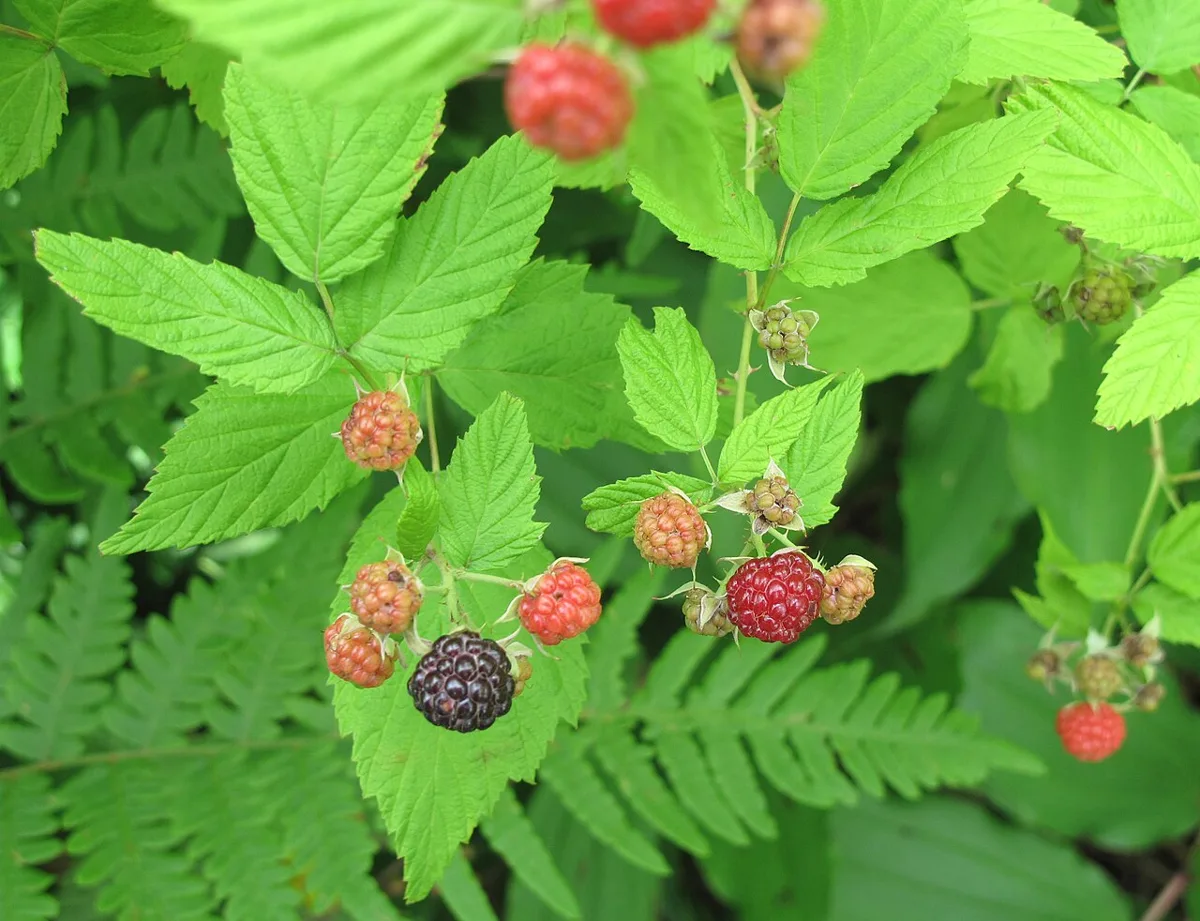
Black Raspberries and Blackberries
Wild brambles - black raspberries in early July, red raspberries, then blackberries into August - told apart by the hollow raspberry and the solid-cored blackberry. No dangerous look-alikes; just thorns, ticks, and timing.
- 4 min
- 8 steps
- 3 questions
- Lesson 25 of 49
In this lesson
- The brambles
- Black raspberries
- Red raspberries
- Blackberries
- Telling them apart
- Picking
- Using them
- What to take from this
Picking up where you left off.
The brambles
Wild brambles (Rubus) are thorny, arching canes with compound leaves and five-petaled white flowers. Each cane lives two years: it grows leaves the first year and flowers and fruits the second, then dies. They’re among the easiest and safest wild foods; there are no poisonous look-alikes among Wisconsin’s aggregate berries.
Wild fruits are explicitly allowed on DNR land for personal use 1, and berry picking is the most common foraging in Wisconsin.
Black raspberries
Black raspberries (Rubus occidentalis), or blackcaps, grow along woods edges, fencerows, and clearings, especially in southern and central Wisconsin.
- Canes: arching, often rooting where the tips touch the ground, with a whitish, waxy bloom that rubs off, and scattered hooked prickles.
- Leaves: usually three leaflets, white and woolly underneath.
- Fruit: ripens red, then purplish black, around early July. A ripe berry is dull black and drops into your hand with a light touch.
- Flavor: rich, sweeter and more intense than a red raspberry.

Quick check
Blackberries have big thorns; black raspberries’ canes have a whitish bloom.
Red raspberries
Wild red raspberries (Rubus idaeus) grow in sunny clearings, cutovers, and burns, and they’re especially abundant in the north, often in great thickets after logging. They ripen in July, overlapping the blackcaps. Canes are bristly rather than strongly thorny, and the leaves are white underneath.
Blackberries
Blackberries (several Rubus species, mostly R. allegheniensis and its relatives) grow in old fields, clearings, and woods edges across the state.
- Canes: stout, ridged, with large, stout prickles; no bloom.
- Leaves: three to five leaflets, green beneath.
- Fruit: ripens from red to glossy black from late July through August, and the berries are larger than raspberries.
- Ripe test: a ripe blackberry turns dull and falls off with a gentle pull; glossy ones are often still tart.
Dewberries are trailing, ground-running blackberries of sandy soils, with fewer, larger drupelets.
Telling them apart
The decisive test is the core (the receptacle):
- A raspberry pulls away hollow, like a thimble, leaving the white core on the plant.
- A blackberry breaks off with the core inside, so the fruit is solid.
Black raspberries also have the whitish waxy canes and white leaf undersides that blackberries lack.
Quick check
Raspberries separate from the receptacle (the core) when picked. Blackberries break off with the core inside the fruit.
Picking
- Dress for it: long sleeves and pants against thorns, poison ivy, and nettles that share the habitat, and check for ticks afterward. Wisconsin’s deer ticks carry Lyme disease.
- Pick into a shallow container; raspberries crush under their own weight. A container hung from your belt frees both hands.
- Go early in the day, and come back every two or three days in season; berries ripen in waves.
- Leave plenty. Birds, bears, and other animals depend on them. Bears love berry patches in the north; make noise.
- Find patches in winter by their canes, and in spring by their flowers.
Using them
Raspberries and blackberries are best eaten the day they’re picked; they mold quickly. Don’t wash until just before using.
- Fresh, on cereal or with cream.
- Jam and jelly: black raspberry jam is a Wisconsin farmhouse classic, and blackberries make good seedless jelly.
- Pies and cobblers.
- Freeze them spread on a tray, then bag them.
What to take from this
Brambles are safe and abundant: black raspberries with whitish canes and white leaf undersides ripen around early July, red raspberries in July (especially up north), and blackberries with big thorns from late July into August. Raspberries come off hollow; blackberries keep their core. Dress for thorns and ticks, pick into shallow containers, and leave plenty for wildlife.
Practice
Black raspberries come first, around the Fourth of July; red raspberries overlap; blackberries follow from late July into August.
Lesson complete
Nice work.
Sources for this lesson
- 1Wis. Admin. Code NR 45.04: Protection of natural resources (department lands). Wisconsin Legislature. verifiedNR 45.04(1)(a) bars removing natural growth from DNR lands; (1s) allows collecting edible fruits, edible nuts, wild mushrooms, wild asparagus, and watercress by hand for personal consumption, and removing listed invasive herbaceous plants. Cited at: NR 45.04(1s).
Further reading
- Samuel Thayer. The Forager's Harvest: A Guide to Identifying, Harvesting, and Preparing Edible Wild Plants. Forager's Harvest Press. 2006. verifiedWisconsin forager's in-depth plant chapters, with sections on identification, safety, conservation, and harvest methods.