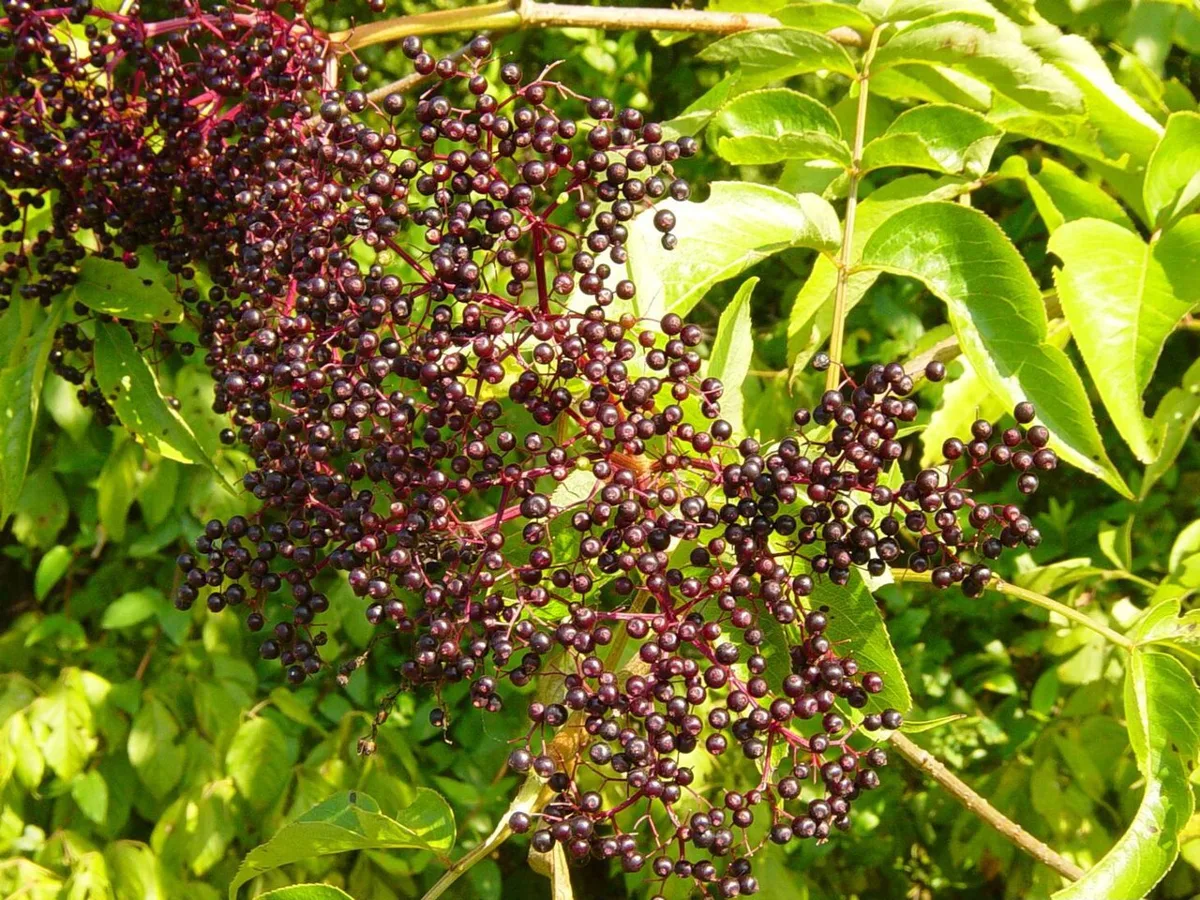
Elderflower and Elderberry
American elder gives flat clusters of cream flowers in June and purple-black berries in late August. Cook the berries, strip every stem, and know the difference from red elderberry and water hemlock.
- 4 min
- 5 steps
- 3 questions
- Lesson 27 of 49
In this lesson
- The plant
- Look-alikes
- Elderflowers
- Elderberries
- What to take from this
Picking up where you left off.
The plant
American elder, or elderberry (Sambucus nigra ssp. canadensis, long called Sambucus canadensis), is a native shrub of moist ground: stream banks, wet ditches, woods edges, and fencerows, throughout Wisconsin.
- Form: a multi-stemmed shrub 5 to 12 feet tall, spreading in thickets.
- Stems: woody, with corky bumps (lenticels) on the bark and a wide white pith inside young stems.
- Leaves: opposite, compound, with 5 to 11 toothed leaflets.
- Flowers: broad, flat-topped clusters of tiny cream-white flowers in June and early July.
- Berries: drooping clusters of small, purple-black berries in late August and September.

Look-alikes
- Red elderberry (Sambucus racemosa), common in Wisconsin’s northern and cool woods, blooms earlier, in May, in dome- or pyramid-shaped clusters, and its berries turn red in early summer. They’re considered toxic raw and are best avoided.
- Water hemlock grows in the same wet ground and has flat white flower clusters, but it’s a soft-stemmed herb, not a woody shrub, with flowers in true umbels (spokes from one point) and a chambered root. It is deadly 1.
- Pokeweed has purple-black berries in drooping clusters, but on bright magenta stalks, with large alternate simple leaves. Toxic.
Check for woody stems and opposite compound leaves, every time.
Quick check
American elder has flat cream flower clusters in June and purple-black berries in late August.
Elderflowers
Elderflowers smell sweet, faintly of muscat. To harvest:
- Snip whole flower clusters on a dry morning when most flowers are open and fresh, and the pollen is yellow.
- Shake out insects. Don’t wash; it removes the pollen and flavor.
- Use soon, or dry them on screens.
Uses:
- Elderflower cordial (syrup): steep flowers with sugar, water, lemon, and often citric acid for a day or two, then strain.
- Fritters: dip whole clusters in batter, fry, and dust with sugar; eat the flowers and leave the stems.
- Tea and champagne-style fermented drinks.
Stems of the flower clusters aren’t for eating; snip the flowers off as closely as you can, and every cluster you take is a cluster of berries you won’t get.
Elderberries
Elderberries are tart, earthy, and rich, with lots of dark pigment. They have one important rule: cook them.
Raw elderberries contain cyanogenic glycosides, which release cyanide as they’re digested, and the stems and leaves contain much more than the berries. Raw elderberry juice made with stems and leaves made a group of people ill in California, serious enough for hospital care, in a case the CDC reported in 1984. Cooking eliminates the risk 2.
To harvest and process 2:
- Cut whole clusters when all the berries are dark purple-black; green and red berries have more of the toxic compounds.
- Pick in the cool of the day and process soon; elderberries spoil quickly.
- Destem: freeze the clusters, then rub them over a wire rack or a screen set over a pan. The frozen berries drop through, leaving the stems behind. Pick out leftover green berries and bits of stem.
- Cook: simmer the berries before eating, juicing, or drying, then strain out the seeds.
Uses: elderberry syrup, jelly (with added pectin, since elderberries are low in it), pie mixed with apples or with lemon for acidity, wine, and sauce for game.
Quick check
Raw elderberry juice has sent people to the hospital. Cooking destroys the toxic compounds in the berries; stems and leaves have more of them and should be removed.
What to take from this
American elder is a woody shrub of wet ground with opposite leaves of 5 to 11 leaflets, flat cream flower clusters in June, and purple-black berry clusters in late August. Red elderberry blooms earlier in dome-shaped clusters with red berries; skip it. Water hemlock and pokeweed are deadly look-alikes in flower or fruit; check for woody stems and opposite compound leaves. Use elderflowers fresh or dried, and always destem and cook the berries.
Practice
Elder has woody, pithy stems and opposite leaves with 5 to 11 leaflets. Water hemlock is a soft-stemmed herb whose flowers are true umbels.
Lesson complete
Nice work.
Sources for this lesson
- 1Plant of the Week: Spotted Water Hemlock (Cicuta maculata). USDA Forest Service. verifiedLeaf veins end in the notches between teeth; chambered roots; wet ditches, stream banks, and marshes; cicutoxin causes convulsions within an hour; considered the most poisonous plant in the North Temperate Zone.
- 2Play It Safe When Preserving Elderberries (EM 9446). Oregon State University Extension Service. verifiedRaw elderberries, and especially stems and leaves, contain cyanogenic glycosides; cooking makes the berries safe; freeze clusters and rub through a rack to destem.
Further reading
- Samuel Thayer. The Forager's Harvest: A Guide to Identifying, Harvesting, and Preparing Edible Wild Plants. Forager's Harvest Press. 2006. verifiedWisconsin forager's in-depth plant chapters, with sections on identification, safety, conservation, and harvest methods.