Natural Cordage
How cord holds together: fibers, yarns, strands, and opposite twists, testing a plant fiber, which inner barks make cord (basswood above all in Wisconsin), twisting two-ply cord by reverse wrapping, and lashing with sinew and rawhide.
- 5 min
- 7 steps
- 3 questions
- Lesson 44 of 49
In this lesson
- Why cord holds together
- Testing a fiber
- Inner bark
- Reverse wrapping
- Sinew and rawhide
- Try it
- What to take from this
Picking up where you left off.
Why cord holds together
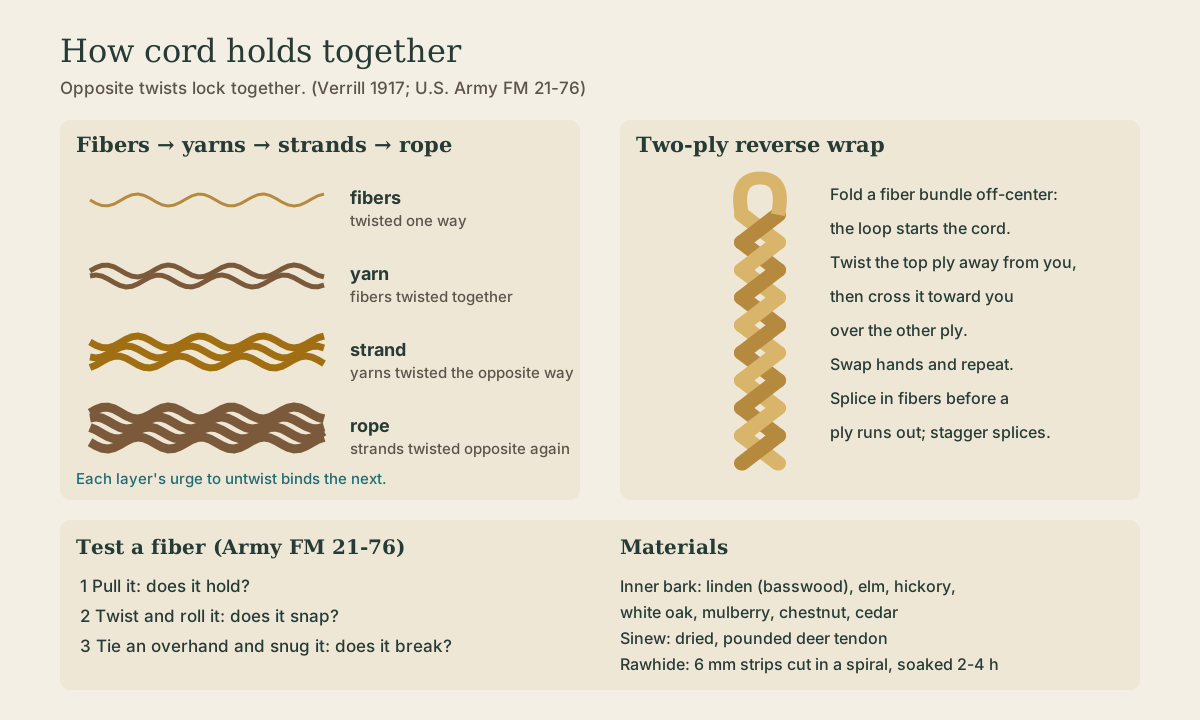
Every rope is built the same way 1:
- Fibers are twisted loosely into a yarn.
- Two or more yarns twisted together, in the opposite direction, make a strand.
- Three or more strands twisted together, opposite again, make a rope.
Because each layer is twisted against the one before it, each one’s urge to untwist is what holds the next one tight 1. Ordinary rope is three-strand and right-hand laid (“with the sun”). Strength depends mostly on the fibers’ strength and length and on how hard each layer is twisted 1.
Hand-twisted cord uses the same trick at a small scale: two plies, each twisted one way, laid around each other the other way.
Quick check
Fibers, yarns, strands, and rope alternate direction at every step.
Testing a fiber
Before spending an hour twisting, test the material 2:
- Pull a length: does it hold?
- Twist it between your fingers and roll the fibers together: does it snap?
- Tie an overhand knot and gently tighten: if the knot doesn’t break, the material is usable.
Quick check
Strength, twistability, and knot strength are what cord needs.
Inner bark
The Army manual lists the inner bark of linden, elm, hickory, white oak, mulberry, chestnut, and red and white cedar, shredded and braided into cord 2. Linden is basswood, common in Wisconsin woods and the classic bark for cordage: strip it in late spring or early summer when the sap is running and the bark peels freely, soak or ret the strips in water for some weeks until the fibrous inner layers separate, and peel them into ribbons. Take bark only from trees you’ve felled or have permission to use; stripping a ring around a standing tree kills it.
Other good fibers: stinging nettle and dogbane stalks (dried, crushed, and stripped of the woody core), and the inner bark of the trees above. Test each with the three steps.
Quick check
Elm, hickory, white oak, mulberry, chestnut, and cedar work too.
Reverse wrapping
Two-ply cord made by reverse wrapping is the basic hand method:
- Take a bundle of fibers and fold it off-center, so the two legs are different lengths (the joins won’t line up later). Pinch the fold.
- Twist the top ply away from you a few turns, then cross it toward you over the other ply. The other ply is now on top.
- Repeat: twist the top ply away, cross it toward you. The twist in each ply and the opposite crossing lock each other, the same principle as rope 1.
- When a ply gets thin, lay new fibers alongside its last few inches and keep twisting them in. Stagger the splices between the two plies.
Keep the twist even; tight, consistent twists make strong cord. Braiding several finished cords together makes them stronger still 2.
Playback is optional. If the player is unavailable, open the video at its source.
Sinew and rawhide
From a deer:
- Sinew: dry the leg and back tendons completely, pound them so they separate into fibers, moisten, and twist into strands. Moist sinew is sticky and shrinks and hardens as it dries, so small lashings need no knots 2.
- Rawhide: scrape off fat and meat, dry the hide, then cut a continuous strip about 6 mm wide in a spiral from the center outward. Soak it 2 to 4 hours until soft, apply it wet and stretched, and it dries hard and tight 2.
Try it
In June, find a basswood that’s been cut or blown down, peel a few strips of bark, and soak them in a bucket of pond water for three to six weeks. Peel the inner fibers into thin ribbons, test them with the three-step test, and reverse-wrap three feet of cord. Then twist a second length from dried nettle stalks and compare: which is stronger with an overhand knot pulled tight?
What to take from this
Rope holds because fibers, yarns, strands, and rope are each twisted opposite to the last. Test a fiber by pulling, twisting, and tying an overhand. The Army manual lists inner bark of linden (basswood), elm, hickory, white oak, mulberry, chestnut, and cedar. Reverse wrap two plies by twisting the top ply away and crossing it toward you, splicing in staggered fibers. Wet sinew needs no knots; rawhide strips about 6 mm wide, soaked 2 to 4 hours, dry tight.
Lesson complete
Nice work.
Sources for this lesson
- 1A. Hyatt Verrill. Knots, Splices and Rope Work. Norman W. Henley (Project Gutenberg edition). 1917. verifiedFibers twist into yarns, yarns into strands the opposite way, strands into rope opposite again, so each layer's tendency to untwist binds the whole; standing part, bight, and end; whip rope ends; overhand and figure-eight knots; square knot tied left over, right over, versus the granny; square and reef knots slip between ropes of unequal size; weaver's knot for small line; two half hitches; clove (builder's) hitch; timber hitch; rolling hitch; the bowline, which never slips or jams and is easily untied; bowline on a bight.
- 2Department of the Army. FM 21-76 Survival. U.S. Department of the Army. 1992. verifiedFirecraft: fire triangle of air, heat, and fuel; clear a circle at least 1 m across; no wet or porous rocks (they can explode); green-log platform on snow; tinder, kindling, fuel; char cloth; tepee, lean-to (green stick at 30 degrees pointed into the wind), cross-ditch (about 30 cm across, 7.5 cm deep), and pyramid lays; light from the upwind side; metal match, flint and steel with carbon steel; bow drill dimensions; bank the fire overnight. Shelters: most common error is building too big; avoid dead trees and sites below the high-water mark; poncho lean-to with drip sticks, back to the wind, round turn and two half hitches; up to 80 percent of body heat lost to the ground at rest; field-expedient lean-to with a fire reflector wall; debris hut with at least 1 m of debris and a 30 cm bed.