Natural Navigation
Finding direction without a compass: the shadow-tip method and shadow clock, the watch method and its limits, finding Polaris from the Big Dipper, using the sun's general path through the day, and why natural signs like moss are unreliable.
- 5 min
- 7 steps
- 3 questions
- Lesson 39 of 49
In this lesson
- Shadow-tip method
- The watch method
- Polaris
- The sun’s daily path
- Natural signs: use with care
- Try it
- What to take from this
Picking up where you left off.
Shadow-tip method
The Army’s land navigation manual calls this simple and accurate 1:
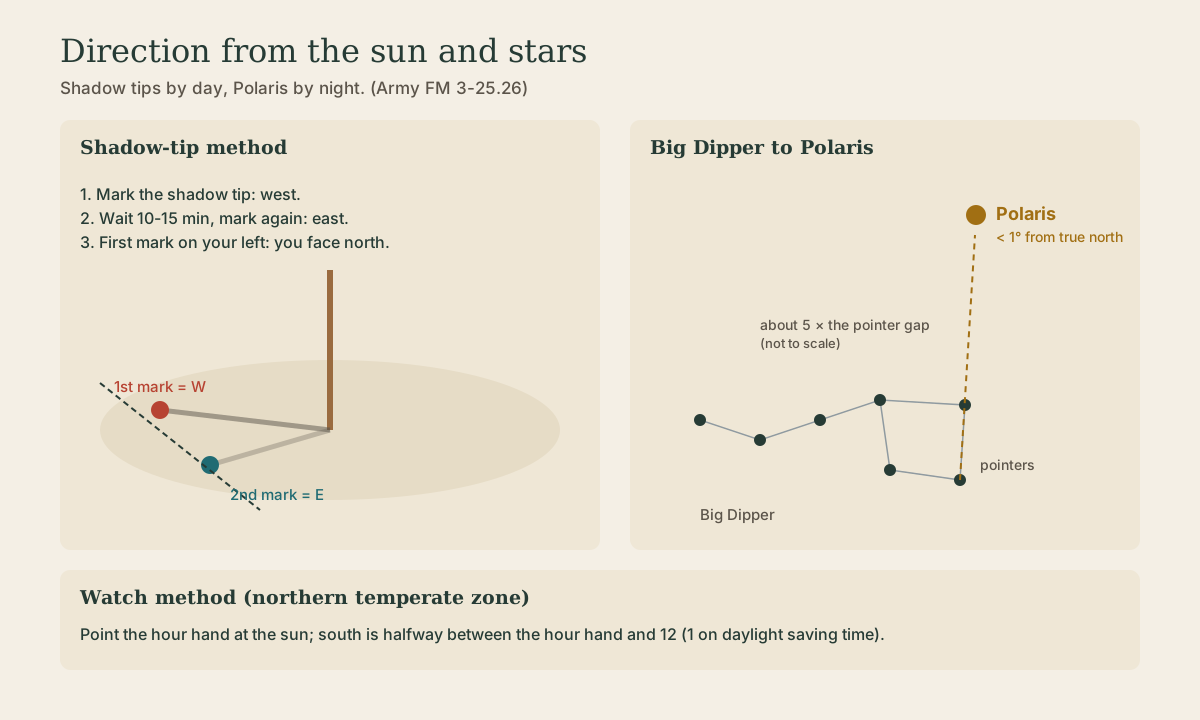
- Push a straight stick into level ground where it casts a clear shadow. Mark the tip of the shadow with a stone or twig. This first mark is always west.
- Wait 10 to 15 minutes, until the tip has moved a few inches, and mark it again. That’s east.
- Draw a line through the two marks: that’s roughly east-west.
- Stand with the first mark on your left and the second on your right: you’re facing north.
A line at right angles to the east-west line is north-south. The rule “first mark west” holds everywhere on earth, because the sun moves east to west and the shadow moves the opposite way 1. It works best when the sun is reasonably high; near sunrise and sunset shadows are long and move fast.
Shadow clock: set the stick upright where the two lines cross. The west end of the east-west line reads 0600 and the east end 1800; the north-south line is noon. It’s a rough clock with 12 unequal “hours” from sunrise to sunset 1.
Playback is optional. If the player is unavailable, open the video at its source.
Quick check
The sun moves east to west, so the shadow tip moves west to east, everywhere on earth.
The watch method
In the northern temperate zone, hold an analog watch flat and point the hour hand at the sun. South is halfway between the hour hand and 12, or 1 on daylight saving time. Before noon the sun is in the east, after noon in the west, which settles any doubt about which end is south 1.
The manual warns it can be well off, especially at lower latitudes, and can lead to walking in circles; use it as a rough check, and reset your watch from a shadow clock as you go 1.
Quick check
Use it as a rough check; set the watch by a shadow clock and recheck.
Polaris
At night, one star stays almost exactly in place: Polaris, the North Star, less than 1° from true north 1.
- Find the Big Dipper. The two stars forming the front edge of the bowl, the side away from the handle, are the Pointers.
- Follow a line through them, from the bottom of the bowl out past the top, about five times their spacing. The moderately bright star there is Polaris, the last star in the handle of the Little Dipper 1.
Polaris isn’t especially bright; many stars outshine it 1. Its value is that it doesn’t move. In Wisconsin it sits about halfway up the northern sky, at an angle roughly equal to your latitude (about 43° to 47°). A star near the northern horizon serves as a guide for about half an hour before you need to recheck 1.
Quick check
Polaris ends the Little Dipper’s handle and sits less than 1° from true north.
The sun’s daily path
In Wisconsin, the sun rises in the east, crosses the southern sky at midday, and sets in the west, rising north of east and setting north of west in summer and south of east and west in winter. At solar noon shadows point north and are shortest. (Solar noon in Wisconsin falls near 12:00 standard time, about 1:00 p.m. on daylight saving time, shifting by up to a quarter hour or so through the year.)
Natural signs: use with care
Moss “on the north side,” tree growth, and anthills are unreliable: moss grows wherever it’s shady and damp, which may be any side of a tree. Larger patterns are better evidence: in Wisconsin, south-facing slopes are drier and warmer (oak and prairie plants on Driftless bluffs; snow melting first), north slopes cooler and wetter, and prevailing west and northwest winter winds shape snowdrifts. Treat all of them as hints, and confirm with the sun or stars.
Try it
On the next sunny day, do the shadow-tip method in the yard and compare the line with a compass corrected for declination (Madison: magnetic north is about 3° west of true). On the next clear night, find Polaris from the Big Dipper and note what’s beneath it on the horizon.
What to take from this
Shadow-tip: mark the shadow tip (west), wait 10-15 minutes, mark again (east); first mark on your left, you face north. The watch method (hour hand at the sun, south halfway to 12, or 1 in daylight time) is a rough check that can mislead. At night, follow the Big Dipper’s pointers about five gaps to Polaris, within 1° of true north. At midday the sun is due south and shadows point north. Moss and other signs are weak evidence.
Lesson complete
Nice work.
Sources for this lesson
- 1FM 3-25.26 Map Reading and Land Navigation. Headquarters, Department of the Army. 2005. verifiedTerrain features in contours: hill, saddle (hourglass), valley (closed end of U or V points upstream), ridge (points away from high ground), depression (tick marks to low ground), draw, spur, cliff; pace count: about 30-in. pace, count per 100 m on similar terrain, longer downhill and shorter uphill or in snow; deliberate offset about 10°, 18 m per degree per 1,000 m; bypassing obstacles at right angles; handrails, catching features, attack points within 500 m; shadow-tip method (first mark west, wait 10-15 minutes); watch method; Polaris less than 1° from true north, found by the Big Dipper's pointers at five times their spacing.