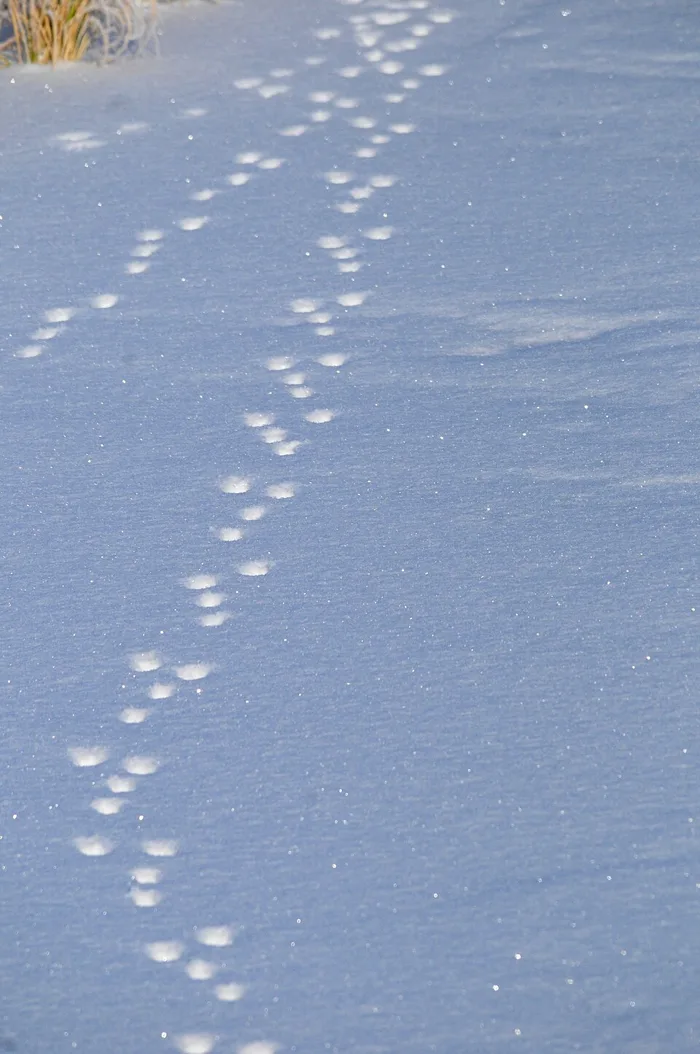
Tracks and Sign in the Winter Woods
Reading the snow: the four track patterns (diagonal walkers, pacers, bounders, gallopers) that sort Wisconsin mammals before you ever measure a print; deer versus rabbit browse; the subnivean zone near 32 °F where mice and voles live all winter; what chickadees, cottontails, and woodchucks are doing; and how the DNR's 17,771 miles of winter snow-track surveys turn into the state's wolf estimate.
- 5 min
- 6 steps
- 4 questions
- Lesson 13 of 49
In this lesson
- Four patterns
- Browse and other sign
- Under the snow
- Tracking for science
- Try it
Picking up where you left off.
Fresh snow turns the woods into a record of who went where overnight. You don’t need to identify every print to read it. Start with the pattern the trail makes, then the size, then where it goes. That gets you most of the way, and the details come with practice.
Four patterns
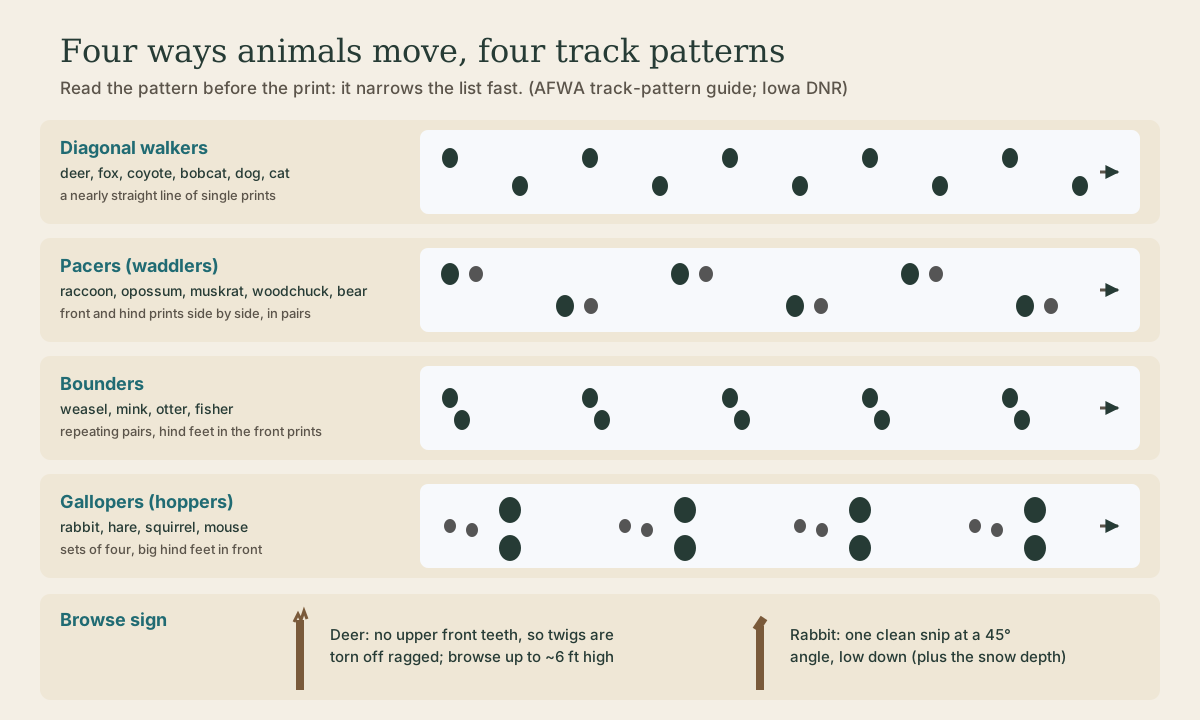
Animals move in a few basic ways, and each leaves its own pattern 1:
- Diagonal walkers (“perfect steppers”): long legs, front and hind feet alike. The hind foot lands in the front foot’s print, so the trail is a nearly straight line of single prints. Deer, fox, coyote, bobcat, and dogs and cats walk this way 1. A fox’s line is neater and narrower than a dog’s, which wanders.
- Pacers (waddlers): wide, heavy bodies on short legs move both legs on one side together, leaving a front and a hind print side by side in pairs. Raccoon, opossum, muskrat, woodchuck, and bear 1.
- Bounders: long bodies and short legs. They leap and land with the hind feet in or next to the front prints, leaving repeating pairs or clusters. Weasel, mink, otter, and fisher 1. An otter will also slide on its belly down banks.
- Gallopers (hoppers): big hind feet, small front feet. The hind feet swing past the front and land ahead and outside, so each set is four prints with the two big ones in front 1. Rabbits, hares, squirrels, and mice. A squirrel’s trail goes tree to tree; a rabbit’s goes brush to brush.
.jpg)
Quick check
Walkers put the hind foot into the front print, so the trail reads as single prints in a line.
Quick check
The big hind feet swing past and land ahead of the small front feet.
Browse and other sign
Twigs tell you who’s been eating. Deer have no upper front teeth: they pinch a twig between their lower incisors and the hard pad above and tear it, so browsed twigs have ragged, torn ends 2. Rabbits bite each twig off with one clean cut at a 45° angle 2, and only as high as they can reach from the snow surface. Deep snow lets them reach higher. Bark gnawed off at the base of young trees, discovered after snowmelt, is usually voles working out of sight under the snow 2.
Deer readily browse arborvitae and white pine, and in deep-snow winters they’ll strip them 2. A sharp browse line in a cedar swamp or a stand of hemlock, with everything bare below about 6 feet, means too many deer for too long.
Quick check
Rabbits cut cleanly at a 45° angle, and only as high as they can reach from the snow.
Under the snow
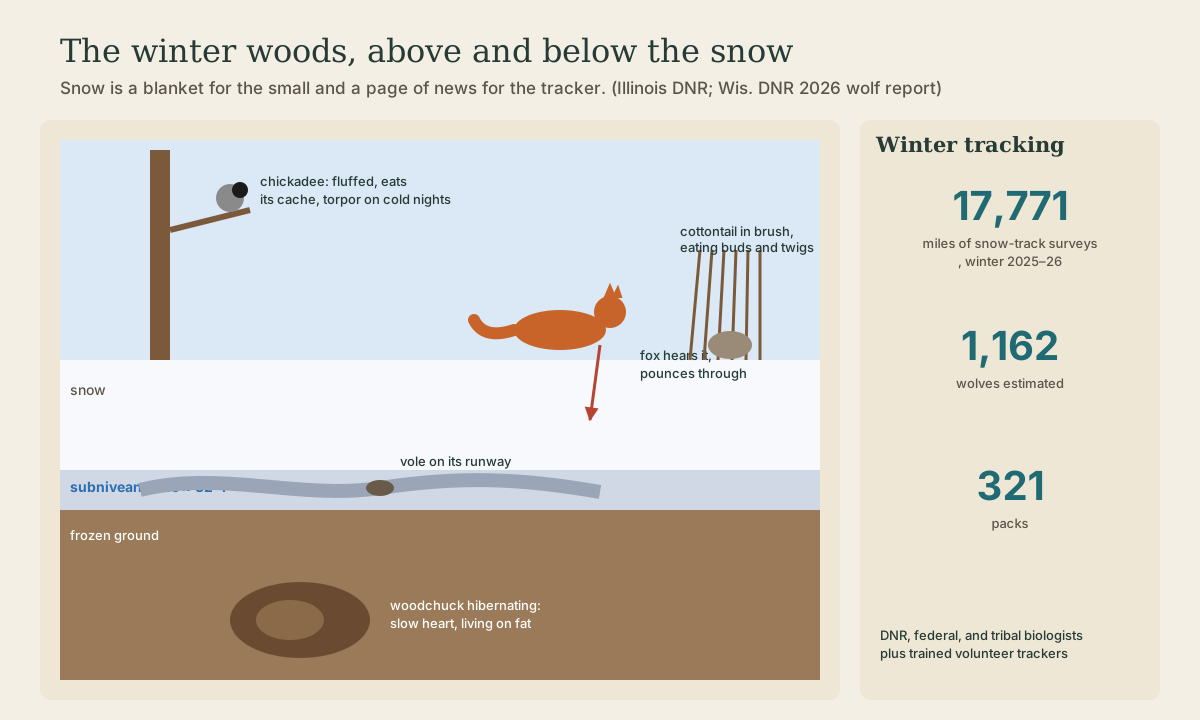
Snow is an insulating blanket. Once it’s deep, the space between its bottom and the frozen ground, the subnivean zone, stays near 32 °F however cold the air gets, because heat from the earth is trapped beneath it 3. Mice and voles live there all winter, running tunnels between their nests and food caches. You see their runways only when the snow melts 3.
Predators know it. A fox or coyote stands still, listens for a vole moving under the snow, then leaps and dives in nose-first 3. A trail that stops at a small crater with a body print in it is a fox’s hunting record.
Above the snow, others get by in their own ways 3:
- Chickadees live on seeds they cached in fall, fluff their feathers, and on very cold nights let their body temperature drop into torpor.
- Cottontails stay active, sheltering in thick brush and eating buds and twigs.
- Woodchucks are true hibernators: heart, breathing, and temperature all turned down in a burrow below the frost, living on fat until spring.
Quick check
That’s the subnivean zone; foxes and coyotes hear them moving and pounce through the snow.
Tracking for science
Wisconsin counts its wolves largely by reading snow. Every winter, DNR, federal, and tribal biologists and trained volunteer trackers survey assigned blocks after fresh snow, recording wolf and other carnivore tracks. In winter 2025–26 they covered 17,771 miles of track surveys, the central input to the model behind the estimate of 1,162 wolves in 321 packs 4. Volunteers take a series of courses to be certified and then run at least three surveys a winter on their blocks.
Playback is optional. If the player is unavailable, open the video at its source.
Try it
The morning after the next fresh snow, walk a field edge or a creek. For each trail, decide the pattern first: line, pairs, clusters, or fours. Then follow one trail as far as you can and write down what the animal did: where it stopped, ate, dug, or met something else. Check the low twigs of any saplings along the way for ragged or clean-cut ends.
Lesson complete
Nice work.
Sources for this lesson
- 1Animal Locomotion and Track Patterns: 4 Basic Gaits. Association of Fish and Wildlife Agencies (conservation education). verifiedPacers (waddlers): wide, heavy bodies and short legs, front and hind feet shaped differently; front and hind prints right next to each other; raccoon, opossum, muskrat, groundhog, bear. Diagonal walkers (perfect steppers): long legs, front and hind feet similar; a nearly straight line of single prints; human, deer, dog, cat. Bounders: long bodies, short legs, feet similar; repeating sets with hind tracks near front tracks; river otter, weasel, fisher. Gallopers (hoppers): large hind feet and small front feet; sets of four with the hind tracks ahead of and outside the front; rabbit, hare, squirrel, mice.
- 2Depredation Whodunnit: Tree Damage. Iowa Department of Natural Resources. verifiedDeer chew woody plants with lower incisors against an upper gum with no teeth, so browsed branches look roughly cut or torn; rabbits bite off smaller stems with one clean cut at a 45-degree angle; voles damage trees out of sight under the snow; deer readily browse arborvitae and white pine, heavily in deep-snow winters.
- 3Winter in Illinois: The Subnivean Zone. Illinois Department of Natural Resources. verifiedThe subnivean zone is the insulated space between snow and frozen ground; heat from the earth trapped by snow keeps it near 32 F; mice and voles tunnel to food caches and their trails show after melt; foxes and coyotes hear them and pounce. Chickadees cache food, fluff up, and can drop into torpor on very cold nights; cottontails stay active in thick brush eating buds and twigs; woodchucks are true hibernators; salamanders brumate below the frost line; only bumble bee queens overwinter.
- 4Wisconsin Gray Wolf Monitoring Report, April 15, 2025 to April 14, 2026. Wisconsin Department of Natural Resources. 2026. verifiedIn winter 2025-26 DNR, federal, tribal, and contracted biologists with volunteer citizen scientists conducted over 17,771 miles of track surveys; the Winter Carnivore Snow Tracking Program surveys wolves and other carnivores and is a central input to the scaled occupancy model; estimate 1,162 pack wolves (95% CI 1,026-1,307) in 321 packs (287-359).