Identifying Wisconsin Trees
A three-question key for the common Wisconsin trees: count the needles in a bundle (white, red, and jack pine, tamarack); check whether leaves and buds are opposite or alternate (maples, ashes, and dogwoods are opposite); then read simple versus compound and the lobes, which separate the oaks, maples, walnut, ash, birch, aspen, and basswood, in summer or in winter.
- 5 min
- 8 steps
- 3 questions
- Lesson 3 of 49
In this lesson
- Needles: count the bundle
- Broad leaves: opposite or alternate
- Simple or compound
- The oaks
- Birch, aspen, and basswood
- In winter
- Try it
- What to take from this
Picking up where you left off.
Needles: count the bundle
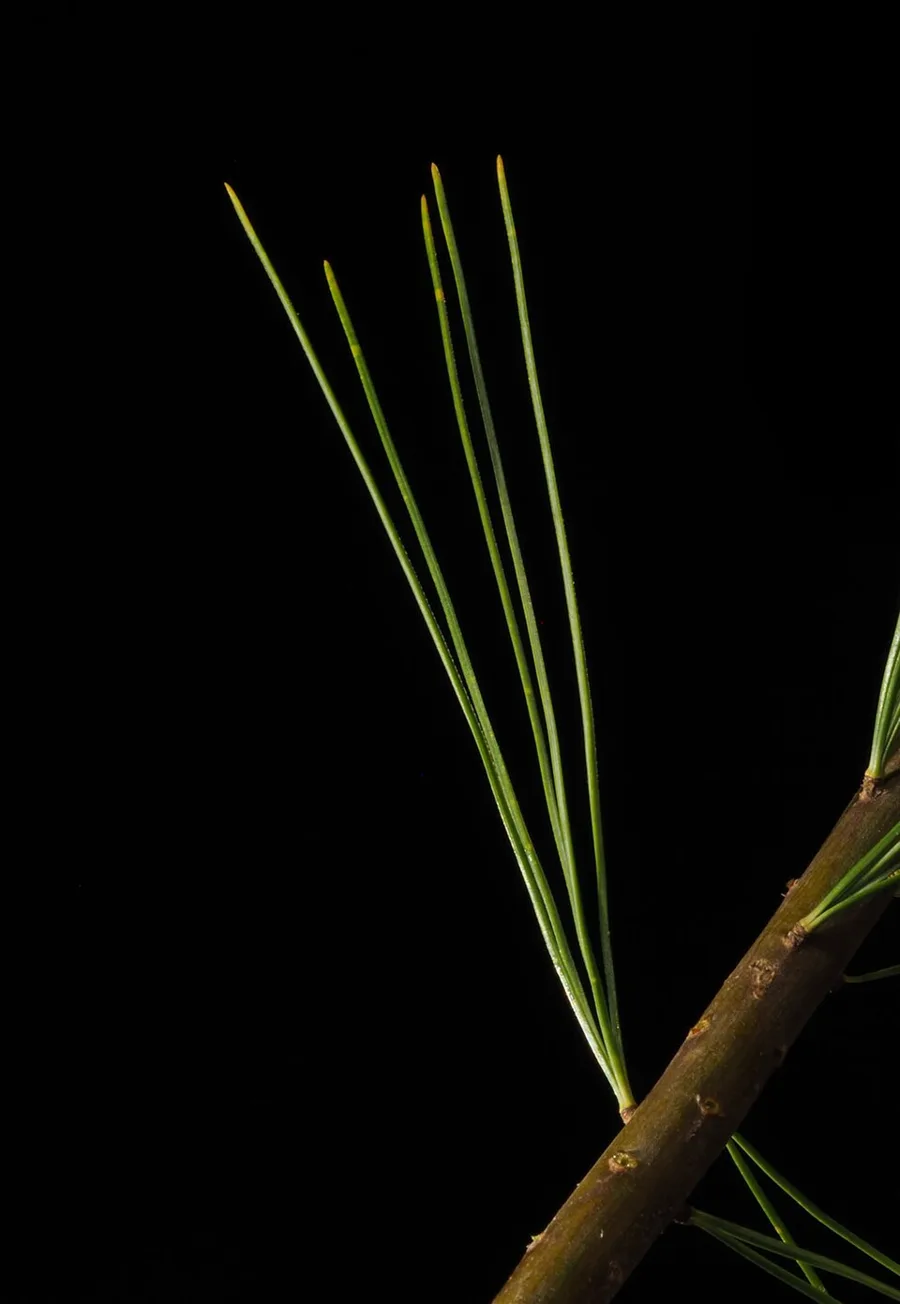
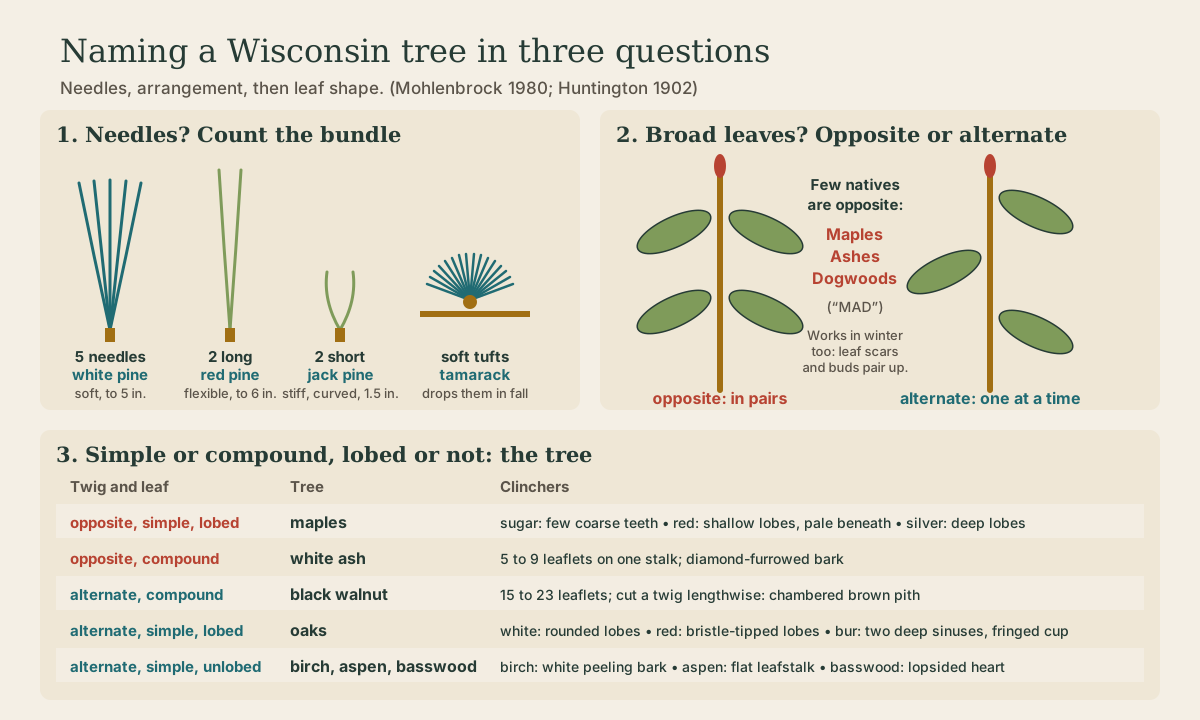
Start with the biggest split: needles or broad leaves. Among the needle trees, the pines carry their needles in bundles (fascicles) wrapped at the base, and the number per bundle sorts them 1:
- White pine: five needles to a bundle, soft and flexible, up to 5 inches, blue-green. Cones up to 8 inches long. Five needles, five letters: W-H-I-T-E.
- Red pine: two needles, long (up to 6 inches) and flexible. Cones without prickles.
- Jack pine: two needles, short (about 1½ inches), stiff, and curved. Small curved cones with prickles.
- Tamarack: soft, pale needles about an inch long in tufts of many on short spurs. It’s a conifer that drops all its needles in autumn, so a bare “dead” conifer in a bog in November is usually a tamarack.

Quick check
Red pine also has two per bundle, but long (to 6 inches) and flexible. White pine has five.
Broad leaves: opposite or alternate
Look at how the leaves (or, in winter, the buds and leaf scars) sit on the twig. Opposite: in pairs, directly across from each other. Alternate: staggered, one at each node, spiraling up the twig 2.
Most trees are alternate. Huntington, working through northeastern trees in winter, noted that flowering dogwood was “the only native tree in our climate, besides the maple and ash,” with opposite leaf scars 2. That gives the mnemonic MAD Horse: Maples, Ashes, Dogwoods, and planted horsechestnut. If a big tree is opposite, it’s almost certainly a maple or an ash.
Simple or compound
A simple leaf has one blade on its stalk. A compound leaf has several leaflets on one stalk. To tell a leaflet from a leaf, find the bud: a bud sits where a whole leaf joins the twig, never at the base of a leaflet.
Combine this with arrangement 1:
- Opposite and compound: white ash, with 5 to 9 leaflets and bark furrowed into a diamond pattern.
- Opposite and simple: the maples. Sugar maple has 3 to 5 lobes with a few coarse teeth and sharp-pointed buds. Red maple has shallow lobes with whitish undersides, and red flowers in late winter before any leaves. Silver maple has very deeply cut lobes.
- Alternate and compound: black walnut, with 15 to 23 leaflets. Slice a twig lengthwise and the pith is brown and chambered, divided into little cells 1 2.
Quick check
Few native trees are opposite (maples, ashes, dogwoods), and of those only the ash has compound leaves. Walnut’s compound leaves are alternate.
The oaks
Oaks are alternate and simple with lobed leaves, and they come in two groups that matter in the woodshop as well as the woods 1:
- White oak: 7 to 9 rounded lobes, no bristles.
- Red oak: 7 to 11 lobes, each lobe ending in bristle tips.
- Bur oak (white oak group): rounded lobes with a pair of deep sinuses near the middle nearly cutting the leaf in two, and a big acorn whose fringed, mossy cup covers half or more of the nut.
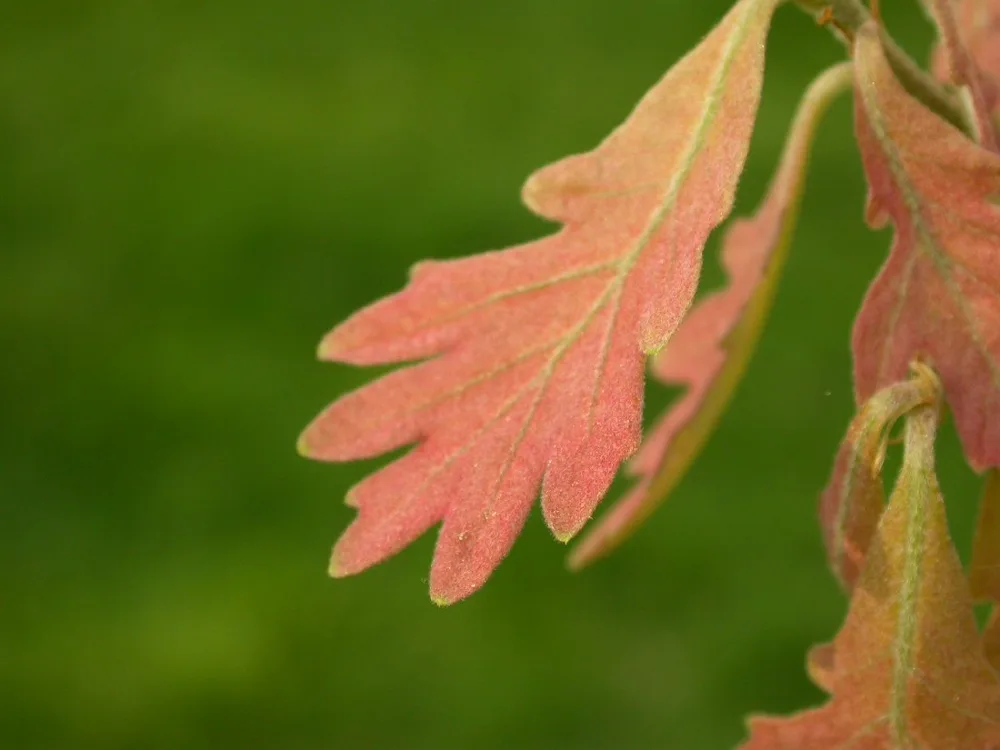

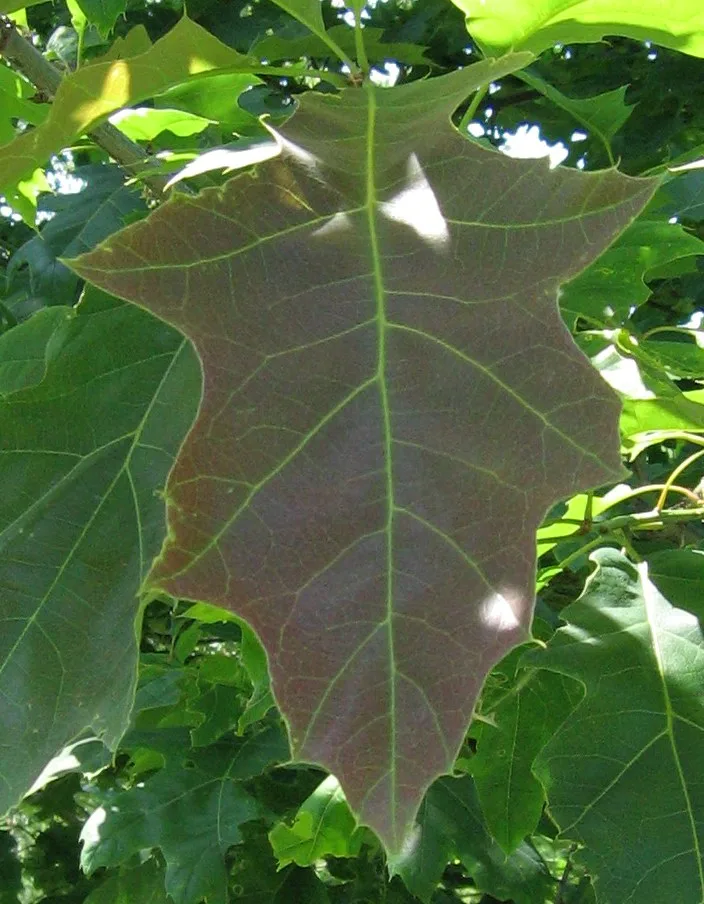

The split carries into the lumber: white oak’s pores are plugged with tyloses, so it holds water and resists rot, while red oak’s pores are open 3. Rounded lobes on the tree mean barrel stock; bristles mean indoor wood.
Quick check
Bur oak, in the white oak group, has rounded lobes too, plus a pair of deep middle sinuses and a fringed acorn cup.
Birch, aspen, and basswood
Alternate, simple, and not lobed 1:
- Paper birch: white bark that peels in papery sheets.
- Quaking aspen: a flattened leafstalk, which is why the leaves tremble in the slightest breeze. Pale, smooth bark.
- Basswood: large heart-shaped leaves with a lopsided base, one side lower than the other. In summer its flowers hang from a strap-shaped leafy bract.
In winter
The key still works with the leaves gone. Leaf scars and buds keep the arrangement: opposite or alternate 2. Pines keep their bundles; tamarack doesn’t. Sugar maple’s buds are sharply pointed, walnut’s pith stays chambered, and paper birch’s bark is unmistakable in any season 1.
Playback is optional. If the player is unavailable, open the video at its source.
Try it
On your own land, or a woodlot walk, pick ten trees and run the key: needles or leaves, opposite or alternate, simple or compound, lobes. Write each name on a scrap of flagging tape. Then do the same ten in February from the buds and bark alone, and see which ones you can still name.
What to take from this
Pines sort by needles per bundle: five for white pine, two long for red, two short and curved for jack; tamarack has soft tufts and drops them in fall. Among broadleaf trees, check arrangement first: opposite means maple, ash, or dogwood (“MAD Horse”). Opposite and compound is ash; alternate and compound with 15 to 23 leaflets and chambered pith is black walnut. Oaks are alternate and lobed: rounded lobes for white oak and bur oak, bristle tips for red oak. Paper birch, aspen, and basswood are alternate and unlobed, told apart by bark, flattened leafstalk, and lopsided heart. Buds, scars, and bark carry the key through winter.
Lesson complete
Nice work.
Sources for this lesson
- 1Robert H. Mohlenbrock. Forest Trees of Illinois (3rd edition). Illinois Department of Conservation, Division of Forest Resources. 1980. verifiedWhite pine: needles 5 per bundle, flexible, to 5 in., blue-green; cones to 8 in. Red pine: needles 2 per bundle, flexible, to 6 in. Jack pine: needles 2 per bundle, stiff, curved, to 1.5 in.; curved prickly cones. Tamarack: soft needles in clusters about 1 in. long on short spurs, shed in autumn; bogs. Sugar maple: opposite leaves with 3 to 5 lobes and few coarse teeth, pointed buds. Red maple: shallowly lobed leaves whitish beneath, red flowers in late winter. Silver maple: deeply lobed leaves. White oak: 7 to 9 rounded lobes without bristles. Red oak: 7 to 11 bristle-tipped lobes. Bur oak: two deep middle sinuses, fringed acorn cup covering half or more of the nut. Paper birch: white papery bark. Quaking aspen: flattened leafstalk. Basswood: heart-shaped leaves with an asymmetrical base; flowers hang from a leafy bract. White ash: opposite compound leaves of 5 to 9 leaflets; diamond-furrowed bark. Black walnut: alternate compound leaves of 15 to 23 leaflets; chambered brown pith.
- 2Annie Oakes Huntington. Studies of Trees in Winter. Knight and Millet. 1902. verifiedLeaf scars may be opposite, as in horsechestnut, maples, and ashes, or alternate, as in hickories, walnuts, and oaks; flowering dogwood is the only native tree in the region besides maple and ash with opposite leaf scars; walnuts have chambered pith, seen by cutting a twig lengthwise.
- 3R. Bruce Hoadley. Understanding Wood: A Craftsman's Guide to Wood Technology. Taunton Press. 2000. verifiedThe woodworker's standard on wood structure, moisture, shrinkage, and drying.