Prairie and Oak Savanna
Southern Wisconsin's original landscape: about 2 million acres of prairie and a savanna of scattered open-grown bur, white, and black oaks covering about 30 percent of the south, both held open by frequent fire. Plowing and the end of fire left about 0.1 percent of the prairie and 0.01 percent of the savanna. How to recognize remnants and old open-grown oaks, and how restoration with fire began at the UW Arboretum.
- 5 min
- 8 steps
- 3 questions
- Lesson 4 of 49
In this lesson
- Three landscapes
- The tension zone
- Fire made them
- What happened to them
- Reading an old oak
- Bringing them back
- Try it
- What to take from this
Picking up where you left off.
Three landscapes
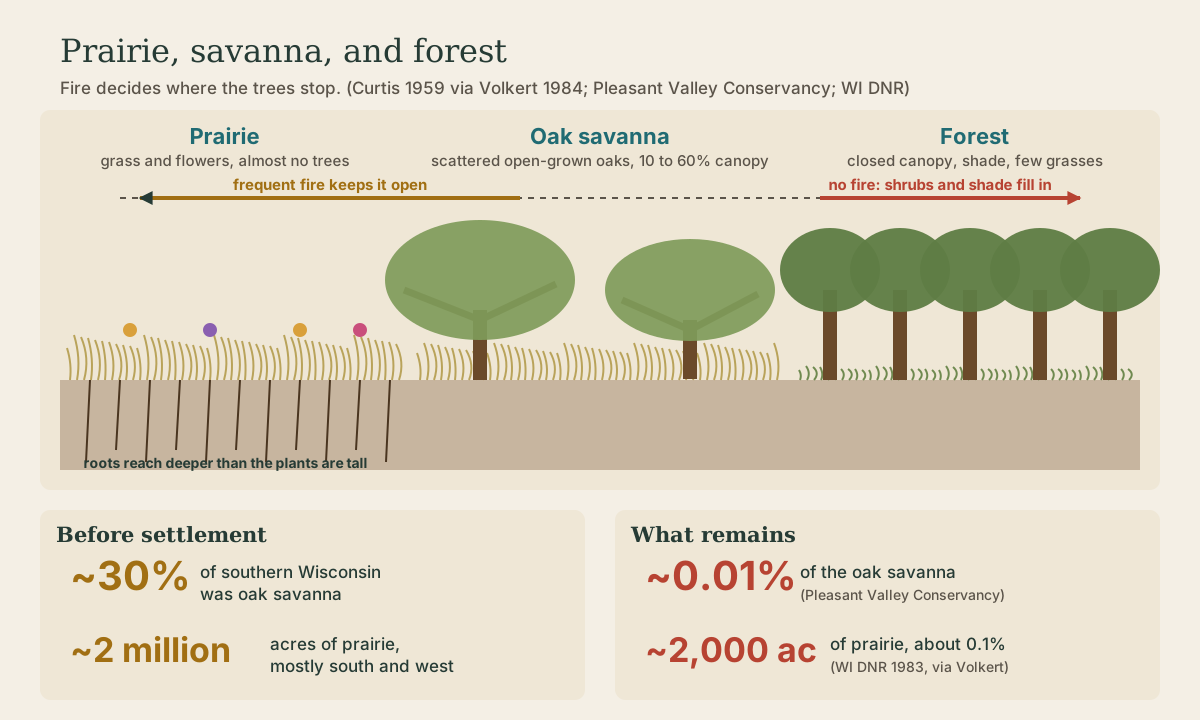
Picture a line running from open grassland into deep woods 1:
- Prairie: grasses such as big bluestem and little bluestem, with wildflowers among them and almost no trees.
- Oak savanna: scattered big oaks with a grassy, flowery ground layer under and between them. The tree crowns cover about 10 to 60 percent of the sky.
- Forest: a closed canopy approaching 100 percent, deep shade, and few grasses.
In southern Wisconsin before settlement, the middle of that line was the most common landscape. About 30 percent of southern Wisconsin was oak savanna 1, and prairie covered an estimated 2 million acres 2. The savanna oaks were bur, white, and black oaks, growing wide and low in the sun 3.
Quick check
A forest’s canopy approaches 100 percent, and the shade keeps most prairie grasses and flowers out.
The tension zone
The botanist John Curtis mapped a diagonal band across the state called the tension zone, running roughly from the St. Croix River in the northwest down to Lake Michigan north of Milwaukee. Southwest of it lies the prairie-forest province, the country of prairie, savanna, and oak; northeast of it, the northern hardwoods of maple, hemlock, and pine. Wisconsin’s prairies grew mainly south of the tension zone 2.
Fire made them
Prairie and savanna were held open by frequent fire. Grassland fires sweep through quickly, and prairie plants come back fast because most of a prairie plant is underground: deep roots and buds below the reach of the flames 4. Big bluestem and many prairie flowers send roots far deeper than the plants stand tall.
The savanna oaks survive too. Bur oak in particular has thick, corky bark that insulates the living layer beneath. Fire-sensitive trees such as elm, maple, and ash do not 1. So each fire knocked back the shrubs and young fire-sensitive trees, while the oaks and the grasses carried on.
Take away the fire and the line slides toward forest. Shrubs and shade-tolerant trees fill in, the canopy closes, and the grasses and flowers die out in the shade 1.

Quick check
Without fire, woody plants fill in and close the canopy.
What happened to them
Two things happened at once after settlement. The deep, black prairie soils were some of the best farmland on the continent, so the prairie was plowed. And fires were stopped, so the savannas that weren’t cleared grew up into closed oak woods.
The losses were nearly total. From about 2 million acres of prairie, Wisconsin had little more than 2,000 acres left by the 1980s, roughly 0.1 percent 2. In Fond du Lac County alone, about 25,000 acres of prairie and 110,000 acres of savanna had probably shrunk to fewer than ten acres of prairie 2. Of the oak savanna, about 0.01 percent remains 1.
Reading an old oak
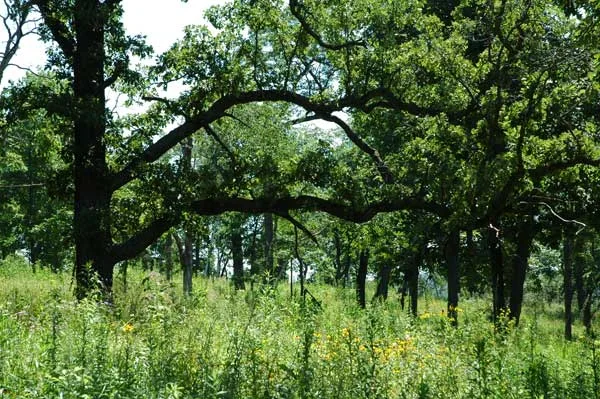
The savanna isn’t completely gone, though; it’s often hiding inside the woods. An oak that grew up in the open develops a short trunk and huge, low limbs reaching sideways toward the sun. An oak that grew up in forest shade is tall and straight, with a narrow crown and few low limbs.
So when you find a giant oak with thick limbs spreading out low, surrounded by younger, skinnier trees, you’re looking at a survivor of the savanna that the forest grew up around. At Franklin Savanna, the big bur, white, and black oaks still show “the spreading branching pattern” of their open past 3.
Quick check
Oaks grown in forest shade are tall with narrow crowns and few low limbs.
Bringing them back
Wisconsin is where prairie restoration began. At the UW–Madison Arboretum, Curtis Prairie, started as experimental plots in 1935, is regarded as the oldest restored prairie in the world. The Arboretum studied fire ecology and tested prescribed burning, with Aldo Leopold leading controlled burns in the early 1940s. Greene Prairie was hand planted by Henry Greene over two decades starting in 1943 5.
The recipe for savanna restoration is the same today: cut and remove the brush and fire-sensitive trees, burn regularly, and seed native grasses and flowers back in 3. Without fire it rarely works 1.
Playback is optional. If the player is unavailable, open the video at its source.
Playback is optional. If the player is unavailable, open the video at its source.
Try it
Walk Curtis Prairie and Greene Prairie at the Arboretum in Madison in August, when big bluestem is taller than you. Then go find an oak with big, low, spreading limbs inside a woodlot near you, and look at the trees around it: if they’re all younger and skinnier, you’ve found an old savanna.
What to take from this
Before settlement, about 30 percent of southern Wisconsin was oak savanna, with bur, white, and black oaks covering 10 to 60 percent of the sky over grasses and flowers, and about 2 million acres were prairie, mostly south of the tension zone. Frequent fire held both open: deep-rooted prairie plants and thick-barked oaks survive it, and shrubs and fire-sensitive trees don’t. Plowing and fire suppression left about 0.1 percent of the prairie and 0.01 percent of the savanna. Old open-grown oaks with low, spreading limbs mark savanna that became forest. Restoration, born at the UW Arboretum in 1935, means brush removal, seeding, and regular fire.
Lesson complete
Nice work.
Sources for this lesson
- 1Oak Savannas. Pleasant Valley Conservancy. verifiedSavanna canopy ranges from 10 to 60 percent, versus near 100 percent in forest; about 30 percent of southern Wisconsin was originally oak savanna, and about 0.01 percent remains; oaks are fire-resistant while invaders such as elm, maple, and ash are not; without fire, woody growth closes the canopy and shades out the grasses and flowers, and savanna restoration without fire is generally unsuccessful.
- 2William K. Volkert. The Occurrence and Distribution of Prairie-Associated Plants and Remnant Prairie Communities in the Northern Kettle Moraine State Forest. UW-Milwaukee Field Station Bulletin 17(1). 1984. verifiedPrairies in Wisconsin occur mainly south of Curtis's (1959) tension zone, the boundary between the prairie-forest province to the southwest and the northern hardwoods province to the northeast; from an estimated two million acres of presettlement prairie, Wisconsin had little more than 2,000 acres left (DNR 1983); Fond du Lac County once had about 25,000 acres of prairie and 110,000 of savanna, with probably under ten acres of prairie left, lost to farming and development.
- 3Franklin Savanna (State Natural Area No. 409). Wisconsin Department of Natural Resources. verifiedLarge open-grown bur, white, and black oaks with the spreading branches of their former open condition; understory remnants include big bluestem, little bluestem, shooting star, May-apple, and yellow star grass; restoration by removing woody species, prescribed burning, and interseeding natives.
- 4Mary Ann Clark, Matthew Douglas, Jung Choi. Biology 2e. OpenStax (Rice University). 2018. verifiedFree peer-reviewed college biology text; animal form and function, plants, and ecology chapters. Cited at: Terrestrial Biomes.
- 5UW–Madison Arboretum Designated as a National Historic Landmark. UW–Madison Arboretum. verifiedCurtis Prairie, begun as experimental plots in 1935, is regarded as the oldest restored prairie in the world; the Arboretum studied fire ecology and tested prescribed fire, with Aldo Leopold leading controlled burns about 1940 to 1945; Greene Prairie was hand planted by Henry Greene over two decades from 1943; listed as a National Historic Landmark in January 2021.