PCR Variations
Variations built on the basic reaction: multiplex PCR and its balancing act, allele-specific (ARMS) PCR using 3' mismatches, digital PCR's partition-and-count absolute quantification with the Poisson correction, and high-throughput array formats.
- 4 min
- 5 steps
- 3 questions
- Lesson 27 of 60
In this lesson
- Multiplex PCR
- Allele-specific PCR
- Digital PCR
- High-throughput formats
- What to take from this
Picking up where you left off.
Multiplex PCR
Multiplex PCR amplifies several targets in one tube with several primer pairs 1. Respiratory panels detecting a dozen or more viruses, STR identity kits amplifying 20+ loci, and an internal control alongside a target are all multiplexes.
The balancing act:
- All primers must work at one annealing temperature and must not form dimers with each other.
- Targets compete for reagents; an abundant target can suppress a weak one, so primer concentrations are tuned.
- Products are told apart by size (gel or capillary), by dye color (real-time probes in different channels), or by melt temperature or array hybridization.
Each added target multiplies the validation work.
Quick check
Primer concentrations are balanced, and products are separated by size or by dye color.
Allele-specific PCR
Allele-specific PCR (ARMS, amplification refractory mutation system) puts the variant base at a primer’s 3’ end 1. A matched 3’ end extends; a mismatched one doesn’t, because the polymerase needs a paired 3’-OH. Designs often add a deliberate second mismatch a few bases from the 3’ end to sharpen discrimination.
Typical setup: one reaction or primer for each allele, plus a control product to show the reaction worked. Uses include point-mutation genotyping (Factor V Leiden, JAK2 V617F) and detecting a low-level mutation against a large normal background. Proofreading polymerases defeat the design by trimming the mismatched 3’ base, so ARMS uses Taq-type enzymes.
Quick check
An extra deliberate mismatch near the 3’ end sharpens discrimination.
Digital PCR
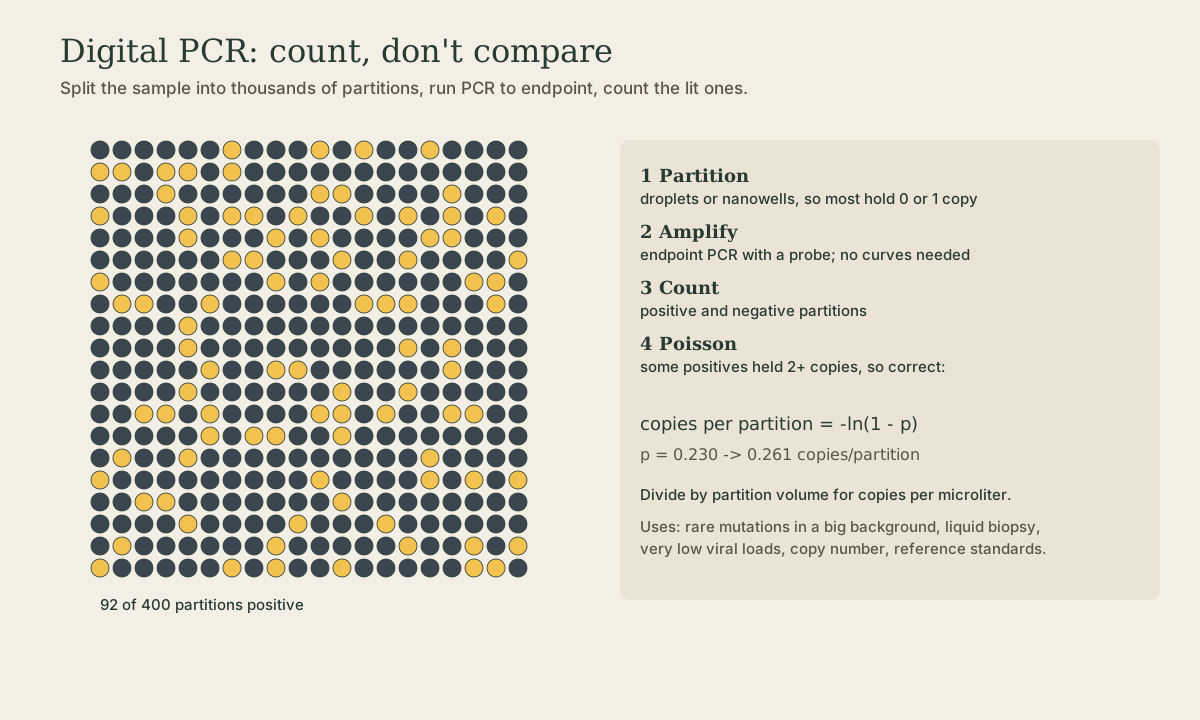
Digital PCR (dPCR) splits the reaction into thousands of tiny partitions - nanowells, or oil-separated droplets in droplet digital PCR (ddPCR) - so each holds zero, one, or a few target molecules. Every partition is amplified to endpoint and scored positive or negative 1.
Some positive partitions held more than one molecule, so a plain count undercounts. Molecules scatter randomly, following the Poisson distribution, and the average copies per partition is λ = -ln(1 - p), where p is the fraction positive 1. Divide by partition volume to get copies per microliter.
What it buys:
- Absolute quantification without a standard curve.
- Precision at low levels and tolerance of inhibitors and efficiency differences, since endpoint scoring doesn’t depend on reaction rate 1.
- Rare variants: a few mutant copies among many normal ones are each isolated in their own partitions.
Uses: minimal residual disease and BCR::ABL1 deep molecular response, liquid biopsy mutations in cell-free DNA, copy-number measurement, and value-assigning reference materials.
Quick check
Some positive partitions held two or more copies, so the Poisson correction raises the estimate.
High-throughput formats
Array and microfluidic platforms run hundreds to thousands of nanoliter PCRs side by side, each well preloaded with a different assay, for many targets times many samples at low cost per data point 1. Pharmacogenomic genotyping panels and expression arrays use these.
What to take from this
Multiplex PCR amplifies several targets at once but needs primers balanced at one annealing temperature and products separated by size or color. Allele-specific PCR exploits the 3’ mismatch rule (with Taq, not proofreading enzymes). Digital PCR partitions the reaction, counts positive partitions, and corrects with λ = -ln(1 - p) for absolute copies with no standard curve - ideal for rare variants and low levels.
Lesson complete
Nice work.
Sources for this lesson
- 1Lela Buckingham. Molecular Diagnostics: Fundamentals, Methods, and Clinical Applications. 3rd ed. F.A. Davis Company. 2019. verifiedThe standard clinical molecular-diagnostics textbook for MLS/MB programs; author holds MB DLM(ASCP). Covers nucleic-acid chemistry, techniques, lab operations, and applications across infectious disease, oncology, genetics, and identity. Primary topic reference for the ASCP MB program.
Further reading
- Michael R. Green, Joseph Sambrook. Molecular Cloning: A Laboratory Manual. 4th ed. Cold Spring Harbor Laboratory Press. 2012. verifiedThe classic three-volume molecular-biology methods manual — authoritative for nucleic-acid isolation, electrophoresis, restriction digestion, labeling, and hybridization techniques. Standard-tier topic reference for the techniques courses.
- Bruce Alberts, Rebecca Heald, Alexander Johnson, David Morgan, Martin Raff, Keith Roberts, Peter Walter. Molecular Biology of the Cell. 7th ed. W. W. Norton & Company. 2022. verifiedThe canonical cell/molecular biology textbook; used for nucleic-acid chemistry and the central dogma.