Primer Design and Optimization
Designing a primer pair that amplifies one product well - length, Tm matching, GC content and clamp, avoiding hairpins, dimers, repeats, and SNPs under the 3' end - then tuning annealing temperature with a gradient, Mg²⁺, touchdown cycling, and additives for GC-rich targets, and diagnosing failed reactions.
- 4 min
- 4 steps
- 4 questions
- Lesson 25 of 60
In this lesson
- Design rules
- Optimizing the reaction
- Troubleshooting
- What to take from this
Picking up where you left off.
Design rules
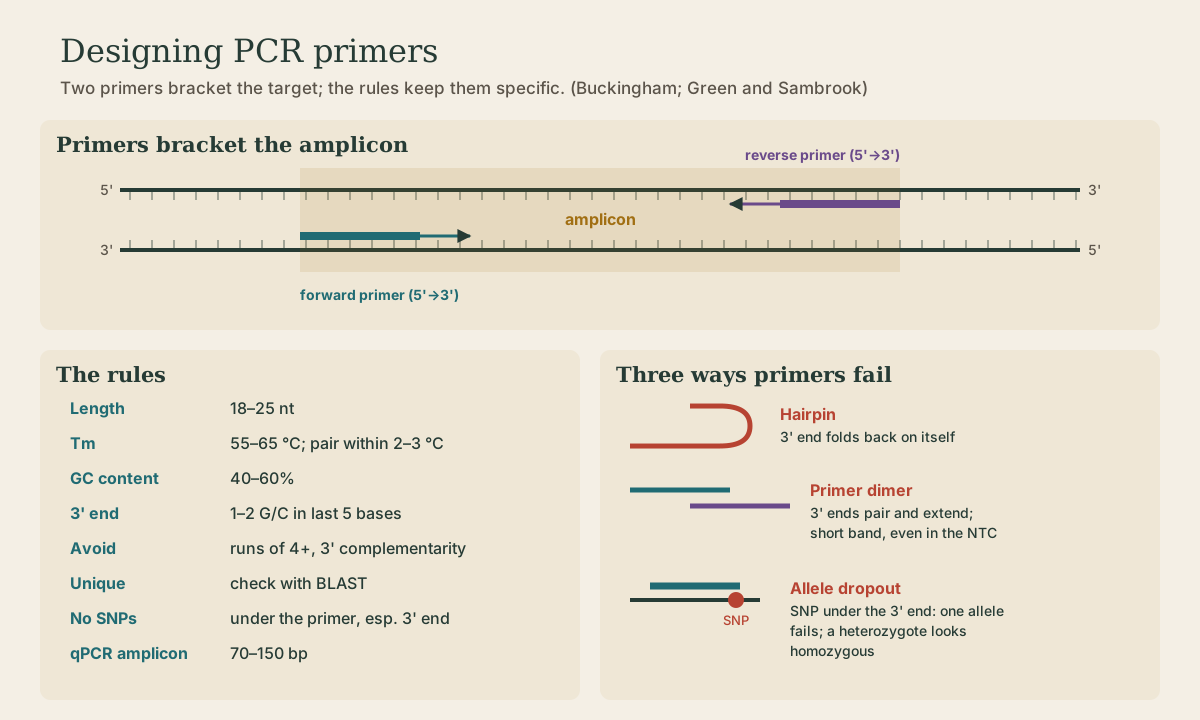
Good PCR starts with good primers. Each rule protects specificity or efficiency 1 2:
| Rule | Typical target | Why |
|---|---|---|
| Length | 18-25 nt | long enough to be unique in a genome, short enough to anneal fast |
| Tm | about 55-65 °C, the pair within 2-3 °C | both primers must bind well at one annealing temperature |
| GC content | 40-60% | balanced binding; avoid very AT- or GC-rich primers |
| 3’ end | one or two G/C in the last five bases (a “GC clamp”), not more than three | stable priming without promoting mispriming |
| Self-complementarity | none at the 3’ end | prevents hairpins and primer dimers |
| Pair complementarity | none, especially at 3’ ends | primers annealing to each other make dimers |
| Repeats and runs | avoid runs of 4+ of one base and dinucleotide repeats | slippage and mispriming |
| Uniqueness | check with BLAST or in-silico PCR | no second binding site, no pseudogenes |
| SNPs | none under the primer, especially the 3’ end | a mismatch can cause allele dropout |
| Amplicon | 70-150 bp for qPCR; up to 1 kb or more for sequencing | short amplifies efficiently and from degraded DNA |
Allele dropout is a real clinical failure: a polymorphism under one primer stops one allele from amplifying, and a heterozygous patient reads as homozygous. Labs check primer sites against population SNP data and redesign when needed.
Design software (Primer3 and its relatives) applies these rules automatically; the judgment is in choosing the region and checking the output.
Quick check
Dropout can turn a heterozygote into an apparent homozygote. Check primer sites against SNP databases.
Optimizing the reaction
| Lever | Effect |
|---|---|
| Annealing temperature | higher = more specific, possibly less yield; find the best with a gradient thermocycler, testing a range across the block in one run |
| Mg²⁺ (usually 1.5-3 mM) | more = more yield and more mispriming; less = cleaner, weaker 1 |
| Primer concentration (often 0.1-0.5 µM) | too much promotes dimers |
| Hot-start polymerase | blocks activity during setup, cutting dimers and misprimed products |
| Touchdown PCR | start annealing above Tm and drop about 1 °C per cycle; the specific product gets a head start |
| Cycle number | enough to detect; too many raise background and smears |
| Additives | DMSO (about 2-10%) or betaine for GC-rich templates; BSA to counter some inhibitors |
| Template amount | too much DNA adds inhibitors and nonspecific priming |
Change one variable at a time, with controls, and record everything.
Quick check
The first products made are the most specific, and they then outcompete off-target products.
Quick check
They reduce secondary structure and help strands separate.
Troubleshooting
| Symptom | Likely cause | First lever |
|---|---|---|
| No product, positive control fine | inhibited or degraded sample | dilute template, re-extract |
| No product anywhere | missing reagent, wrong program, annealing too high | check setup, lower annealing, check Mg²⁺ |
| Extra bands | annealing too low, too much Mg²⁺ | raise annealing, lower Mg²⁺, hot-start |
| Primer dimer (short band, also in NTC) | primer 3’ complementarity, low template | hot-start, less primer, redesign |
| Smear | too much template, too many cycles, degraded DNA | less template, fewer cycles |
| Product in the NTC | contamination | stop, decontaminate, fresh reagents (see contamination control) |
Quick check
Extra bands mean conditions are too permissive.
What to take from this
Primers are 18-25 nt with matched Tm near 60 °C, 40-60% GC, a modest GC clamp, no 3’ complementarity, unique sequence, and no SNPs under the 3’ end, which would cause allele dropout. Optimize annealing with a gradient, tune Mg²⁺, use hot-start, try touchdown cycling, and add DMSO or betaine for GC-rich targets. Read symptoms back to levers: extra bands mean too permissive, no product means too stringent or a failed sample.
Lesson complete
Nice work.
Sources for this lesson
- 1Lela Buckingham. Molecular Diagnostics: Fundamentals, Methods, and Clinical Applications. 3rd ed. F.A. Davis Company. 2019. verifiedThe standard clinical molecular-diagnostics textbook for MLS/MB programs; author holds MB DLM(ASCP). Covers nucleic-acid chemistry, techniques, lab operations, and applications across infectious disease, oncology, genetics, and identity. Primary topic reference for the ASCP MB program.
- 2Michael R. Green, Joseph Sambrook. Molecular Cloning: A Laboratory Manual. 4th ed. Cold Spring Harbor Laboratory Press. 2012. verifiedThe classic three-volume molecular-biology methods manual — authoritative for nucleic-acid isolation, electrophoresis, restriction digestion, labeling, and hybridization techniques. Standard-tier topic reference for the techniques courses.
Further reading
- Bruce Alberts, Rebecca Heald, Alexander Johnson, David Morgan, Martin Raff, Keith Roberts, Peter Walter. Molecular Biology of the Cell. 7th ed. W. W. Norton & Company. 2022. verifiedThe canonical cell/molecular biology textbook; used for nucleic-acid chemistry and the central dogma.