Genetic Identity: STR Profiling and Parentage
Short tandem repeats, the 20 CODIS core loci, reading an electropherogram, parentage math with paternity indices, and using identity testing to catch specimen mix-ups.
- 4 min
- 6 steps
- 3 questions
- Lesson 58 of 60
In this lesson
- Short tandem repeats
- CODIS
- Reading an electropherogram
- Parentage testing
- Clinical identity testing
- What to take from this
Picking up where you left off.
Short tandem repeats
Short tandem repeats (STRs) are stretches where a 2- to 6-base unit repeats, most often a 4-base unit in identity testing (for example, TCAT repeated 5 to 11 times at TH01). The number of repeats varies from person to person, so each locus has many alleles named by repeat number. Testing 20 or so independent loci gives a profile shared by no one else except an identical twin.
Workflow:
- Extract DNA (blood, buccal swab, tissue, or forensic evidence).
- Multiplex PCR amplifies all loci at once with fluorescently labeled primers.
- Capillary electrophoresis separates products by size; different loci use different dye colors and size ranges.
- Software compares peaks to an allelic ladder to name each allele.
Amelogenin is included as a sex marker: a 6-bp deletion in the X-linked copy gives an X peak and a slightly longer Y peak.
Quick check
The FBI expanded the CODIS core from 13 to 20 STR loci effective January 1, 2017.
CODIS
The FBI’s Combined DNA Index System (CODIS) stores forensic profiles. Its core expanded from 13 to 20 STR loci on January 1, 2017, adding D1S1656, D2S441, D2S1338, D10S1248, D12S391, D19S433, and D22S1045 to the original 13 (CSF1PO, D3S1358, D5S818, D7S820, D8S1179, D13S317, D16S539, D18S51, D21S11, FGA, TH01, TPOX, and vWA) 1. The expansion improved discrimination and compatibility with international databases 1.
Reading an electropherogram
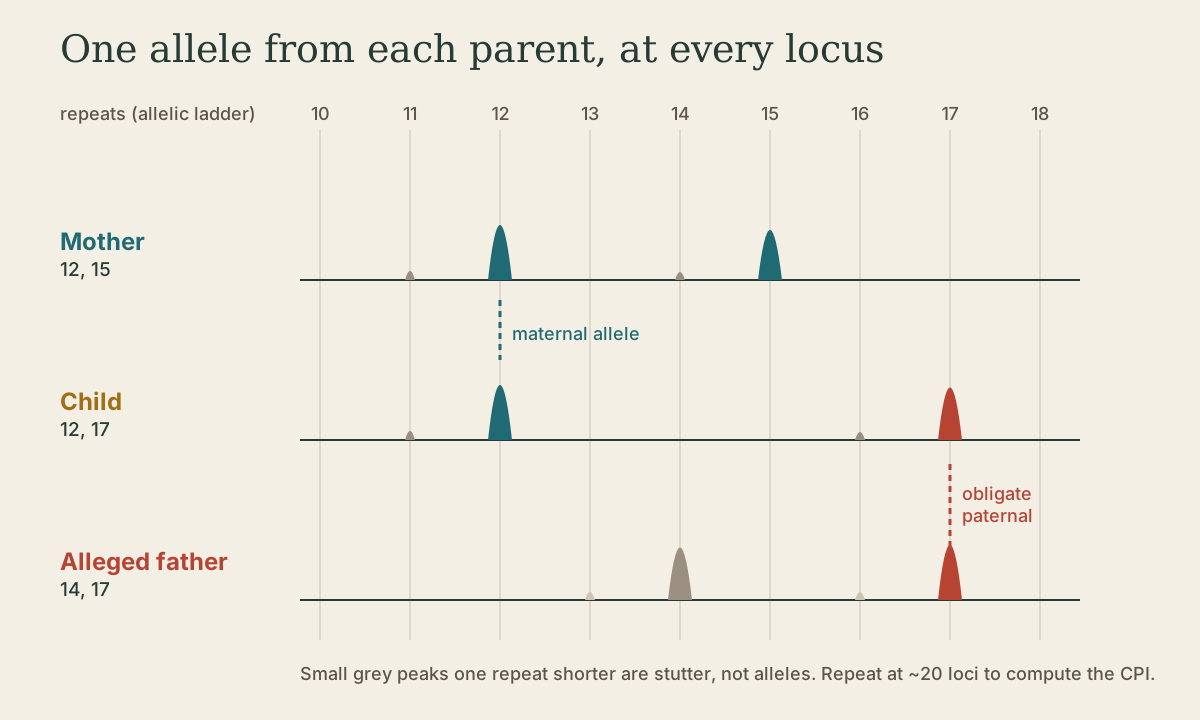
- Heterozygote: two peaks; homozygote: one, about twice the height.
- Stutter: a small peak one repeat shorter than the true allele, from polymerase slippage. Labs set stutter thresholds so it isn’t called as an allele.
- Mixtures: three or more peaks at several loci suggest DNA from more than one person - common in forensic evidence, and a red flag for contamination or a mixed sample in clinical testing.
- Allele dropout: a low-template sample can lose an allele.
Parentage testing
A child inherits one allele at each locus from each parent. In a trio:
- Identify the child’s alleles that could come from the mother.
- The remaining allele is the obligate paternal allele.
- Check whether the alleged father has it at every locus.
If he lacks it at several loci, he’s excluded (a single mismatch could be a mutation, so labs require mismatches at more than one locus). If he has it at every locus, the strength of the match is calculated:
- Paternity index (PI) at each locus: how many times more likely the result is if he’s the father than if a random unrelated man is. A rare shared allele gives a high PI.
- Combined paternity index (CPI): the product of all locus PIs.
- Probability of paternity = CPI / (CPI + 1), assuming 50% prior probability.
AABB relationship testing standards require at least 99.0% probability of paternity to report a tested man as not excluded, and most AABB labs use a CPI threshold of 100 for trios 2. Results for legal use require chain of custody: identity verification and photos at collection, sealed and tracked specimens.
Quick check
The child’s 12 can come from the mother, so 17 is the obligate paternal allele. A man without 17 at this locus is inconsistent at this locus.
Clinical identity testing
Molecular labs use STRs to:
- Resolve specimen mix-ups: compare a questioned specimen (a tissue block, a tube) to a known sample from the patient.
- Detect contamination in tissue (a “floater” from another patient in a biopsy).
- Confirm maternal cell contamination status in prenatal samples.
- Verify cell line identity in research.
- Monitor chimerism after transplant (next lesson).
What to take from this
STRs are short repeats with many alleles; multiplex PCR and capillary electrophoresis size them against an allelic ladder, with amelogenin as a sex marker. CODIS has used 20 core STR loci since January 1, 2017. Watch for stutter, mixtures, and dropout. In parentage, the allele the mother can’t explain is the obligate paternal allele; PIs multiply into a CPI, and AABB requires at least 99.0% probability of paternity. Clinical labs use the same tools to catch specimen mix-ups and contamination.
Practice
AABB relationship testing standards require at least 99.0% probability of paternity; most labs use a combined paternity index threshold of 100.
Lesson complete
Nice work.
Sources for this lesson
- 1Countdown to 2017: Internal Validation of the New CODIS Loci. ISHI News (Promega). verifiedThe FBI expanded the CODIS core loci from 13 to 20 STRs effective January 1, 2017, adding D1S1656, D2S441, D2S1338, D10S1248, D12S391, D19S433, and D22S1045.
- 2How many familial relationship testing results could be wrong?. PubMed Central (PMC7425842). verifiedAABB standards require at least 99.0% probability of paternity for a non-excluded tested man; most AABB labs use a likelihood ratio (CPI) threshold of 100 for trios.
Previous: Imprinting, Mitochondrial Disease, and Disease-Associated HLA