Imprinting, Mitochondrial Disease, and Disease-Associated HLA
When the parent of origin matters - Prader-Willi and Angelman syndromes - when inheritance runs only through mothers in mitochondrial DNA, and the HLA alleles that raise disease risk without causing disease.
- 4 min
- 6 steps
- 3 questions
- Lesson 57 of 60
In this lesson
- Imprinting
- Prader-Willi and Angelman
- Testing
- Mitochondrial disorders
- Disease-associated HLA
- What to take from this
Picking up where you left off.
Imprinting
For most genes, both parents’ copies are active. Imprinted genes are expressed from only one parent’s copy; the other is silenced by DNA methylation set in the egg or sperm. Losing the active copy causes disease even though the silent copy is intact.
Prader-Willi and Angelman
Both syndromes involve the same region, 15q11-q13, with opposite parental origins.
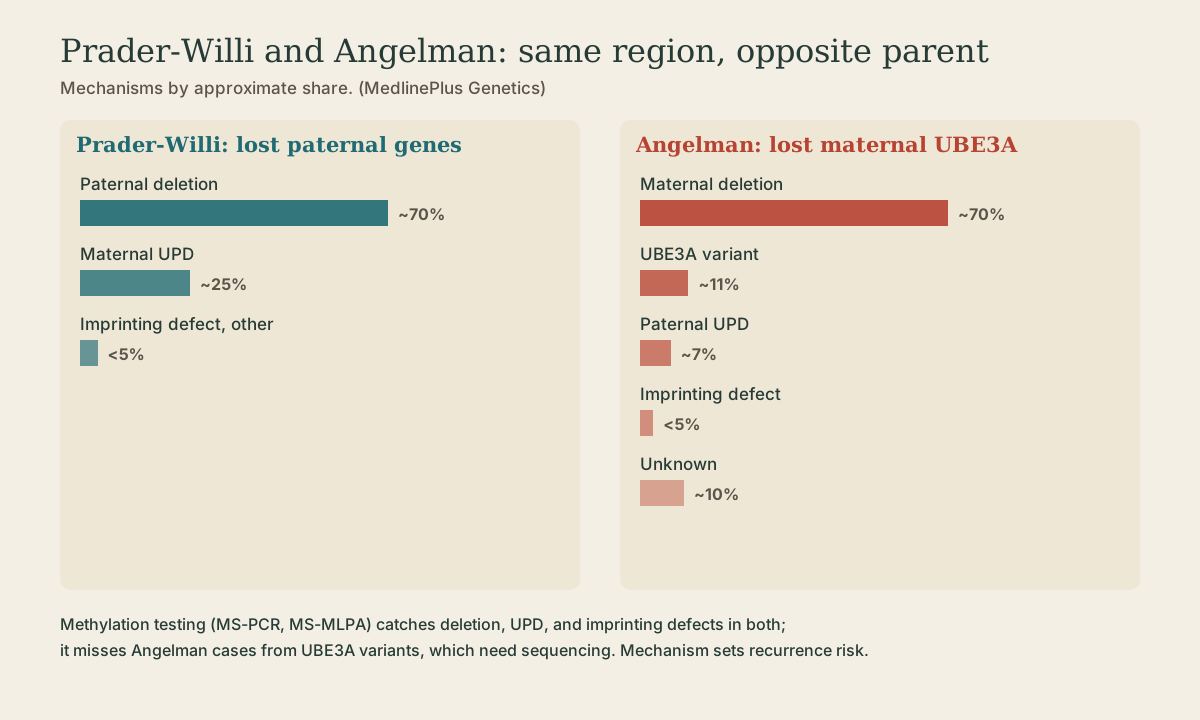
Prader-Willi syndrome (PWS): loss of paternally expressed genes (the SNORD116 cluster plays a major role). Infant hypotonia and feeding problems, then insatiable appetite, obesity, short stature, and intellectual disability. Mechanisms 1:
- Paternal deletion of 15q11-q13: about 70%.
- Maternal uniparental disomy (UPD): about 25% (two maternal chromosome 15s, no paternal).
- Imprinting defects and rearrangements: under 5%.
Angelman syndrome (AS): loss of the maternally expressed UBE3A gene, active only from the maternal copy in neurons. Severe intellectual disability, absent speech, seizures, ataxia, and a happy, excitable demeanor. Mechanisms 2:
- Maternal deletion: about 70%.
- UBE3A variants: about 11%.
- Paternal UPD: about 7%.
- Imprinting defects: about 3%.
- Unknown: about 10%.
Quick check
Prader-Willi results from loss of paternally expressed genes at 15q11-q13. Maternal uniparental disomy removes the paternal copy and causes about 25% of PWS.
Testing
- Methylation analysis (methylation-specific PCR or MS-MLPA) at the 15q11-q13 imprinting center detects all three main mechanisms of PWS, since each leaves only a maternal pattern. For AS it detects deletion, UPD, and imprinting defects, but not UBE3A variants, which need sequencing.
- FISH or microarray confirms a deletion; microsatellite (STR) analysis of parents and child detects UPD.
Identifying the mechanism matters for recurrence risk: deletions and UPD are usually sporadic, while some imprinting-center defects and UBE3A variants can be inherited.
Quick check
All three mechanisms leave only the maternal methylation pattern. Methylation testing catches them all for PWS; follow-up tests determine the mechanism.
Mitochondrial disorders
Mitochondria carry their own small circular genome (mtDNA, about 16.6 kb, 37 genes for oxidative phosphorylation, tRNAs, and rRNAs). Key features:
- Maternal inheritance: mitochondria come from the egg; fathers don’t transmit mtDNA variants 3.
- Heteroplasmy: cells hold many mtDNA copies, a mix of normal and mutant. Disease appears when the mutant fraction passes a tissue-specific threshold, so severity varies widely, even among siblings.
- High-energy tissues (brain, muscle, heart, eye) are hit hardest.
Examples:
| Disorder | Common variant |
|---|---|
| MELAS (encephalopathy, lactic acidosis, stroke-like episodes) | m.3243A>G in MT-TL1 (variants in MT-TL1 cause more than 80% of MELAS 3) |
| MERRF (myoclonic epilepsy, ragged-red fibers) | m.8344A>G in MT-TK |
| LHON (Leber hereditary optic neuropathy) | m.11778G>A in MT-ND4, usually homoplasmic |
Because heteroplasmy varies by tissue, blood may underestimate the mutant load; urine sediment or muscle often shows more. Quantitative methods (pyrosequencing, digital PCR, NGS) measure heteroplasmy percentage. Many mitochondrial diseases are actually caused by nuclear genes and follow Mendelian inheritance.
Disease-associated HLA
The HLA genes on chromosome 6 are the most polymorphic in the genome, with hundreds of alleles per gene 4. Some alleles raise disease risk without causing disease:
- HLA-B27 and ankylosing spondylitis: a strong association, but only 1 to 5% of carriers develop it 4.
- HLA-DQ2 and DQ8 and celiac disease: almost all patients carry them, but so do about 30% of people, and only about 3% of carriers develop celiac disease 5. A negative result makes celiac disease very unlikely; a positive one means little by itself.
- Drug hypersensitivity alleles (B57:01 abacavir, B15:02 carbamazepine, B*58:01 allopurinol) 4 are covered in the pharmacogenomics lesson.
What to take from this
Imprinted genes are expressed from one parent. PWS is loss of paternal 15q11-q13 (70% deletion, 25% maternal UPD); Angelman is loss of maternal UBE3A (70% deletion, 11% UBE3A variants, 7% paternal UPD). Methylation testing catches all PWS mechanisms but misses UBE3A variants in Angelman. Mitochondrial DNA is maternally inherited and heteroplasmic; MELAS is usually m.3243A>G. Disease-associated HLA alleles like B27 and DQ2/DQ8 raise risk, and their negative results are more informative than their positives.
Practice
Mitochondrial DNA is inherited from the mother. All her children receive her mitochondria, though the proportion of mutant mtDNA (heteroplasmy) varies.
Lesson complete
Nice work.
Sources for this lesson
- 1Prader-Willi syndrome. MedlinePlus Genetics (National Library of Medicine). verifiedAbout 70% from deletion of paternal 15q11-q13, about 25% maternal uniparental disomy, under 5% imprinting defects or rearrangements.
- 2Angelman syndrome. MedlinePlus Genetics (National Library of Medicine). verifiedLoss of maternal UBE3A in neurons; about 70% maternal deletion, 11% UBE3A variants, 7% paternal UPD, 3% imprinting defects, 10% unknown.
- 3Mitochondrial encephalomyopathy, lactic acidosis, and stroke-like episodes (MELAS). MedlinePlus Genetics (National Library of Medicine). verifiedVariants in MT-TL1 cause more than 80% of MELAS; mitochondrial DNA is inherited from the mother only.
- 4HLA-B gene. MedlinePlus Genetics (National Library of Medicine). verifiedHundreds of HLA-B alleles; HLA-B27 raises ankylosing spondylitis risk (1-5% of carriers develop it); B*57:01 abacavir, B*15:02 carbamazepine, B*58:01 allopurinol reactions.
- 5Celiac disease. MedlinePlus Genetics (National Library of Medicine). verifiedAlmost all people with celiac disease carry specific HLA-DQA1/DQB1 variants (DQ2, DQ8), which are also found in about 30% of the general population; only about 3% of carriers develop celiac disease.
Previous: Single-Gene Disorders: CF, Gaucher, Hemochromatosis