Single-Gene Disorders: CF, Gaucher, Hemochromatosis
Autosomal recessive disorders the MB exam loves: cystic fibrosis and its thousand-plus CFTR variants, Gaucher disease in Ashkenazi Jewish carriers, and HFE hemochromatosis - with carrier screening logic and residual risk.
- 4 min
- 6 steps
- 3 questions
- Lesson 56 of 60
In this lesson
- Recessive inheritance
- Cystic fibrosis
- Gaucher disease
- Hereditary hemochromatosis
- Genotyping methods
- What to take from this
Picking up where you left off.
Recessive inheritance
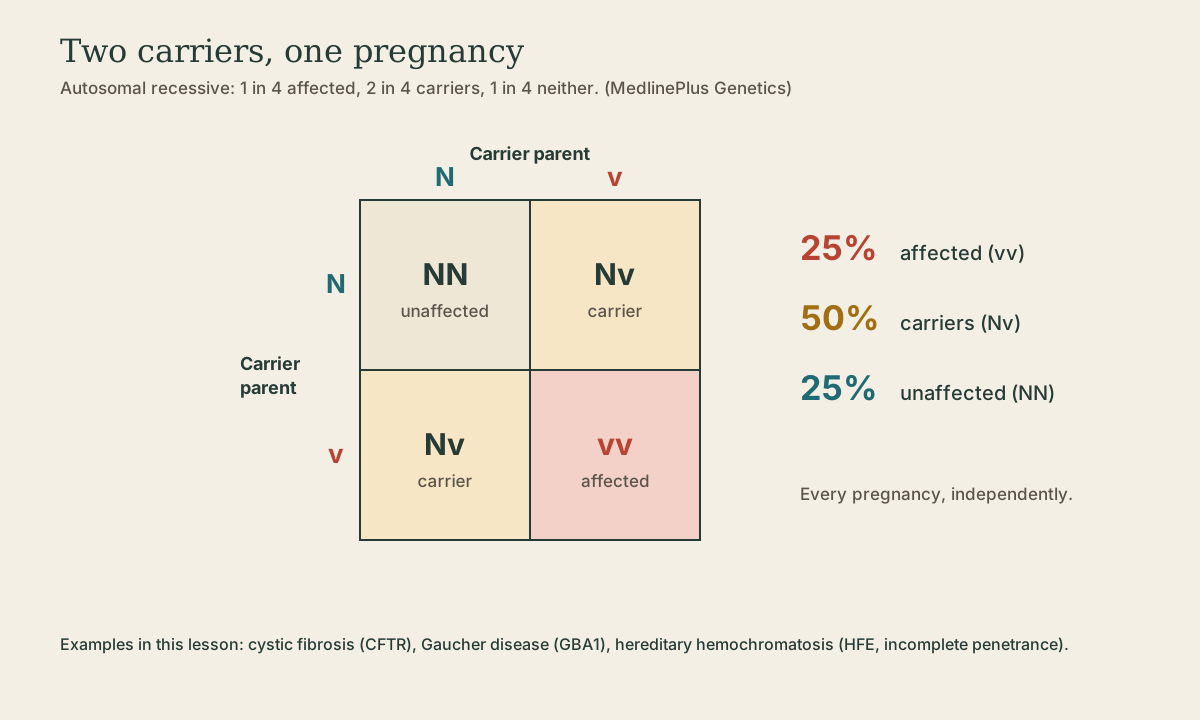
The disorders in this lesson are autosomal recessive: disease requires pathogenic variants on both copies of the gene. Carriers (one copy) are usually healthy. When two carriers have a child, each pregnancy has a 25% chance of an affected child, 50% chance of a carrier, and 25% chance of neither.
Quick check
Each parent passes the variant half the time: 1/2 × 1/2 = 1/4 affected, 1/2 carriers, 1/4 unaffected non-carriers.
Cystic fibrosis
Cystic fibrosis (CF) comes from variants in CFTR, a chloride channel in epithelial cells. Faulty transport makes thick, sticky mucus that clogs airways, the pancreas, and other glands 1. More than 1,000 CFTR variants have been found in people with CF 1.
- F508del (c.1521_1523del, p.Phe508del) is the most common. The protein misfolds and is degraded before reaching the cell membrane 1.
- Variants are grouped by mechanism: no protein made (nonsense, splice), misfolding (F508del), defective gating (G551D: reaches the membrane but won’t open), reduced conductance, and reduced amount.
- Mild variants in males can cause only congenital bilateral absence of the vas deferens (CBAVD) and infertility 1. The 5T variant in the intron 8 poly-T tract reduces correct splicing and contributes to CBAVD, with its effect modified by the adjacent TG repeat.
- CFTR modulators are matched to genotype: ivacaftor potentiates gating variants such as G551D, and combination modulators (elexacaftor/tezacaftor/ivacaftor) treat patients with at least one F508del. So the specific variants matter for therapy.
Testing:
- Newborn screening measures immunoreactive trypsinogen, then often a CFTR variant panel; the sweat chloride test confirms the diagnosis.
- Carrier screening uses targeted panels (the ACMG’s original 23-variant core panel, now usually expanded) or full sequencing. Detection rates vary by ancestry, so a negative result lowers but doesn’t eliminate carrier risk: residual risk.
- Diagnostic testing sequences CFTR and checks for deletions.
Quick check
More than 1,000 CFTR variants exist. A negative targeted panel lowers carrier probability by the panel’s detection rate for the person’s ancestry, leaving residual risk.
Gaucher disease
Gaucher disease is a lysosomal storage disorder from variants in GBA1, which encodes the enzyme that breaks down glucocerebroside. Fatty material builds up in macrophages, enlarging the liver and spleen and causing anemia, easy bruising, and bone disease 2.
- Type 1 is most common and spares the brain; types 2 and 3 are neuronopathic 2.
- It affects 1 in 50,000 to 100,000 people generally but 1 in 500 to 1,000 of Ashkenazi Jewish heritage 2, where a few variants (most commonly N370S, now p.Asn409Ser) account for most alleles, so targeted panels detect most carriers.
- Enzyme assay (beta-glucocerebrosidase activity) confirms diagnosis; enzyme replacement therapy is available.
Gaucher is one of several conditions on Ashkenazi Jewish carrier screening panels, alongside Tay-Sachs, Canavan disease, familial dysautonomia, and others.
Hereditary hemochromatosis
Type 1 hereditary hemochromatosis comes from HFE variants and is autosomal recessive 3. Excess iron absorption gradually loads the liver, heart, pancreas, and joints.
- C282Y homozygosity (p.Cys282Tyr) accounts for most type 1 cases in people of Northern European ancestry.
- H63D (p.His63Asp) is milder; C282Y/H63D compound heterozygotes usually have little or no iron overload.
- Penetrance is incomplete: many C282Y homozygotes never develop clinical disease, especially women (menstrual iron loss).
- Testing follows elevated transferrin saturation and ferritin; treatment is phlebotomy.
Genotyping methods
Targeted variant panels use multiplex PCR with allele-specific primer extension, probe arrays, real-time PCR, or melt curves. Full-gene analysis uses Sanger or NGS sequencing plus deletion/duplication analysis (MLPA or NGS read depth), since some pathogenic variants are large deletions. Every variant is classified with the ACMG/AMP five-tier system 4.
What to take from this
CF, Gaucher, and HFE hemochromatosis are autosomal recessive, with a 25% recurrence risk for carrier couples. CF has more than 1,000 CFTR variants; F508del misfolds and is degraded, G551D won’t open, and modulator drugs depend on the variants. Negative targeted carrier panels leave residual risk. Gaucher (GBA1) is common in Ashkenazi Jewish populations. HFE C282Y homozygosity causes most type 1 hemochromatosis but with incomplete penetrance.
Practice
F508del (c.1521_1523del) removes one amino acid; the protein misfolds and is broken down, so little channel reaches the surface.
Lesson complete
Nice work.
Sources for this lesson
- 1CFTR gene. MedlinePlus Genetics (National Library of Medicine). verifiedMore than 1,000 CFTR variants cause CF; F508del is the most common and causes the channel to be degraded before reaching the membrane; milder variants cause CBAVD.
- 2Gaucher disease. MedlinePlus Genetics (National Library of Medicine). verifiedGBA1 variants, autosomal recessive; type 1 is most common and spares the brain; 1 in 500 to 1,000 people of Ashkenazi Jewish heritage.
- 3Hereditary hemochromatosis. MedlinePlus Genetics (National Library of Medicine). verifiedType 1 hemochromatosis results from HFE variants and is autosomal recessive.
- 4Sue Richards, et al.. Standards and guidelines for the interpretation of sequence variants (ACMG/AMP). Genetics in Medicine 17(5):405-424. 2015. verifiedFive terms for Mendelian variants - pathogenic, likely pathogenic, uncertain significance, likely benign, benign - assigned from weighted evidence codes (very strong, strong, moderate, supporting).