Quantitative Viral Load
How much virus is in the blood, and why it's reported in logs and international units: HIV, HCV, HBV, and CMV monitoring, what counts as a real change, and how WHO standards let different assays agree.
- 4 min
- 8 steps
- 3 questions
- Lesson 47 of 60
In this lesson
- What viral load measures
- Logs
- HIV
- Hepatitis C and B
- CMV and transplant
- International units
- Worked example
- What to take from this
Picking up where you left off.
What viral load measures
A viral load test measures the amount of viral nucleic acid in a specimen, usually plasma. Real-time PCR (RT-qPCR for RNA viruses) and other quantitative methods compare each sample to calibrators to produce a concentration. Viral loads are used to:
- Monitor treatment (HIV, HBV, HCV).
- Decide when to treat (CMV after transplant; HBV).
- Confirm cure (HCV sustained virologic response: undetectable RNA after therapy ends).
Logs
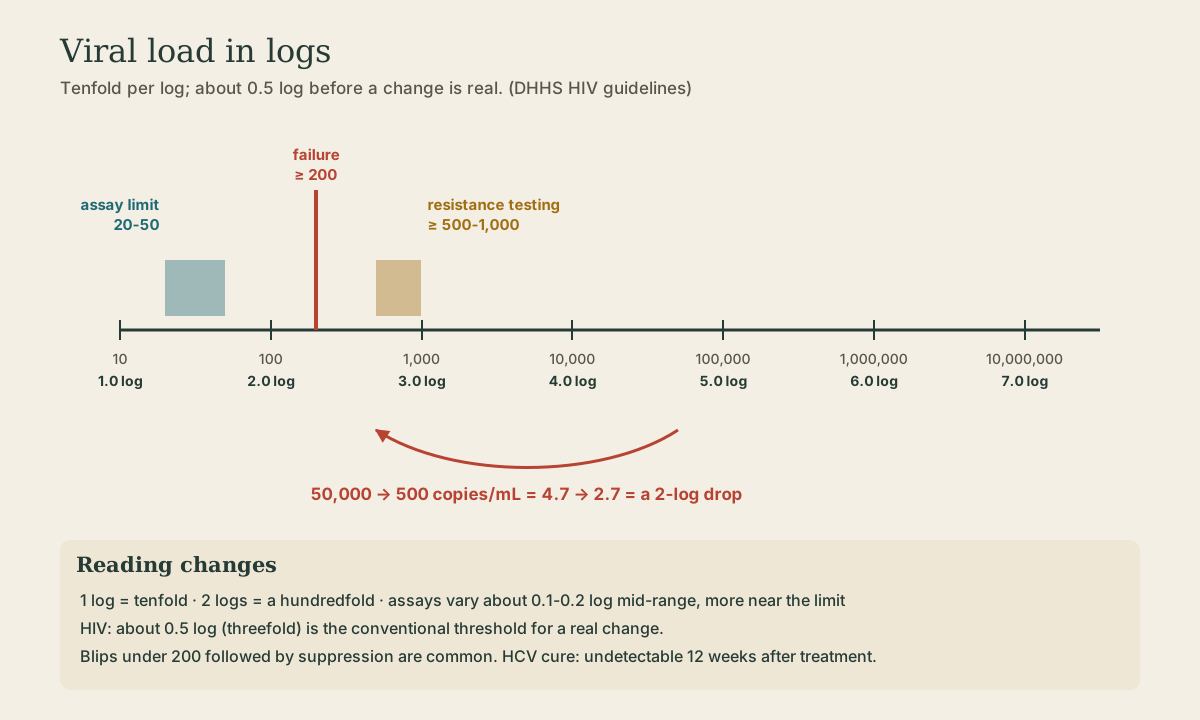
Viral loads span from tens to tens of millions, so they’re reported and compared in log10 units:
| Copies/mL | log10 |
|---|---|
| 100 | 2.0 |
| 1,000 | 3.0 |
| 50,000 | 4.7 |
| 1,000,000 | 6.0 |
A change of 1 log is tenfold; 2 logs is a hundredfold. A drop from 50,000 to 500 copies/mL is a 2-log decrease.
What counts as a real change? Every assay has imprecision, roughly 0.1 to 0.2 log at mid-range and more near the limit of detection. For HIV, a change of about 0.5 log (threefold) is the conventional threshold for a meaningful change. Smaller swings may be assay noise or normal biological variation. Use the same assay for serial monitoring when possible.
Quick check
log10(50,000) = 4.7 and log10(500) = 2.7; the difference is 2.0 logs, a 100-fold drop.
HIV
- Treatment goal: suppression below the assay’s limit of detection (current assays detect about 20 to 50 copies/mL).
- Virologic failure: HIV RNA 200 copies/mL or more 1.
- Blips: isolated detectable values below 200 copies/mL followed by suppression are common and usually not significant.
- Resistance testing needs enough virus to amplify: recommended above 1,000 copies/mL, and worth attempting at 500 to 1,000 1. The next lesson covers it.
Hepatitis C and B
- HCV RNA confirms active infection after a positive antibody test (antibody alone may mean past, cleared infection), sets a baseline, and confirms cure: undetectable HCV RNA 12 weeks after treatment ends.
- HBV DNA guides when to start antivirals and monitors response. Both are reported in IU/mL.
CMV and transplant
Cytomegalovirus reactivates in transplant recipients and other immunosuppressed patients. Serial CMV viral loads in plasma or whole blood guide preemptive therapy: start antivirals when the load rises past an institutional threshold, before disease develops. Whole blood and plasma give different numbers, so specimen type must stay consistent.
International units
Early viral load assays reported copies/mL, and different assays gave different numbers for the same sample, making it hard to compare results between labs or apply published thresholds.
The fix is a WHO International Standard: a reference material assigned a value in international units (IU). Manufacturers calibrate assays to it and report IU/mL, with a conversion factor from copies. The first WHO International Standard for human CMV for NAT was established in 2010 (NIBSC code 09/162, 5 × 10^6 IU/mL when reconstituted) 2. HBV and HCV assays are similarly traceable to WHO standards 2.
Harmonization is imperfect: different extraction methods, target genes, and amplicon sizes still produce differences, especially for CMV, so serial monitoring should stay on one assay.
Quick check
Copies/mL from different assays disagreed. Calibrating each assay to the same WHO standard, and reporting in IU/mL, harmonizes results across platforms.
Worked example
A kidney transplant patient’s CMV loads (IU/mL, same plasma assay) over four weeks are 500, 1,200, 4,800, and 15,000.
- log10 values: 2.7, 3.1, 3.7, 4.2.
- Total rise: 1.5 logs, about 30-fold, with each step well beyond assay noise.
- This is a genuine, accelerating rise; if the program’s preemptive threshold is, say, 1,000 IU/mL, therapy should have started at week 2.
What to take from this
Viral load is quantitative nucleic acid in plasma or blood, reported in log10 units: 1 log is tenfold, and for HIV about 0.5 log is the smallest meaningful change. HIV virologic failure is 200 copies/mL or more, and resistance testing needs about 1,000 copies/mL. HCV RNA confirms active infection and cure; HBV DNA guides therapy; CMV loads trigger preemptive therapy after transplant. WHO International Standards and IU/mL reporting make assays comparable, but serial tests belong on one assay and specimen type.
Practice
Virologic failure is an HIV RNA of 200 copies/mL or more. Isolated low-level ‘blips’ below that are common and usually not significant.
Lesson complete
Nice work.
Sources for this lesson
- 1Guidelines for the Use of Antiretroviral Agents in Adults and Adolescents with HIV. U.S. Department of Health and Human Services. verifiedVirologic failure is HIV RNA of 200 copies/mL or more; resistance testing at more than 1,000 copies/mL (consider at 500-1,000) while on the failing regimen or within 4 weeks of stopping.
- 2First WHO International Standard for human cytomegalovirus and quantitative NAT (commutability study). PubMed Central (PMC3697667). verifiedThe first WHO International Standard for CMV NAT (NIBSC 09/162), established in 2010 at 5 × 10^6 IU/mL; assays apply conversion factors to report IU/mL.