Solid Tumor Biomarkers and Companion Diagnostics
The somatic changes that pick cancer drugs - EGFR in lung cancer, RAS and BRAF in colorectal cancer, ALK fusions, HER2 amplification, MSI - how they're tested in FFPE and blood, and how somatic variants are tiered.
- 5 min
- 7 steps
- 3 questions
- Lesson 51 of 60
In this lesson
- Somatic testing
- Lung cancer
- Colorectal cancer
- Breast cancer
- Melanoma
- Reporting somatic variants
- What to take from this
Picking up where you left off.
Somatic testing
Solid tumor testing looks for somatic changes - mutations acquired by the tumor, not inherited - that predict response to specific drugs. A test that FDA approves alongside a drug, as the required way to select patients, is a companion diagnostic (CDx) 1.
Lung cancer
Non-small cell lung cancer, especially adenocarcinoma, is tested broadly, usually by an NGS panel:
- EGFR: exon 19 deletions and exon 21 L858R predict response to EGFR tyrosine kinase inhibitors (osimertinib, erlotinib, gefitinib, afatinib); the cobas EGFR Mutation Test v2 is one companion diagnostic 1. T790M is the common acquired resistance mutation to first- and second-generation EGFR TKIs; osimertinib was developed to overcome it.
- ALK rearrangements (most often EML4::ALK) select ALK inhibitors such as crizotinib, alectinib, and brigatinib; the Vysis ALK Break Apart FISH probe is one CDx 1. A break-apart probe shows split red and green signals when the gene is rearranged.
- ROS1, RET, NTRK fusions, BRAF V600E, MET exon 14 skipping, and KRAS G12C each have targeted drugs.
Quick check
Exon 19 deletions and L858R are the classic sensitizing EGFR mutations. T790M is the classic acquired resistance mutation to first- and second-generation TKIs.
Colorectal cancer
- KRAS and NRAS (exons 2, 3, and 4): activating mutations mean anti-EGFR antibodies (cetuximab, panitumumab) won’t work; they benefit only RAS wild-type tumors 2. The therascreen KRAS kit is a CDx for panitumumab, cetuximab, and the KRAS G12C inhibitors sotorasib and adagrasib 1.
- BRAF V600E: predicts poor response to anti-EGFR antibodies alone 2, selects BRAF-targeted combinations, and in MSI-high tumors points to a sporadic rather than Lynch syndrome cancer 3.
- Mismatch repair / MSI: every new colorectal cancer is screened for mismatch repair deficiency by IHC or MSI testing 3. MSI-high/dMMR tumors respond to immune checkpoint inhibitors, and the result also screens for Lynch syndrome (next lesson).
MSI testing compares the lengths of short repeat markers (mononucleotide repeats such as BAT-25 and BAT-26) in tumor and normal DNA by PCR and capillary electrophoresis; new allele sizes in the tumor mean instability.
Quick check
Activating KRAS or NRAS mutations signal downstream of EGFR, so blocking EGFR doesn’t help. Testing for RAS (and BRAF) is required before anti-EGFR therapy.
Breast cancer
HER2 (ERBB2) amplification selects HER2-targeted drugs (trastuzumab, pertuzumab, ado-trastuzumab emtansine), with FISH kits as CDx 1. HER2 is assessed by IHC first, with in situ hybridization (ISH) for equivocal cases. A dual-probe ISH result is clearly positive (group 1) when the HER2/CEP17 ratio is ≥2.0 and the average HER2 copy number is ≥4.0 signals per cell; the less common discordant groups 2 to 4 need concurrent IHC review 4.
PIK3CA mutations and BRCA1/2 (somatic or germline) also select therapies.
Melanoma
BRAF V600E/K mutations select BRAF plus MEK inhibitors (dabrafenib plus trametinib, encorafenib plus binimetinib); the THxID BRAF kit is a CDx 1.
Specimen issues
- FFPE tissue gives fragmented, cross-linked DNA; assays use short amplicons and must handle formalin artifacts.
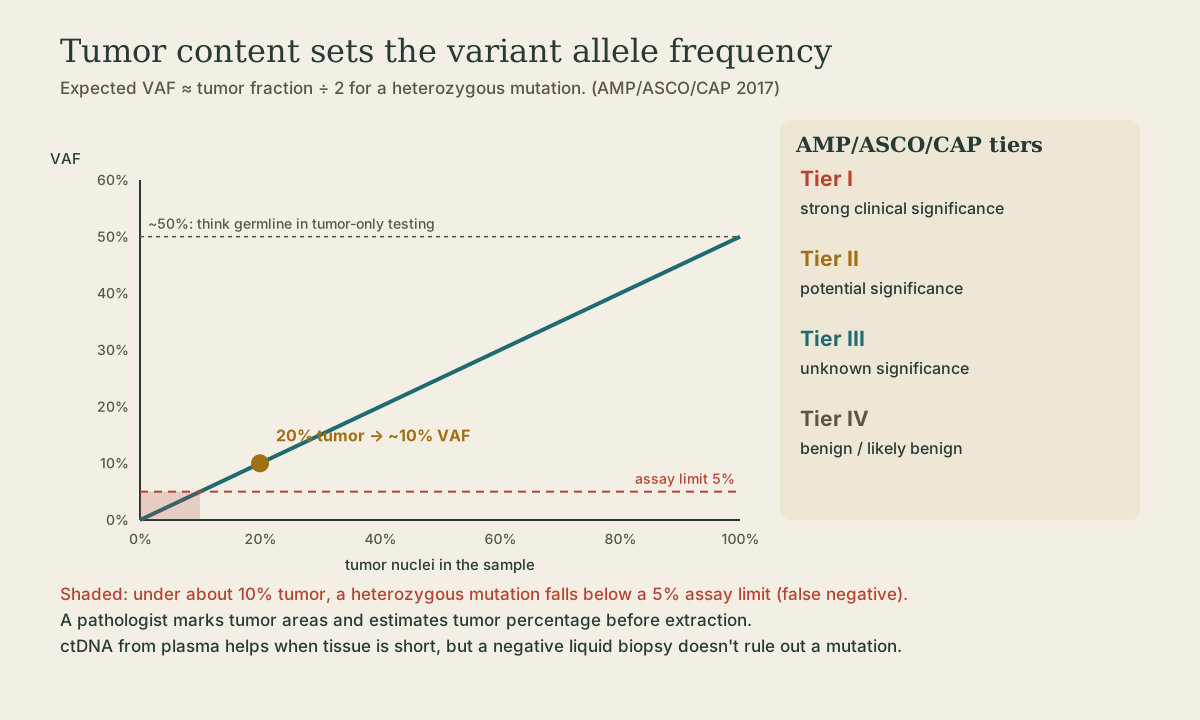
- Tumor content: a pathologist marks tumor areas and estimates the percentage of tumor nuclei. A heterozygous mutation in a sample that’s 20% tumor appears at about 10% variant allele frequency; if the assay’s limit of detection is 5% VAF, samples below about 10% tumor risk false negatives. Macrodissection enriches tumor.
- Liquid biopsy: circulating tumor DNA (ctDNA) in plasma can be tested when tissue is unavailable or to find resistance mutations such as EGFR T790M. A negative ctDNA result doesn’t rule out a mutation, since some tumors shed little DNA.
Reporting somatic variants
The AMP/ASCO/CAP guideline sorts somatic variants into four tiers 5:
- Tier I: strong clinical significance (FDA-approved therapy or guideline-endorsed).
- Tier II: potential clinical significance.
- Tier III: unknown clinical significance.
- Tier IV: benign or likely benign.
Tumor-only sequencing can find germline variants (a BRCA2 variant near 50% VAF, for example), which should prompt germline testing and counseling.
What to take from this
Companion diagnostics tie a somatic biomarker to a drug. In lung cancer, EGFR exon 19 deletions and L858R predict TKI response and T790M causes resistance; ALK and other fusions select their own inhibitors. In colorectal cancer, RAS mutations rule out anti-EGFR antibodies, BRAF V600E predicts poor response and suggests sporadic MSI, and MMR/MSI screening selects immunotherapy and flags Lynch syndrome. HER2 ISH is positive at a ratio ≥2.0 with ≥4 copies. Tumor percentage limits sensitivity, ctDNA can’t rule out a mutation, and somatic variants are reported in four tiers.
Practice
Group 1 (ratio ≥2.0 and copy number ≥4.0) is positive. Groups 2-4, with discordant ratio and copy number, need concurrent IHC review.
Lesson complete
Nice work.
Sources for this lesson
- 1List of FDA-Authorized Companion Diagnostic Devices (In Vitro and Imaging Tools). U.S. Food and Drug Administration. verifiedExamples include cobas EGFR v2 (exon 19 del, L858R; osimertinib and others), therascreen KRAS (panitumumab, cetuximab, sotorasib), THxID BRAF, Vysis ALK FISH, BRACAnalysis CDx (PARP inhibitors), HER2 FISH, FoundationOne CDx, LeukoStrat CDx FLT3.
- 2Colorectal Cancer - Predictive Testing for Anti-EGFR Therapy. ARUP Consult. verifiedAnti-EGFR antibodies (cetuximab, panitumumab) benefit only RAS wild-type metastatic colorectal cancer; KRAS, NRAS, and BRAF V600E mutations predict lack of benefit.
- 3Genetics of Colorectal Cancer (PDQ) - Health Professional Version. National Cancer Institute. verifiedLynch syndrome from germline MLH1, MSH2, MSH6, PMS2, or EPCAM variants, autosomal dominant; universal tumor screening by MSI or MMR IHC; MLH1 promoter hypermethylation and BRAF V600E point to sporadic tumors; EPCAM deletions silence MSH2; FAP from APC.
- 42018 HER2 Testing Algorithms (ASCO/CAP Focused Update). American Society of Clinical Oncology. 2018. verifiedDual-probe ISH group 1 (HER2/CEP17 ≥2.0 and average HER2 copy number ≥4.0) is positive; groups 2-4 require concurrent IHC review.
- 5Marilyn M. Li, et al.. Standards and Guidelines for the Interpretation and Reporting of Sequence Variants in Cancer (AMP/ASCO/CAP). Journal of Molecular Diagnostics 19(1). 2017. verifiedFour tiers for somatic variants - I strong clinical significance, II potential, III unknown, IV benign or likely benign.