Controls for Molecular Assays
What each control in a molecular run proves - positive, negative, no-template, extraction, internal amplification, low-positive - what CLIA requires daily, and how to read a run where something fails.
- 4 min
- 5 steps
- 3 questions
- Lesson 38 of 60
In this lesson
- What controls prove
- What CLIA requires
- Reading a run
- Worked example
- What to take from this
Picking up where you left off.
What controls prove
Every control answers one question about the run:
| Control | Contains | Proves |
|---|---|---|
| Positive (external) | Known target, taken through the test | The assay detects target when present |
| Negative (external) | Matrix without target | No false positive from reagents or process |
| No-template control (NTC) | Reagents with water instead of sample | Reagents and setup are free of contaminating target |
| Extraction control | A known sample carried through extraction | Extraction recovered nucleic acid |
| Internal control (IC) | A non-target sequence in every sample (spiked or endogenous, such as RNase P or beta-globin) | That sample’s extraction and amplification worked; no inhibitor |
| Low-positive | Target near the cutoff | Sensitivity at the threshold hasn’t drifted |
Internal controls come in two kinds. An endogenous IC is a human gene present in the specimen itself, which also shows the specimen contained cells. An exogenous IC is a synthetic sequence spiked into each sample before extraction, which tests extraction and inhibition but says nothing about specimen adequacy 1.
What CLIA requires
At least once each day patient specimens are tested, CLIA requires 2:
- Quantitative procedures: two control materials at different concentrations.
- Qualitative procedures: a negative and a positive control.
- Procedures with an extraction phase: two controls, one able to detect extraction errors.
- Molecular amplification procedures: two controls, plus a control capable of detecting inhibition if inhibition is a significant source of false negatives.
Acceptability criteria must be set before patient results are reported, and control results documented 2.
Good practice goes further 1:
- Rotate positive controls through different alleles in genotyping assays, since running every genotype in every run often isn’t feasible.
- For quantitative assays, use controls at more than one level (low and high) across the measuring range.
- Run controls after maintenance, a new operator, or a new reagent lot.
- CAP requires cut-off verification for qualitative tests with every new lot or at least every six months; an external low-positive near the threshold satisfies it (MOL.34516) 1.
Quick check
42 CFR 493.1256(d)(5) requires two controls for molecular amplification and an inhibition control when inhibition can cause false negatives.
Reading a run
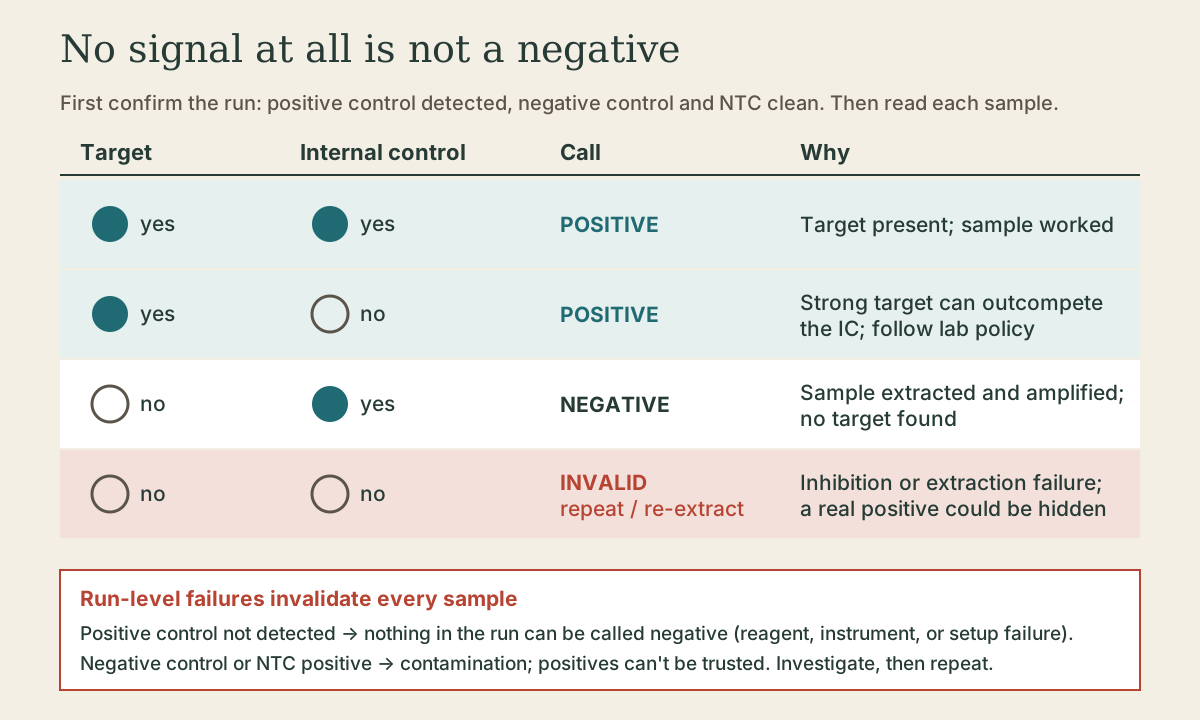
Controls first, then samples.
Run-level failures invalidate the whole run:
- Positive control negative or out of range: reagent failure, instrument fault, or wrong setup. Nothing in the run can be reported negative.
- Negative control or NTC positive: contamination. Positives from the run can’t be trusted; investigate before repeating.
Sample-level interpretation with an internal control:
| Target | Internal control | Call |
|---|---|---|
| Detected | Detected | Positive |
| Detected | Not detected | Positive (high target can outcompete the IC); laboratory policy may require review |
| Not detected | Detected | Negative |
| Not detected | Not detected | Invalid: inhibition or extraction failure. Re-extract, dilute, or recollect |
The last row is the one that matters most. A sample with neither signal is not a negative.
Quick check
A true negative must show the internal control. With neither signal, the sample may contain an inhibitor or have failed extraction, so a negative call would be unsafe.
Worked example
A quantitative HIV-1 viral load run includes a high positive control at 5.2 log copies/mL (expected 5.0 ± 0.3), a low positive at 2.9 (expected 3.0 ± 0.3), and a negative control. All controls pass. Sample 14 reads target not detected, and its internal control Cq is 38 against a usual 30 ± 1.5.
The run is valid, but sample 14’s IC is delayed by 8 cycles, about a 250-fold drop: strong partial inhibition. A “not detected” here could be a false negative. Report it as invalid or repeat after re-extraction or dilution, per the lab’s procedure.
What to take from this
Each control tests something specific: positive (detection works), negative and NTC (no contamination), extraction (recovery), internal control (that sample worked), low-positive (sensitivity at the cutoff). CLIA requires two controls daily for molecular amplification and an inhibition control when inhibition causes false negatives. Read controls before samples, and never call a sample negative when its internal control also failed.
Practice
A strong positive passes even when sensitivity has drifted. A weak positive near the cutoff fails first, which is what you want a control to do.
Lesson complete
Nice work.
Sources for this lesson
- 1Rachel Lee. Molecular Laboratory Design and QA/QC Considerations. Association of Public Health Laboratories (NBS Molecular Training Workshop). 2020. verifiedThree areas with positive pressure in reagent prep and negative in sample prep and post-amp; CAP MOL.35350 carryover and run order; fresh 10% bleach then ethanol and water; monthly wipe tests; MOL.49520 thermocycler checks annually; MOL.34516 cut-off verification each lot or 6 months; control types.
- 242 CFR 493.1256 - Control procedures. Legal Information Institute (CLIA regulations). verifiedDaily - two levels for quantitative tests, positive and negative for qualitative, two controls including an extraction control when there's an extraction phase; molecular amplification - two controls plus an inhibition control when inhibition causes false negatives. Cited at: (d)(3), (d)(5).