Specimens and Reagents
Right tube, right temperature, right time: EDTA not heparin, protecting RNA, the realities of FFPE tissue, and managing reagents through aliquots, lot changes, and light-sensitive probes.
- 4 min
- 6 steps
- 3 questions
- Lesson 39 of 60
In this lesson
- Blood
- RNA
- Swabs, tissue, and other specimens
- Rejection criteria
- Reagent management
- What to take from this
Picking up where you left off.
Blood
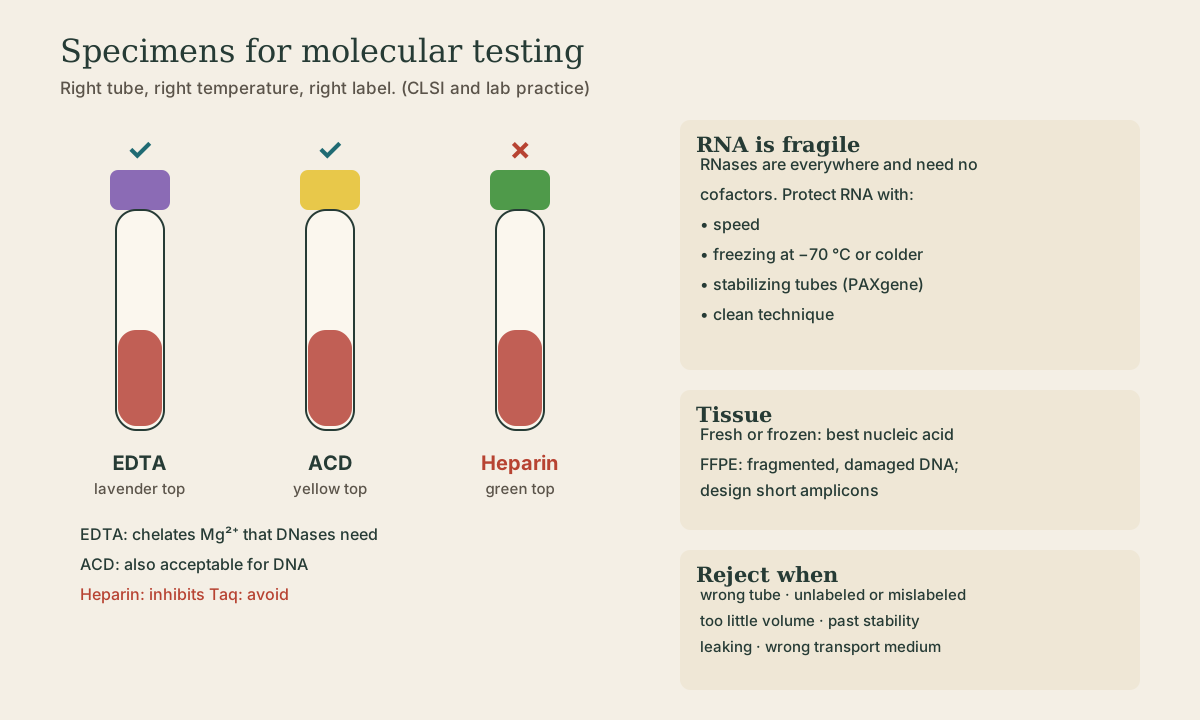
For most DNA and RNA testing from blood, collect in EDTA (lavender top) or ACD (yellow top). EDTA chelates the magnesium that DNases need, which also protects the sample.
Avoid heparin (green top). Heparin inhibits Taq polymerase and reverse transcriptase, and standard extractions don’t reliably remove it. In one comparison, HLA typing worked on all ten EDTA specimens but failed on two of ten heparinized ones, especially those with low white counts 1. If heparinized material is the only sample (bone marrow drawn for cytogenetics, for example), labs use extra cleanup steps or heparinase and interpret failures with caution.
Plasma for viral load is separated from cells within the time limits in the assay’s instructions, usually a few hours at room temperature, because cells can release nucleic acid and RNA degrades.
Quick check
Heparin inhibits Taq polymerase and reverse transcriptase and isn’t reliably removed by standard extraction. EDTA and ACD are the usual choices.
RNA
RNA is fragile because RNases are everywhere (skin, dust, reagents) and need no cofactors. Protect it by:
- Processing quickly, or freezing at −70 °C or colder.
- Using stabilizing tubes or reagents (such as PAXgene blood tubes or RNAlater for tissue) or guanidinium-based lysis buffers that inactivate RNases on contact.
- Using RNase-free tips, tubes, and water, and changing gloves often.
- Minimizing freeze-thaw cycles.
Swabs, tissue, and other specimens
- Swabs go in the transport medium validated for the assay; some molecular media inactivate organisms and lyse cells.
- Fresh or frozen tissue gives the best nucleic acid.
- FFPE tissue is the norm for tumor testing. Formalin cross-links proteins to DNA, fragments it, and can produce artifactual C>T changes. Assays for FFPE use short amplicons and are validated for it. Pathologist review marks the tumor area and estimates tumor percentage, because a mutation present in tumor cells is diluted by normal cells.
- Decalcified bone marrow biopsies may be unusable if strong acids were used.
Rejection criteria
Every lab defines when a specimen is rejected: wrong tube, unlabeled or mislabeled, insufficient volume, exceeded stability time or temperature, leaking containers, wrong transport medium. Mislabeled specimens are rejected rather than relabeled. Rejection means a recollection, so the criteria must be in the collection instructions.
Reagent management
Molecular reagents are expensive, fragile, and easy to contaminate.
- Aliquot primers, probes, and master mix to limit freeze-thaw cycles and contain contamination to a single tube 2 3.
- Use non-frost-free freezers for reagents, since frost-free models warm periodically 3.
- Keep enzymes and nucleic acids cold on the bench in benchtop coolers 2.
- Protect fluorescent probes and dyes from light with amber tubes or foil 2.
- Label every reagent with contents, lot, date received, date opened, and expiration; don’t use expired reagents.
- Store reagents in the reagent prep area, separate from controls and specimens 3.
New lots are checked before use: run the new lot side by side with the old on controls and representative samples, and confirm results agree within set limits. For qualitative tests with a cutoff, CAP requires cut-off verification with each new lot 2.
Quick check
Freeze-thaw cycles degrade oligonucleotides and enzymes, and a contaminated aliquot can be thrown away without losing the whole lot.
What to take from this
Collect blood for molecular testing in EDTA or ACD, not heparin, which inhibits polymerases. Protect RNA from RNases with speed, cold, stabilizers, and clean technique. FFPE tissue gives fragmented, damaged DNA that needs short amplicons and tumor-percentage review. Reject specimens that fail written criteria. Aliquot reagents, keep them cold and dark, store them away from controls, and test each new lot against the old before use.
Practice
Formalin cross-links and fragments nucleic acid and can cause artifactual C>T changes. Assays for FFPE use short amplicons and account for damage.
Lesson complete
Nice work.
Sources for this lesson
- 1Effects of heparin on polymerase chain reaction for blood white cells. Journal of Clinical Laboratory Analysis 13(3). 1999. verifiedHeparin inhibits Taq polymerase and reverse transcriptase; HLA typing failed in some heparinized samples while all EDTA samples worked.
- 2Rachel Lee. Molecular Laboratory Design and QA/QC Considerations. Association of Public Health Laboratories (NBS Molecular Training Workshop). 2020. verifiedThree areas with positive pressure in reagent prep and negative in sample prep and post-amp; CAP MOL.35350 carryover and run order; fresh 10% bleach then ethanol and water; monthly wipe tests; MOL.49520 thermocycler checks annually; MOL.34516 cut-off verification each lot or 6 months; control types.
- 3Dean A. Jobe, Erik Reisdorf. PCR Contamination and Laboratory Best Practices. Wisconsin State Laboratory of Hygiene and Gundersen Health System. 2018. verifiedSigns of contamination (rising positivity for rare targets, more high-Ct positives, out-of-season positives, positive environmental swabs); bleach, HCl, UV, and UNG; wipe testing with a wet polyester swab.