DNA Replication
Semiconservative copying at replication forks: helicase, SSBs, topoisomerase, primase, polymerase, and ligase; leading and lagging strands; proofreading; telomerase; and how DNA polymerase's four requirements became the recipe for PCR.
- 5 min
- 9 steps
- 5 questions
- Lesson 5 of 60
In this lesson
- Semiconservative copying
- Origins and forks
- The crew at the fork
- What DNA polymerase needs
- Leading and lagging strands
- Fidelity and proofreading
- Telomeres and telomerase
- The recipe for PCR
- What to take from this
Picking up where you left off.
Semiconservative copying
Each strand of the parent helix templates a new partner, so every daughter molecule has one old strand and one new one: semiconservative replication 1. Because the strands are complementary, either one fully specifies the other - the information is stored twice.
Quick check
Each parental strand serves as a template and stays paired with its copy.
Origins and forks
Replication starts at origins, where initiator proteins open the helix 1. Bacteria usually have one origin per chromosome; human chromosomes have thousands, so the genome can be copied in hours. From each origin two replication forks move in opposite directions, opening a growing bubble.
The crew at the fork
| Protein | Job 2 |
|---|---|
| Helicase | unwinds the duplex, breaking base-pair hydrogen bonds |
| Single-strand binding proteins | coat exposed strands so they don’t re-pair or fold |
| Topoisomerase | relieves the supercoiling that builds ahead of the fork |
| Primase | lays down a short RNA primer |
| DNA polymerase | extends the primer, matching the template |
| DNA ligase | seals nicks between finished segments |
Playback is optional. If the player is unavailable, open the video at its source.
Quick check
Helicase unwinds; topoisomerase nicks and reseals to release the twist that unwinding creates.
What DNA polymerase needs
DNA polymerase has four non-negotiable requirements 2:
- a template to read;
- a primer with a free 3’-OH - it can’t start a strand on its own;
- the four dNTPs;
- it only adds to the 3’ end, so synthesis runs 5’ to 3’.
Keep these in mind: they are the shopping list for PCR.
Leading and lagging strands
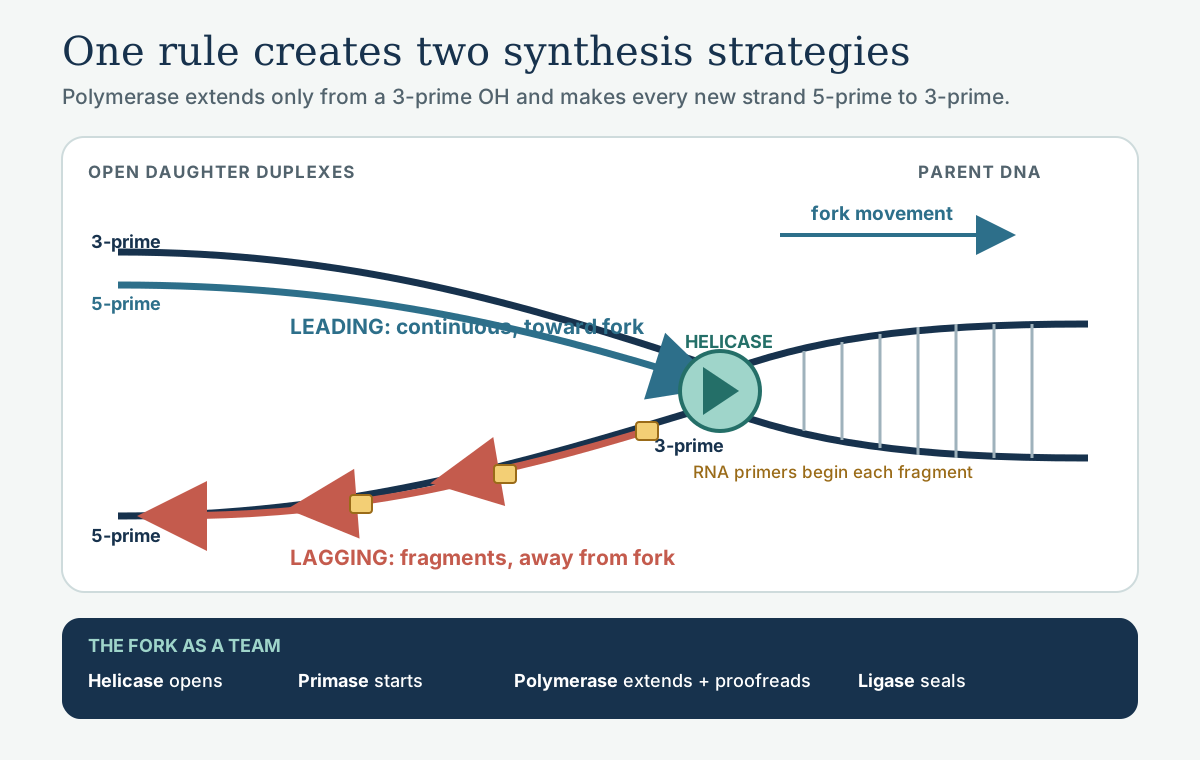
The templates are antiparallel and polymerase only goes 5’→3’, so the two new strands are made differently 1:
- The leading strand is made continuously toward the fork from a single primer.
- The lagging strand is made away from the fork in short Okazaki fragments, each needing its own RNA primer. The primers are later removed and filled with DNA, and ligase joins the fragments.
Quick check
Synthesis on that template must run away from the fork, so it restarts with a new primer as more template is exposed.
Fidelity and proofreading
Two layers keep copying accurate 2:
- Base selection: correct pairs fit the polymerase’s active site far better than wrong ones.
- Proofreading: many polymerases have a 3’→5’ exonuclease that backs up, clips off a mismatched nucleotide, and resumes.
Proofreading cuts errors by orders of magnitude, and mismatch repair catches most of the rest 1. In the lab this matters: Taq polymerase has no proofreading, while high-fidelity enzymes (Pfu and engineered relatives) do, and are chosen for cloning and sequencing templates.
Quick check
The enzyme backs up and clips the mismatched nucleotide off the 3’ end. Taq lacks this activity; high-fidelity enzymes like Pfu have it.
Telomeres and telomerase
Linear chromosomes can’t be fully copied at their ends: when the last lagging-strand primer is removed there’s no 3’ end upstream to fill the gap, so each round shortens the chromosome - the end-replication problem 1.
Telomerase carries its own RNA template and extends the repetitive telomeres (TTAGGG repeats in humans) to compensate. Stem and germ cells keep telomerase active; most somatic cells have little, so their telomeres shorten with age. Most cancers reactivate it.
The recipe for PCR
To copy DNA in a tube, supply exactly what polymerase demands 3:
| In the cell | In PCR |
|---|---|
| helicase separates strands | heat, about 95 °C |
| primase makes RNA primers | synthetic DNA primers flank the target |
| dNTPs from the cell | dNTPs in the master mix |
| replicative polymerase | heat-stable polymerase (Taq) |
| Mg²⁺ cofactor | MgCl₂ in the buffer |
Melt, anneal primers, extend, repeat: each cycle doubles the region between the primers. Amplification is covered in its own course.
Quick check
95 °C melts the template; synthetic DNA primers replace primase’s RNA primers.
What to take from this
Replication is semiconservative and starts at origins, with forks run by helicase, SSBs, topoisomerase, primase, polymerase, and ligase. Polymerase needs a template, a primed 3’-OH, dNTPs, and works only 5’→3’, so the leading strand is continuous and the lagging strand is built from Okazaki fragments. A 3’→5’ exonuclease proofreads (Taq lacks it). Telomerase rebuilds chromosome ends. PCR is replication stripped to polymerase’s requirements, with heat in place of helicase.
Lesson complete
Nice work.
Sources for this lesson
- 1Bruce Alberts, Rebecca Heald, Alexander Johnson, David Morgan, Martin Raff, Keith Roberts, Peter Walter. Molecular Biology of the Cell. 7th ed. W. W. Norton & Company. 2022. verifiedThe canonical cell/molecular biology textbook; used for nucleic-acid chemistry and the central dogma.
- 2David L. Nelson, Michael M. Cox, Aaron A. Hoskins. Lehninger Principles of Biochemistry. 8th ed. W. H. Freeman (Macmillan Learning). 2021. verifiedStandard biochemistry reference for nucleotide chemistry, nucleic-acid structure, and enzymology.
- 3Lela Buckingham. Molecular Diagnostics: Fundamentals, Methods, and Clinical Applications. 3rd ed. F.A. Davis Company. 2019. verifiedThe standard clinical molecular-diagnostics textbook for MLS/MB programs; author holds MB DLM(ASCP). Covers nucleic-acid chemistry, techniques, lab operations, and applications across infectious disease, oncology, genetics, and identity. Primary topic reference for the ASCP MB program.