Transcription and RNA Processing
RNA polymerase reads the template strand from a promoter without a primer; cells make mRNA, tRNA, rRNA, and regulatory RNAs; and eukaryotic pre-mRNA is capped, polyadenylated, and spliced - which is why cDNA lacks introns and why RT-PCR primers span exon junctions.
- 5 min
- 5 steps
- 5 questions
- Lesson 6 of 60
In this lesson
- RNA polymerase
- Classes of RNA
- Processing eukaryotic pre-mRNA
- In the lab
- What to take from this
Picking up where you left off.
RNA polymerase
RNA polymerase copies a stretch of DNA into RNA. Like DNA polymerase it builds 5’→3’, reading the template 3’→5’, but the product uses ribose and puts U opposite A instead of T 1 2. And unlike DNA polymerase, it needs no primer - it starts chains from scratch 1.
Which strand? Only one strand of a gene is read:
| Strand | Also called | Relation to RNA |
|---|---|---|
| Template | antisense | read by the polymerase; complementary to the RNA |
| Coding | sense | same sequence as the RNA, with T for U |
coding    5'-ATGCATGG-3'
template  3'-TACGTACC-5'
mRNA      5'-AUGCAUGG-3'
Gene sequences in databases are written as the coding strand, so they read like the mRNA 2.
Where to start. A promoter upstream of the gene positions the polymerase and sets the direction; in eukaryotes, general transcription factors assemble there first (the TATA box is a classic promoter element) 1.
Playback is optional. If the player is unavailable, open the video at its source.
Quick check
The RNA matches the coding (sense) strand, with U in place of T; it’s built against the template strand.
Quick check
RNA polymerase starts chains from scratch at a promoter; DNA polymerase can only extend a primed 3’ end.
Classes of RNA
| RNA | Job 1 |
|---|---|
| mRNA | carries the coding message to the ribosome |
| tRNA | adaptor matching each codon to its amino acid |
| rRNA | structural and catalytic core of the ribosome; most of a cell’s RNA by mass |
| Regulatory RNAs (microRNA and others) | tune which genes are expressed and how much |
Only mRNA is translated. rRNA genes are conserved enough to compare across species, which is why 16S rRNA sequencing identifies bacteria.
Quick check
rRNA is also the target of 16S sequencing for bacterial identification.
Processing eukaryotic pre-mRNA
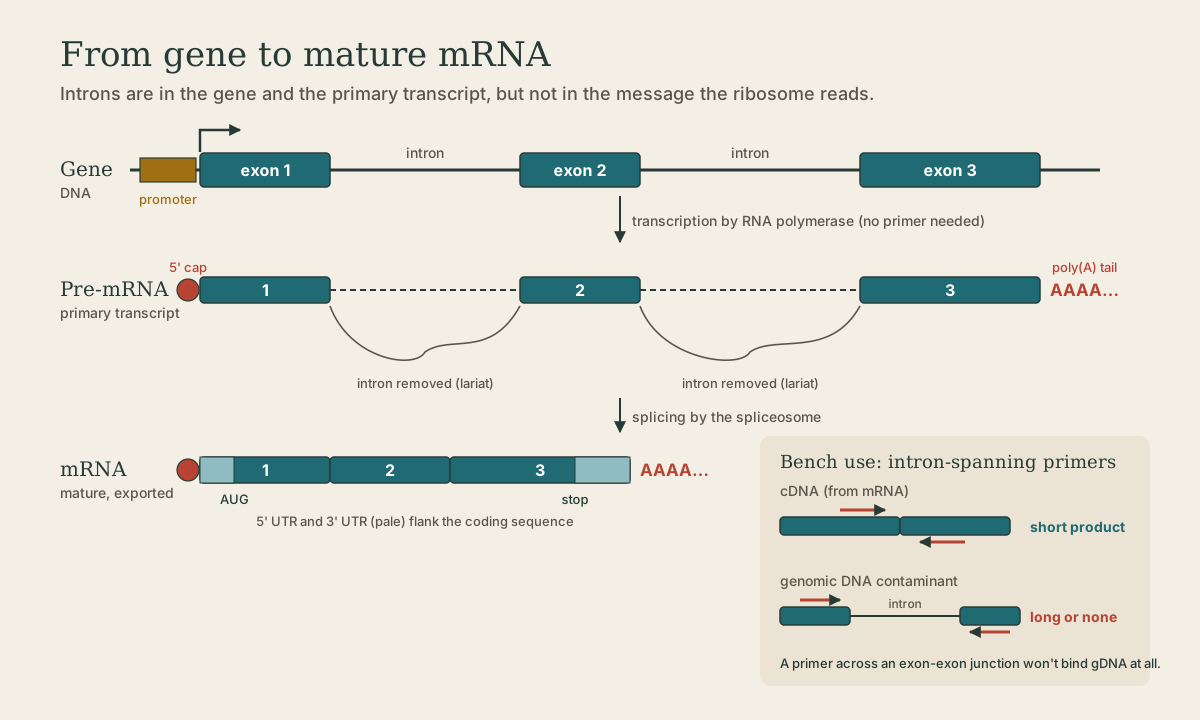
The first transcript, pre-mRNA, gets three modifications, the first two while transcription is still going 1:
- 5’ cap: a modified guanine added to the first nucleotide. Protects the 5’ end and is what the ribosome recognizes to start translation 1.
- Poly(A) tail: the 3’ end is cut and 100-250 adenines added. Helps stability and export 2.
- Splicing: most genes are split into exons separated by introns. The spliceosome (proteins plus small nuclear RNAs) recognizes intron boundaries - nearly always GT at the start and AG at the end - cuts out each intron as a lariat, and joins the exons 1.
Alternative splicing includes or skips different exons, so one gene yields several mRNAs and proteins 1. That’s one reason about 20,000 human genes make far more distinct proteins.
The mature mRNA is cap, 5’ untranslated region, coding sequence, 3’ untranslated region, poly(A). The introns in the gene are gone 2. Bacteria, by contrast, mostly lack introns and translate their mRNA while it’s still being made.
Quick check
Oligo(dT) pairs with poly(A), so it primes cDNA synthesis from mRNA but not rRNA or tRNA.
In the lab
Mature mRNA represents only the exons, and only the genes that cell is actually expressing. Reverse transcriptase copies it into complementary DNA (cDNA), which carries the joined exons and no introns 3. Practical consequences:
- Oligo(dT) priming: a string of Ts pairs with poly(A), so cDNA synthesis can start specifically from mRNA.
- Intron-spanning primers: an RT-PCR assay with primers in two different exons gives a short product from cDNA and a long product (or none) from contaminating genomic DNA. A primer straddling an exon-exon junction won’t bind genomic DNA at all.
- Fusion transcripts: a translocation like BCR::ABL1 joins exons of two genes; RT-PCR across the junction detects the fused mRNA, as in the CML monitoring lesson.
- No-RT control: running the sample without reverse transcriptase checks whether any signal comes from DNA.
RT-PCR is taught in the amplification course.
Quick check
Intron-spanning or junction-spanning primers keep genomic DNA from being counted as RNA.
What to take from this
RNA polymerase reads the template strand from a promoter, needs no primer, and makes RNA matching the coding strand with U for T. Cells make mRNA, tRNA, rRNA, and regulatory RNAs; only mRNA is translated. Eukaryotic pre-mRNA is capped, polyadenylated, and spliced (introns out at GT…AG, exons joined), and alternative splicing makes several mRNAs from one gene. cDNA from mRNA has no introns, so oligo(dT) priming, intron-spanning primers, and no-RT controls follow directly from processing.
Lesson complete
Nice work.
Sources for this lesson
- 1Bruce Alberts, Rebecca Heald, Alexander Johnson, David Morgan, Martin Raff, Keith Roberts, Peter Walter. Molecular Biology of the Cell. 7th ed. W. W. Norton & Company. 2022. verifiedThe canonical cell/molecular biology textbook; used for nucleic-acid chemistry and the central dogma.
- 2David L. Nelson, Michael M. Cox, Aaron A. Hoskins. Lehninger Principles of Biochemistry. 8th ed. W. H. Freeman (Macmillan Learning). 2021. verifiedStandard biochemistry reference for nucleotide chemistry, nucleic-acid structure, and enzymology.
- 3Lela Buckingham. Molecular Diagnostics: Fundamentals, Methods, and Clinical Applications. 3rd ed. F.A. Davis Company. 2019. verifiedThe standard clinical molecular-diagnostics textbook for MLS/MB programs; author holds MB DLM(ASCP). Covers nucleic-acid chemistry, techniques, lab operations, and applications across infectious disease, oncology, genetics, and identity. Primary topic reference for the ASCP MB program.