Polymerases and Reverse Transcriptase
The synthesis enzymes as reagents in a tube: what every DNA polymerase needs, why Taq survives cycling, proofreading versus Taq's 5'-to-3' nuclease, hot-start enzymes, strand-displacing polymerases for isothermal methods, phage RNA polymerases, and reverse transcriptase with its three priming choices.
- 6 min
- 9 steps
- 5 questions
- Lesson 9 of 60
In this lesson
- Enzymes in a tube
- What every DNA polymerase needs
- Thermostable polymerases
- Fidelity and proofreading
- Taq and hydrolysis probes
- Strand-displacing polymerases
- RNA polymerases as reagents
- Reverse transcriptase
- What to take from this
Picking up where you left off.
Enzymes in a tube
The replication and transcription enzymes from the last module are sold as purified reagents. For each one, the practical questions are what it needs, what it makes, and which of its activities an assay is built on.
What every DNA polymerase needs
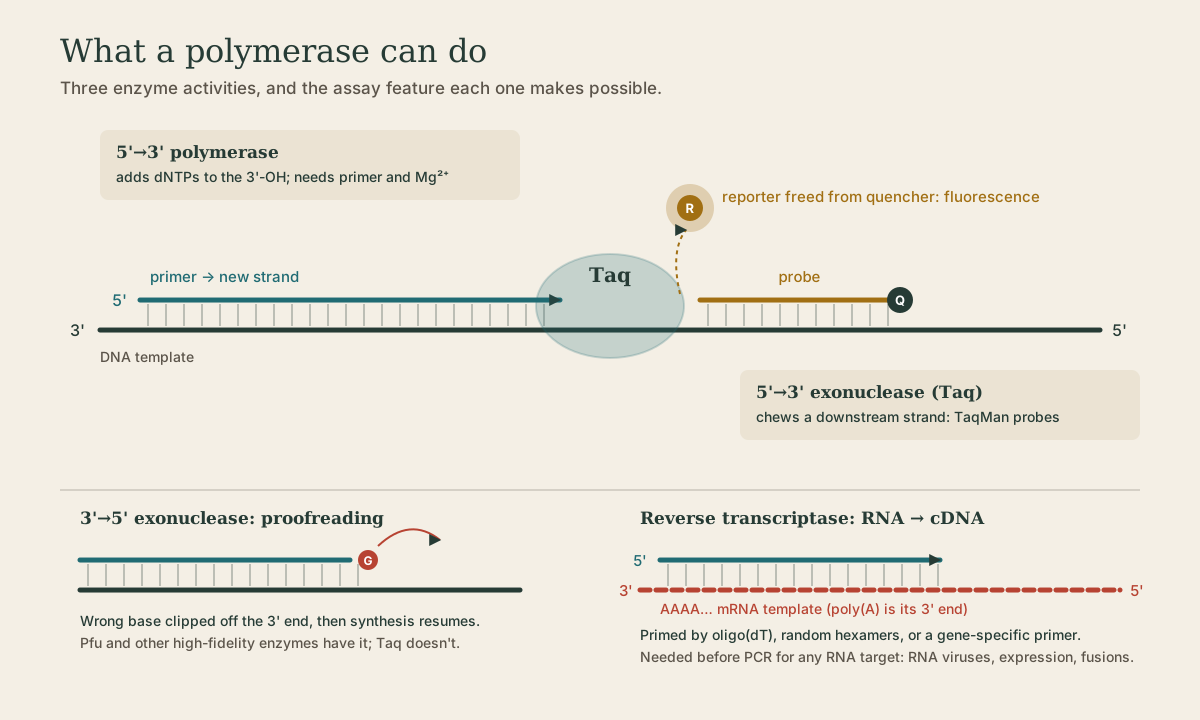
Every DNA polymerase needs 1:
- a template to copy (single-stranded where it’s being read);
- a primer with a free 3’-OH - no polymerase starts DNA from nothing;
- the four dNTPs;
- Mg²⁺ for catalysis.
Synthesis runs 5’→3’, and each addition releases pyrophosphate 2. Each requirement turns into an assay variable: primers must be designed and oriented toward each other, Mg²⁺ is tuned (too little and yield drops; too much and specificity drops), and dNTPs must be balanced.
Quick check
Promoters position RNA polymerase. DNA polymerase needs template, primer, dNTPs, and Mg²⁺.
Thermostable polymerases
Ordinary enzymes die at the 95 °C needed to separate DNA strands. Taq polymerase from Thermus aquaticus, a bacterium from Yellowstone hot springs, survives repeated near-boiling steps and resumes work when the temperature drops 3. One enzyme addition lasts the whole run, which made automated thermal cycling practical. Taq extends best around 72 °C, at roughly 1,000 bases per minute.
Hot-start versions are blocked by an antibody, chemical modification, or aptamer until the first heating step. This stops the enzyme from extending primers that have bound loosely to each other or off-target while the reaction sits at room temperature, so there are fewer primer dimers and nonspecific products.
Quick check
From the hot-spring bacterium Thermus aquaticus; it doesn’t need replacing after each denaturation.
Fidelity and proofreading
Some polymerases have a 3’→5’ exonuclease that backs up, removes a wrong base, and tries again 1. Taq lacks it; high-fidelity enzymes (Pfu from Pyrococcus furiosus and engineered successors) have it and make an order of magnitude or more fewer errors 3.
| Need | Choose |
|---|---|
| Accurate copy for cloning or a sequencing template | proofreading high-fidelity polymerase |
| Robust detection, qPCR, genotyping | Taq-based, hot-start |
| Probe cleavage (TaqMan) | Taq-type enzyme with 5’→3’ nuclease |
Taq also tends to add one extra A to the 3’ end of its products - the basis of “TA cloning.” Proofreading enzymes leave blunt ends.
Quick check
Proofreading lowers the error rate by roughly an order of magnitude or more compared with Taq.
Taq and hydrolysis probes
Taq has a second nuclease running the other way: a 5’→3’ exonuclease that chews up any strand bound downstream in its path 3. If that strand is a probe carrying a reporter dye at one end and a quencher at the other, cutting it frees the reporter and the tube fluoresces. That’s hydrolysis-probe (TaqMan) real-time PCR, covered in the amplification course. Many high-fidelity enzymes lack this activity and won’t work with hydrolysis probes.
Quick check
Taq cuts the probe bound ahead of it, separating reporter from quencher.
Strand-displacing polymerases
Some polymerases, such as Bst (from Geobacillus stearothermophilus) and phage phi29, push a downstream strand aside instead of cutting it. That lets them copy double-stranded DNA without heat denaturation, which is the basis of isothermal methods: LAMP (Bst at about 65 °C) and whole-genome amplification (phi29). Isothermal tests need only a heat block, which is why they show up in point-of-care devices.
RNA polymerases as reagents
RNA polymerases need no primer, read 3’→5’, build 5’→3’, and use NTPs and Mg²⁺ 2. Phage enzymes (T7, T3, SP6) each start only at their own short promoter, so a template carrying a T7 promoter can be transcribed into large amounts of defined RNA: labeled RNA probes, RNA standards and controls 3. T7 RNA polymerase is also the amplification engine in transcription-mediated amplification (TMA), used in some high-volume chlamydia and gonorrhea assays.
Reverse transcriptase
Reverse transcriptase (RT) is an RNA-dependent DNA polymerase: it copies RNA into complementary DNA (cDNA) 1. It comes from retroviruses, whose RNA genomes are copied into DNA during infection 2. Like any DNA polymerase it needs a primer, dNTPs, and a metal ion 3.
Common lab enzymes are derived from Moloney murine leukemia virus (MMLV) and avian myeloblastosis virus (AMV), often engineered to work at 50 °C or above, which helps melt RNA secondary structure.
Priming choices:
| Primer | Binds | Use |
|---|---|---|
| Oligo(dT) | poly(A) tails | mRNA only; full-length cDNA from intact RNA |
| Random hexamers | anywhere | all RNA, fragmented RNA (FFPE), non-polyadenylated viral RNA |
| Gene-specific | one target | most sensitive for a single target; one-step RT-PCR |
PCR polymerases copy DNA, so every RNA target - RNA viruses like HIV, HCV, SARS-CoV-2, and influenza; gene expression; fusion transcripts like BCR::ABL1 - starts with reverse transcription 3.
Quick check
Oligo(dT) needs an intact poly(A) tail; random hexamers prime anywhere.
What to take from this
DNA polymerases need a template, a primed 3’-OH, dNTPs, and Mg²⁺, and build 5’→3’. Taq survives cycling but doesn’t proofread; hot-start versions cut primer dimers; proofreading enzymes (Pfu) copy far more accurately. Taq’s 5’→3’ nuclease powers TaqMan probes, and strand-displacing enzymes (Bst, phi29) allow isothermal amplification. Phage RNA polymerases (T7, SP6) transcribe from their own promoters without a primer. Reverse transcriptase turns RNA into cDNA, primed by oligo(dT), random hexamers, or a gene-specific primer.
Lesson complete
Nice work.
Sources for this lesson
- 1Bruce Alberts, Rebecca Heald, Alexander Johnson, David Morgan, Martin Raff, Keith Roberts, Peter Walter. Molecular Biology of the Cell. 7th ed. W. W. Norton & Company. 2022. verifiedThe canonical cell/molecular biology textbook; used for nucleic-acid chemistry and the central dogma.
- 2David L. Nelson, Michael M. Cox, Aaron A. Hoskins. Lehninger Principles of Biochemistry. 8th ed. W. H. Freeman (Macmillan Learning). 2021. verifiedStandard biochemistry reference for nucleotide chemistry, nucleic-acid structure, and enzymology.
- 3Lela Buckingham. Molecular Diagnostics: Fundamentals, Methods, and Clinical Applications. 3rd ed. F.A. Davis Company. 2019. verifiedThe standard clinical molecular-diagnostics textbook for MLS/MB programs; author holds MB DLM(ASCP). Covers nucleic-acid chemistry, techniques, lab operations, and applications across infectious disease, oncology, genetics, and identity. Primary topic reference for the ASCP MB program.