Microbial Genetics
Bacterial chromosomes, operons, and plasmids; transformation, transduction, and conjugation; resistance genes as direct test targets (mecA, vanA/B, carbapenemases) and their limits; 16S and ITS for identification; and why RNA viruses mutate into quasispecies, genotypes, and drug resistance.
- 6 min
- 7 steps
- 5 questions
- Lesson 13 of 60
In this lesson
- Bacterial genomes
- Horizontal gene transfer
- Resistance genes as targets
- Identification targets
- Viral genomes change fast
- How microbial targets differ
- What to take from this
Picking up where you left off.
Bacterial genomes
Most bacteria keep their essential genes on one circular chromosome in the cytoplasm, with no nucleus 1. The genome is compact (E. coli is about 4.6 million bp) and gene-dense, with little noncoding DNA and almost no introns. Related genes often sit together in operons: several genes transcribed from one promoter as one mRNA and switched on and off together, like the lac operon for lactose use 1.
Many bacteria also carry plasmids - small, independently replicating circles, one to many per cell 1. They aren’t needed for basic survival, but they often carry genes that help in a particular environment, above all antimicrobial-resistance genes 2. Transposons (“jumping genes”) can move resistance genes between plasmids and the chromosome.
Quick check
The lac operon is the textbook example: genes for lactose use, switched on together.
Horizontal gene transfer
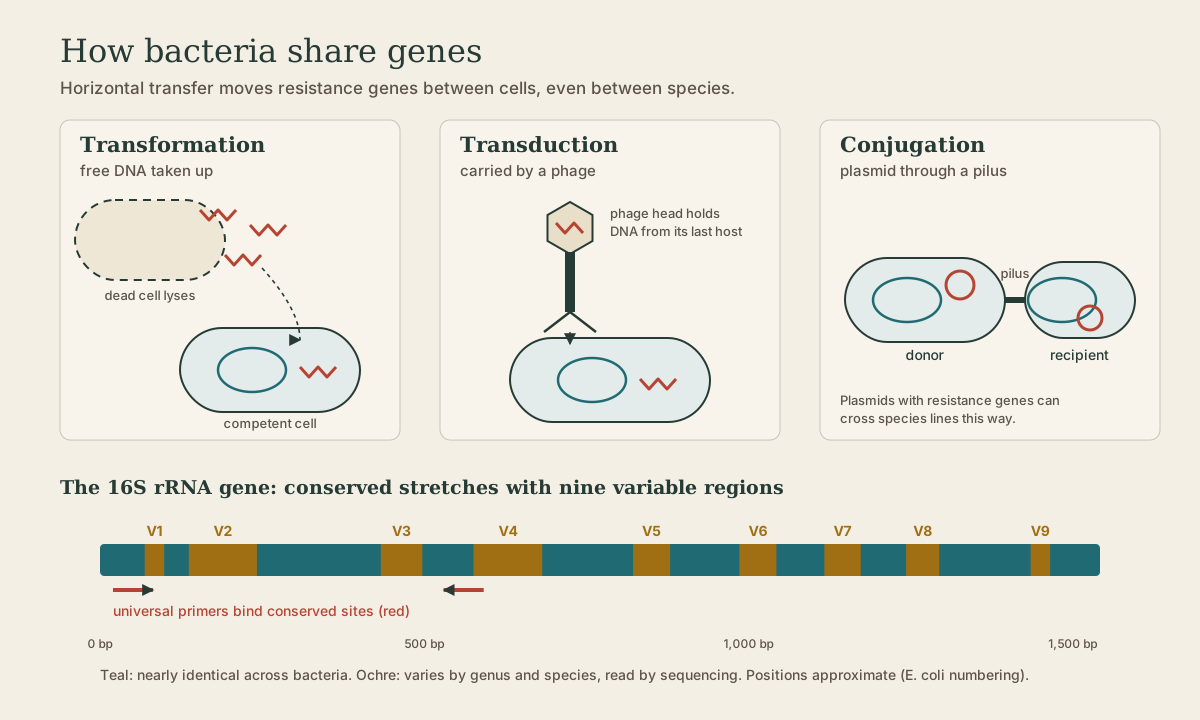
Besides inheriting genes from a parent cell, bacteria pick up DNA from neighbors - horizontal gene transfer - which is why resistance spreads so fast 1.
| Mechanism | How DNA moves 1 | Example |
|---|---|---|
| Transformation | a competent cell takes up free DNA from lysed cells | Streptococcus pneumoniae picking up altered penicillin-binding protein genes |
| Transduction | a phage packages host DNA by mistake and injects it into the next cell | spread of toxin and resistance genes in S. aureus |
| Conjugation | direct contact through a pilus, usually passing a plasmid | carbapenemase plasmids moving among Enterobacterales |
A plasmid-borne gene can jump species by conjugation, so resistance can appear in an unrelated organism without any new mutation 2.
Quick check
Conjugation is cell-to-cell transfer, usually of plasmids, and can cross species.
Resistance genes as targets
Once a resistance gene is a known sequence, a lab can test for it directly instead of waiting a day or two for growth in the presence of drugs 2:
| Gene | Organism | Effect |
|---|---|---|
| mecA (and mecC) | S. aureus (MRSA), coagulase-negative staphylococci | encodes PBP2a, a beta-lactam target the drugs barely bind: resistance to methicillin and most beta-lactams 2 |
| vanA, vanB | enterococci (VRE) | rebuild the cell-wall target so vancomycin binds poorly 2 |
| blaKPC, NDM, OXA-48, VIM, IMP | Enterobacterales, Pseudomonas, Acinetobacter | carbapenemases that destroy carbapenems |
| blaCTX-M | E. coli, Klebsiella | extended-spectrum beta-lactamase (ESBL) |
Rapid panels on positive blood cultures report these within hours, letting antibiotics be adjusted early. The limits:
- Detected usually means resistant, but a gene can be present and not expressed.
- Not detected doesn’t mean susceptible: other genes or mutations can cause resistance. Phenotypic susceptibility testing still runs alongside.
- Variant genes (mecC instead of mecA) can escape an assay’s primers.
Quick check
mecA encodes PBP2a, which beta-lactams bind poorly. mecC is a rarer homolog that some mecA assays miss.
Identification targets
To identify an organism, a test needs a sequence present in every member of the group and reliable as a fingerprint - usually a slowly changing essential gene 2:
- 16S rRNA gene (bacteria): about 1,500 bp, with conserved stretches where universal primers bind and nine variable regions (V1-V9) that differ by genus and species. Sequencing it identifies organisms that won’t grow or can’t be identified by phenotype. Its resolution is limited for very close relatives (it can’t separate E. coli from Shigella).
- ITS region (fungi): the internal transcribed spacers between ribosomal RNA genes, with conserved flanks around a variable core 2.
Ribosomal genes are present in every cell and often in several copies (E. coli has seven rRNA operons), and each cell holds thousands of ribosomes, so rRNA targets are both universal and abundant 3. In routine bacteriology, MALDI-TOF mass spectrometry of ribosomal proteins now does most identification; sequencing handles the hard cases.
Quick check
Fungi use the ITS region on the same logic.
Viral genomes change fast
Viral genomes can be DNA or RNA, single- or double-stranded, and one piece or segmented 1 (see the genome table in Chromosome and Extrachromosomal Structure). RNA viruses copy themselves with enzymes that don’t proofread, so they mutate fast 1. One infected person carries a swarm of related variants, a quasispecies, on which drugs and immunity select. Consequences:
| Phenomenon | Example |
|---|---|
| Genotypes | HCV genotypes (1 through 6 and beyond) once decided drug choice and treatment length |
| Drug resistance mutations | HIV reverse transcriptase and protease mutations, found by resistance genotyping before therapy |
| Drift | point mutations in influenza surface proteins, the reason for yearly vaccine updates |
| Shift (reassortment) | influenza’s 8 RNA segments swapping between strains in a co-infected host, creating new subtypes |
| Primer escape | variants with mismatches under primers or probes, a reason assays target two regions |
DNA viruses mutate more slowly, but even CMV develops resistance mutations (in UL97 and UL54) under antiviral pressure.
Quick check
High error rates plus fast replication generate variants on which drugs and immunity select. Influenza also reassorts its segments.
How microbial targets differ
| Property | Human target | Microbial target |
|---|---|---|
| Copy number | 2 per cell for a nuclear gene | one chromosome, but multicopy rRNA genes and plasmids |
| Conservation | one reference genome | conserved genes (16S, ITS) allow one assay for many species |
| Variability | low, germline | high in RNA viruses; resistance genes move between species |
Copy number sets how much template a specimen gives; conservation decides whether one assay can catch many organisms; variability decides whether a fixed probe keeps working 2.
What to take from this
Bacteria carry a compact circular chromosome with operons, plus plasmids that often hold resistance genes. Transformation, transduction, and conjugation move genes between cells and species. Resistance genes like mecA, vanA/B, and carbapenemases can be detected directly, but “not detected” doesn’t mean susceptible. 16S (bacteria) and ITS (fungi) identify organisms through conserved primer sites around variable regions. RNA viruses mutate into quasispecies, which gives genotypes, drug resistance, influenza drift and shift, and primer escape.
Lesson complete
Nice work.
Sources for this lesson
- 1Bruce Alberts, Rebecca Heald, Alexander Johnson, David Morgan, Martin Raff, Keith Roberts, Peter Walter. Molecular Biology of the Cell. 7th ed. W. W. Norton & Company. 2022. verifiedThe canonical cell/molecular biology textbook; used for nucleic-acid chemistry and the central dogma.
- 2Lela Buckingham. Molecular Diagnostics: Fundamentals, Methods, and Clinical Applications. 3rd ed. F.A. Davis Company. 2019. verifiedThe standard clinical molecular-diagnostics textbook for MLS/MB programs; author holds MB DLM(ASCP). Covers nucleic-acid chemistry, techniques, lab operations, and applications across infectious disease, oncology, genetics, and identity. Primary topic reference for the ASCP MB program.
- 3David L. Nelson, Michael M. Cox, Aaron A. Hoskins. Lehninger Principles of Biochemistry. 8th ed. W. H. Freeman (Macmillan Learning). 2021. verifiedStandard biochemistry reference for nucleotide chemistry, nucleic-acid structure, and enzymology.