Assessing Nucleic Acid Quality and Quantity
The extract gate: A260 concentration with worked dilution math, what A260/A280 and A260/A230 ratios reveal, why fluorometry beats UV for a specific target, and reading integrity from a gel, the 28S:18S ratio, RIN, and DV200.
- 5 min
- 6 steps
- 4 questions
- Lesson 16 of 60
In this lesson
- The gate
- UV spectrophotometry
- Fluorometry
- Integrity
- Putting it together
- What to take from this
Picking up where you left off.
The gate
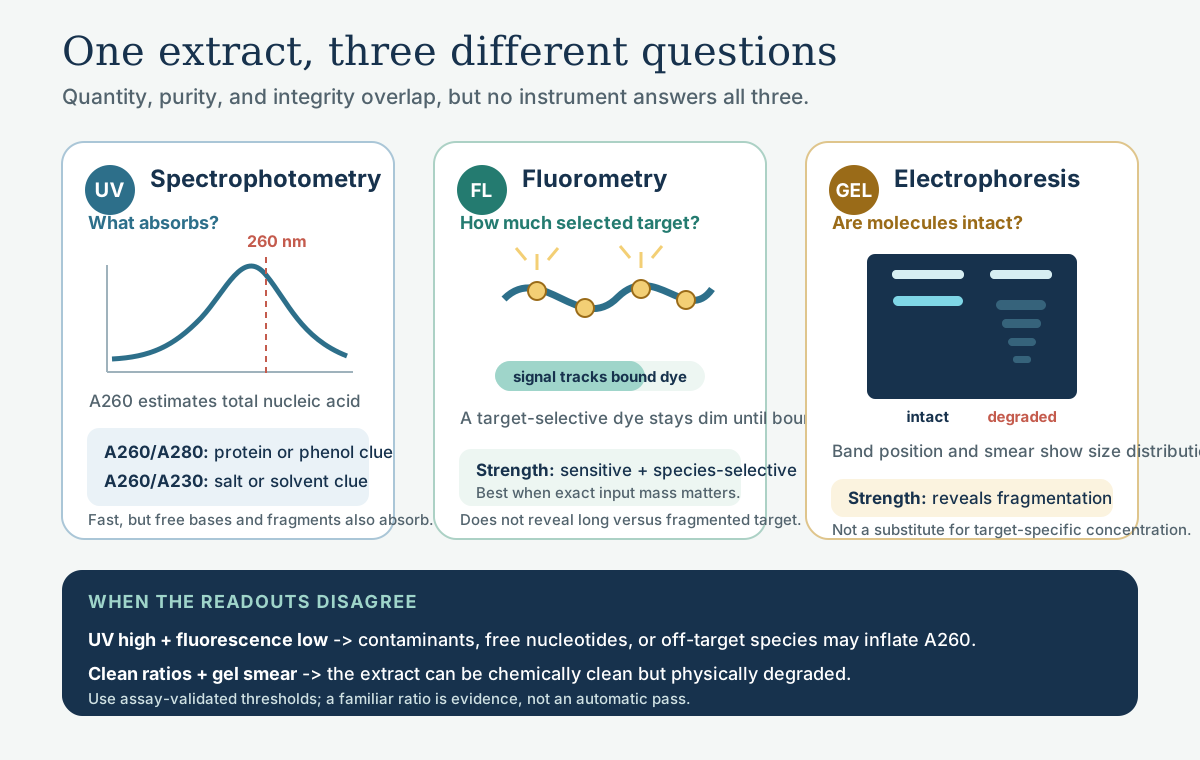
Before an extract goes into an assay, the lab needs to know how much nucleic acid there is and how clean and intact it is. An abundant but contaminated or degraded extract fails as surely as a dilute one 1. The answer decides whether a specimen goes forward, gets re-extracted, or is rejected.
UV spectrophotometry
Bases absorb UV maximally at 260 nm 2. At a 1-cm path, A260 = 1.0 corresponds to about 3:
| Nucleic acid | ng/µL per A260 unit |
|---|---|
| double-stranded DNA | 50 |
| single-stranded RNA | 40 |
| single-stranded DNA (oligos) | about 33 |
Concentration = A260 × factor × dilution. A dsDNA sample diluted 1:10 reading A260 = 0.25 is 0.25 × 50 × 10 = 125 ng/µL. Readings are most reliable in the instrument’s linear range, roughly A260 0.1-1.0; micro-volume instruments read undiluted.
| Ratio | Pure | Low value means |
|---|---|---|
| A260/A280 | about 1.8 for DNA, 2.0 for RNA | protein or phenol |
| A260/A230 | about 2.0-2.2 | guanidinium, phenol, carbohydrate, EDTA |
A DNA prep reading well above 1.8 for A260/A280 may carry RNA. A low A260/A230 with a normal A260/A280 is the classic signature of chaotropic salt carryover from a silica kit - a cue to repeat the wash.
The limitation: UV measures everything that absorbs at 260 nm - RNA in a DNA prep, free nucleotides, degraded fragments - so it can overstate usable target.
Quick check
0.15 × 50 ng/µL × 20 = 150 ng/µL.
Quick check
A260/A280 is fine; a low A260/A230 points to guanidinium, phenol, or carbohydrate carryover.
Fluorometry
Fluorometric assays use dyes that fluoresce only when bound to a specific species - double-stranded DNA, RNA, or single-stranded DNA - and read against standards 1. Free nucleotides, protein, and other nucleic acid types contribute little signal, so fluorometry is more specific and more sensitive than UV, down to low picogram-per-microliter levels.
Use it whenever an assay calls for a defined input mass - NGS library preparation, for example - or when samples are dilute. It’s normal for a fluorometric dsDNA value to come in lower than the UV value for the same extract.
Quick check
For a defined input mass (as in NGS library prep), trust the fluorometric value.
Integrity
Concentration and purity say nothing about whether the molecules are whole.
- Genomic DNA: intact DNA runs as a tight high-molecular-weight band near the wells; degraded DNA smears down the lane.
- Total RNA: dominated by ribosomal RNA. Intact RNA shows sharp 28S and 18S bands, the 28S about twice as intense as the 18S; degradation fades 28S first and adds a low-molecular-weight smear 3.
- Instrument scores: microfluidic electrophoresis assigns an RNA integrity number (RIN) from 1 (degraded) to 10 (intact) 1. Many expression assays want RIN above about 7. For FFPE RNA, where every sample is fragmented, labs use DV200: the percentage of RNA fragments longer than 200 nucleotides. Similar scores exist for DNA.
Quick check
Degradation fades the 28S band first and adds a low-molecular-weight smear; RIN formalizes this on a 1-10 scale.
Putting it together
| Result | Interpretation | Action |
|---|---|---|
| Good UV and fluorometry, tight band | fit to use | proceed |
| Low A260/A230 | chaotrope carryover | re-wash or re-purify |
| Low A260/A280 | protein or phenol | re-extract or clean up |
| UV much higher than fluorometry | RNA, nucleotides, or degraded fragments | rely on fluorometry; check integrity |
| Smear or low RIN | degraded | shorter amplicons, re-collect, or reject |
The acceptance thresholds come from the assay’s validation and are documented as part of quality assurance (see the lab operations course).
What to take from this
Concentration = A260 × 50 (dsDNA) or 40 (RNA) × dilution. A260/A280 of about 1.8 (DNA) or 2.0 (RNA) rules out protein and phenol; A260/A230 of about 2.0-2.2 rules out guanidinium and similar carryover. Fluorometry measures a specific target and is preferred for defined inputs. Integrity comes from a gel or a score: a tight high-molecular-weight DNA band, sharp 28S:18S at about 2:1, RIN, or DV200 for FFPE RNA.
Lesson complete
Nice work.
Sources for this lesson
- 1Lela Buckingham. Molecular Diagnostics: Fundamentals, Methods, and Clinical Applications. 3rd ed. F.A. Davis Company. 2019. verifiedThe standard clinical molecular-diagnostics textbook for MLS/MB programs; author holds MB DLM(ASCP). Covers nucleic-acid chemistry, techniques, lab operations, and applications across infectious disease, oncology, genetics, and identity. Primary topic reference for the ASCP MB program.
- 2Bruce Alberts, Rebecca Heald, Alexander Johnson, David Morgan, Martin Raff, Keith Roberts, Peter Walter. Molecular Biology of the Cell. 7th ed. W. W. Norton & Company. 2022. verifiedThe canonical cell/molecular biology textbook; used for nucleic-acid chemistry and the central dogma.
- 3Michael R. Green, Joseph Sambrook. Molecular Cloning: A Laboratory Manual. 4th ed. Cold Spring Harbor Laboratory Press. 2012. verifiedThe classic three-volume molecular-biology methods manual — authoritative for nucleic-acid isolation, electrophoresis, restriction digestion, labeling, and hybridization techniques. Standard-tier topic reference for the techniques courses.