Columns, Beams, and Arches
Every building is a way of getting weight down to the ground. Stone and concrete are strong when squeezed and weak when stretched. A beam bends, squeezing its top and stretching its bottom, so a stone beam cracks from underneath and can't span far. An arch turns the load into pure squeezing, but it pushes outward at its feet and needs something to lean on. Robert Hooke found the perfect arch shape by hanging a chain and turning it upside down, and the Pont du Gard carried a Roman aqueduct across a river valley on three tiers of arches.
- 5 min
- 6 steps
- 3 questions
- Lesson 42 of 49
In this lesson
- Squeezing and stretching
- The beam
- The arch
- Hooke’s hanging chain
- Try it
Picking up where you left off.
Every building, from a garden shed to a cathedral, is a way of getting weight down to the ground. The roof, the floors, the people, the snow, and the building’s own weight all have to travel through something solid until they reach the earth. How a building does that, and what it’s made of, decides almost everything about how it looks.
Squeezing and stretching
Two kinds of force do most of the work. Compression squeezes a material, pushing its parts together. Tension stretches it, pulling its parts apart. A column holding up a roof is in compression; a rope holding up a swing is in tension.
Materials differ wildly in how well they take each one. Stone, brick, and concrete are strong in compression and weak in tension: concrete can carry big loads when squeezed but is “very poor at carrying loads in tension” 1. Wood and steel handle both. Most of the history of building is people finding shapes that let stone and brick work only in the way they’re strong.
The beam
The simplest way to span a gap is to lay something across it: a beam on two posts, or a stone lintel over a doorway. Put a load on the middle and the beam bends. Its top edge gets shorter and is squeezed; its bottom edge gets longer and is stretched 1.
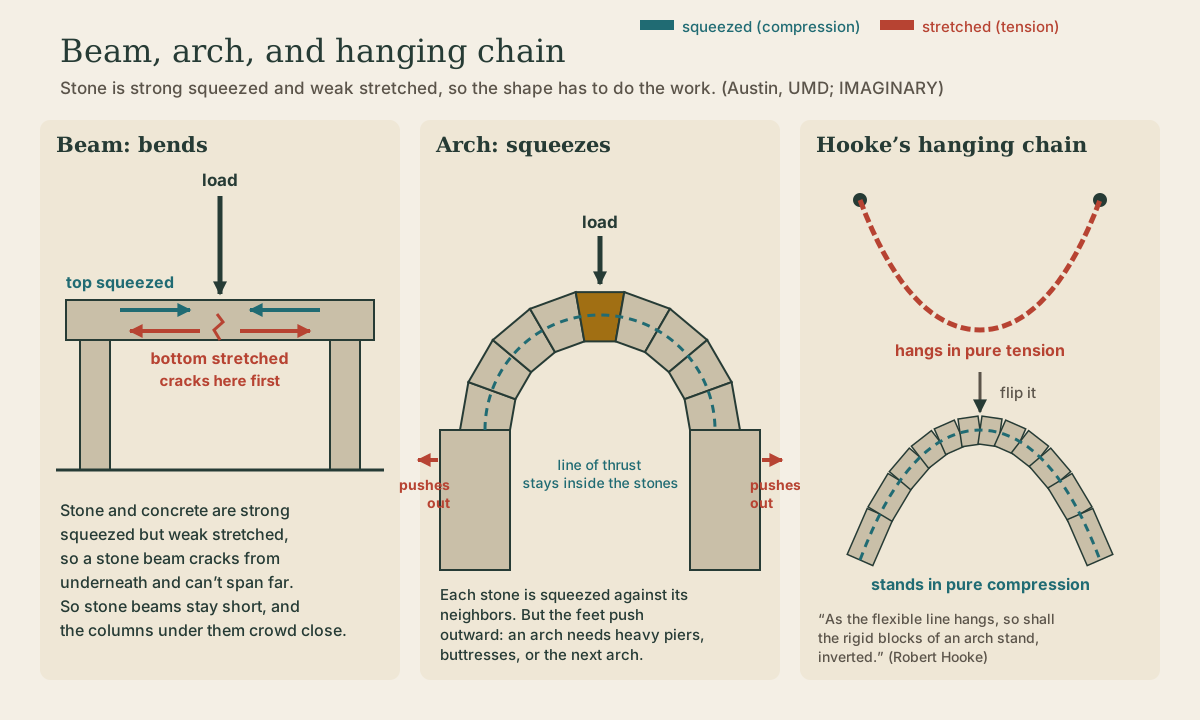
Stone takes the squeezing on top without trouble. But the stretched bottom is where it’s weak, and that’s where cracks begin 1. So a stone beam can only span a short gap before its own weight is enough to crack it. Stone-beam buildings need their posts close together, which is why a row of stone columns has narrow spaces between them. Wood, which handles tension, can span farther, and steel farther still.
Quick check
Stone and concrete resist squeezing well and stretching poorly, so the stretched bottom fails first.
The arch
The way out is to stop asking stone to bend. An arch is a curve of wedge-shaped stones, called voussoirs, each pressed against its neighbors. The weight on top travels around the curve as pure squeezing, so every stone works in compression, the way stone is strong. Austin’s lecture notes call this removing “the constraint that beams are straight,” and it shrinks the bending to almost nothing 1.
But there’s a price. A beam just pushes straight down on its posts; an arch also pushes outward at its feet. Those sideways forces have to be resisted, and Austin notes the assumption every arch rests on: its supports will not move 1. Let them spread and the arch falls. That’s why arches stand on massive piers, lean against thick walls or buttresses, or, as in a row of arches, lean on each other, the outward push of one canceling the push of the next.
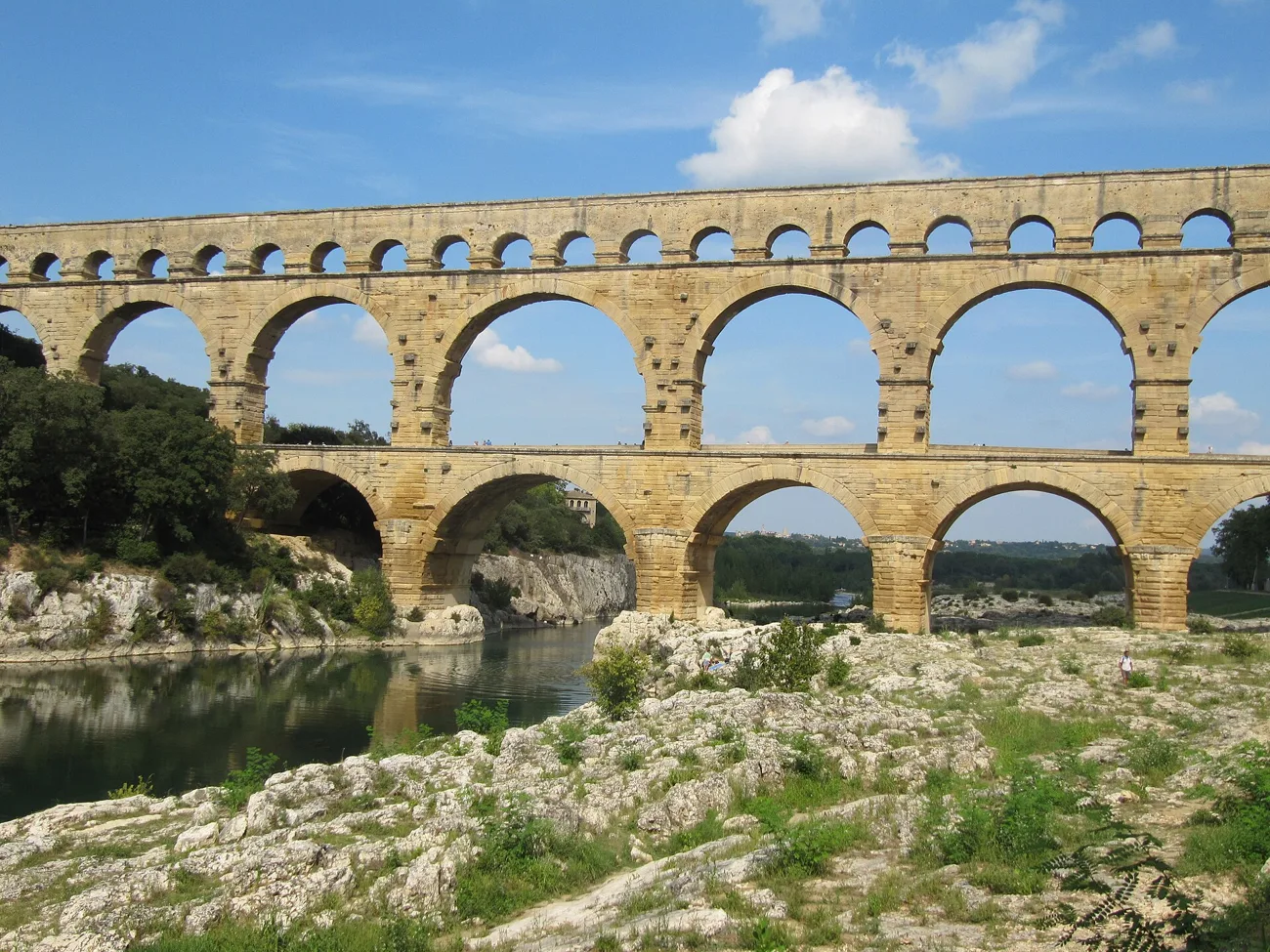
The Romans built arches on a scale nobody had before. The Pont du Gard in southern France, built shortly before the Christian era, carries the aqueduct of Nîmes, a channel almost 50 kilometers long, across the Gardon river on three tiers of arches almost 50 meters high, the longest tier 275 meters 2.

Quick check
An arch carries load by squeezing, but it pushes sideways at its supports, and if they move, it falls.
Hooke’s hanging chain
What’s the best shape for an arch? In the 1670s the English scientist Robert Hooke published the answer as a Latin anagram, a coded sentence, which decoded reads: “As the flexible line hangs, so shall the rigid blocks of an arch stand, inverted” 3.
Hang a chain loosely between two nails. It sags into a curve called a catenary, and every link is in pure tension, because a chain can’t do anything else. Flip that curve upside down and every force reverses: tension becomes compression, and you have an arch in which every stone is squeezed and nothing bends. Mathematicians with the IMAGINARY project tested this by 3D-printing arches shaped as a pointed Gothic arch, an ellipse, a parabola, and a catenary, all the same span and length, and holding the blocks together with a thread. When they loosened the thread, only the catenary kept standing 3.
Real arches carry more than their own weight, so they aren’t all catenaries. But the principle holds: an arch stands as long as its line of thrust, the path the squeezing force takes, stays inside the stones. When it wanders outside, the arch hinges open and collapses 3.
Playback is optional. If the player is unavailable, open the video at its source.
Quick check
‘As the flexible line hangs, so shall the rigid blocks of an arch stand, inverted.’ The curve is called a catenary.
Try it
Look at the windows of an old brick building. Over each opening there’s either a flat lintel (stone, or a steel angle hidden behind the bricks) or a shallow arch of bricks set on end. Find an arch and look at its ends: what’s holding the feet in? Usually it’s simply the heavy wall on either side. Then hang a necklace or a bike chain from two fingers and look at the curve upside down.
Lesson complete
Nice work.
Sources for this lesson
- 1Mark A. Austin. Arch Structures (ENCE 353 lecture notes, part 1). University of Maryland, Department of Civil and Environmental Engineering. 2025. verifiedSimply supported beam: compression on top, tension on the bottom; cracking starts at the tension face. Concrete carries compression well but is very poor in tension; strategy 1, reinforced concrete beam (post-1850), steel at the tension face; strategy 2, prestressing; strategy 3, remove the constraint that the beam be straight: an arch reduces bending moments but introduces horizontal reactions at the supports, which must not move. Pont du Gard carried water about 50 km.
- 2Pont du Gard (Roman Aqueduct). UNESCO World Heritage Centre. verifiedBuilt shortly before the Christian era to carry the aqueduct of Nîmes (almost 50 km long) across the Gardon. Almost 50 m high, on three levels, the longest 275 m.
- 3Jelena Bekavac Krčadinac, Goran Igaly, Vedran Krčadinac. All Manner of Arches. IMAGINARY. verifiedRobert Hooke's anagram in A description of helioscopes: 'Ut pendet continuum flexile, sic stabit contiguum rigidum inversum' (As the flexible line hangs, so shall the rigid blocks of an arch stand, inverted). 3D-printed Gothic, elliptical, parabolic, and catenary arches of equal span and length, held by a thread; when the thread is loosened only the catenary stands. The catenary is the ideal shape of a self-supporting arch under its own weight; the others collapse where the line of thrust leaves the profile.