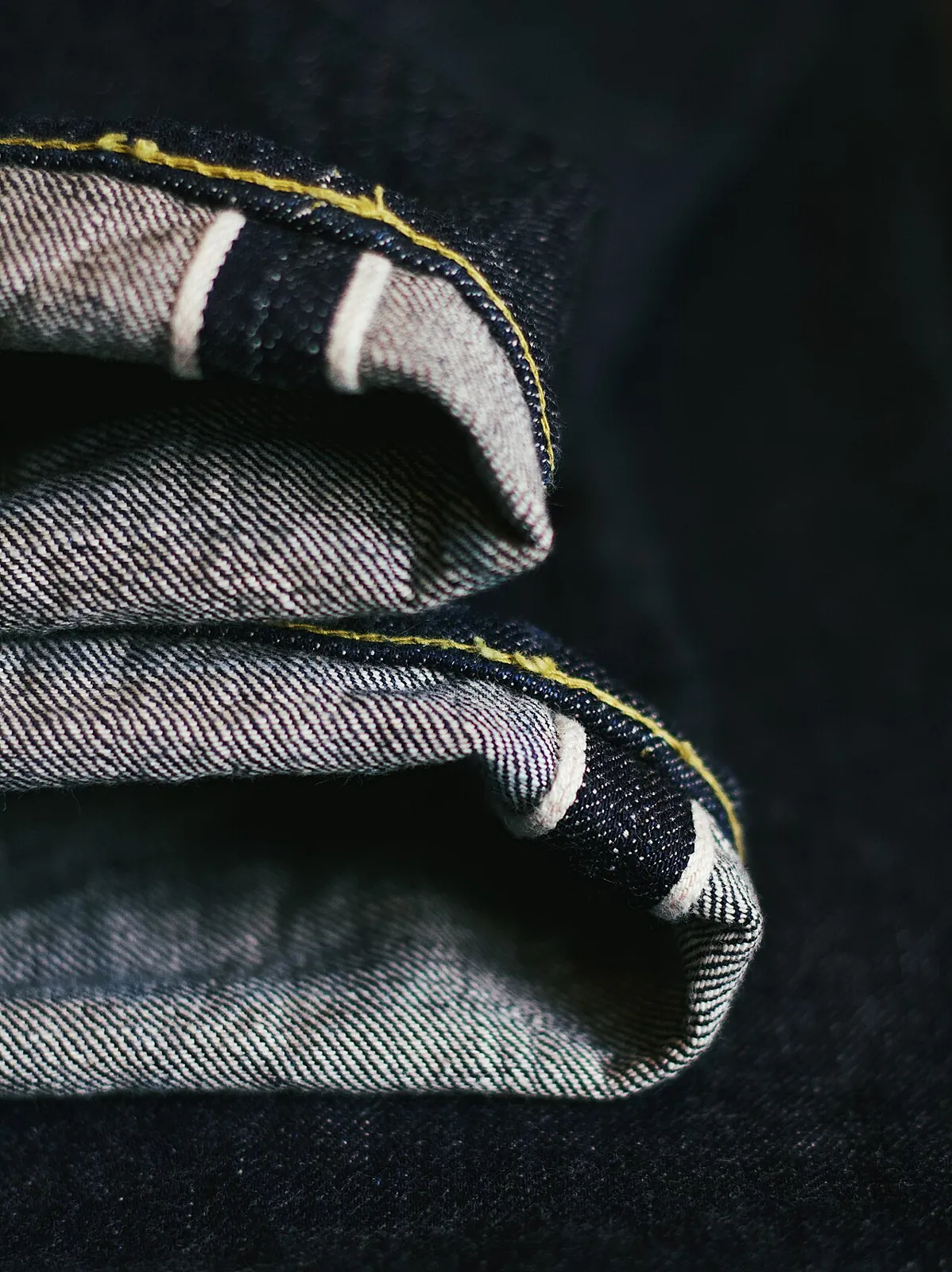
Denim: Beyond the Selvedge ID
Reading jeans beyond the selvedge edge: why selvedge marks a loom, not a grade, cotton classing, ring-spun and open-end yarn, the indigo dye system, fabric geometry, garment construction, and what raw, one-wash, and distressed mean.
- 6 min
- 7 steps
- 3 questions
- Lesson 9 of 49
In this lesson
- Selvedge is an edge, not a grade
- Five systems inside one pair of jeans
- Raw, one-wash, and distressed are condition statements
- Use WARP
- The cuff-and-seam lab
- Rule of thumb
Open alongside this lesson
-
How can two “selvedge” jeans be so different in price? What are you paying for? #denim #education (opens in a new tab)
Use selvedge as one visible production clue, then apply the WARP checklist to the less visible variables.
-
Denim Basics (opens in a new tab)
Connect ring or open-end spinning, twist, indigo, weave, mass, and garment processing to different surfaces and wear patterns.
-
Cotton Classing Services (opens in a new tab)
Replace vague “premium cotton” language with fibre length, uniformity, strength, micronaire, colour, and trash measurements.
Picking up where you left off.
Denim is usually a warp-faced twill: lengthwise warp yarns dominate the face while crosswise filling yarns show more on the reverse. In classic blue denim, indigo colours the warp while the filling remains lighter. That compact description still leaves room for radically different cotton, yarn, dyeing, loom settings, mass, finish, sewing, and fit.
Fineas Jackson’s denim sequence moves from a $400-jeans puzzle through Japanese production and finally to the sharper question: why can two pairs both called selvedge have very different prices 1 2 3? The answer begins by refusing to use selvedge as a synonym for quality.
Playback is optional. If the player is unavailable, open the video at its source.
Selvedge is an edge, not a grade
A loom forms cloth across a working width. On traditional shuttle weaving, a continuous filling yarn travels back and forth, turning at each side and creating self-finished edges: selvedges. On many modern high-speed looms, filling is inserted as separate lengths and the edges are secured by other methods.

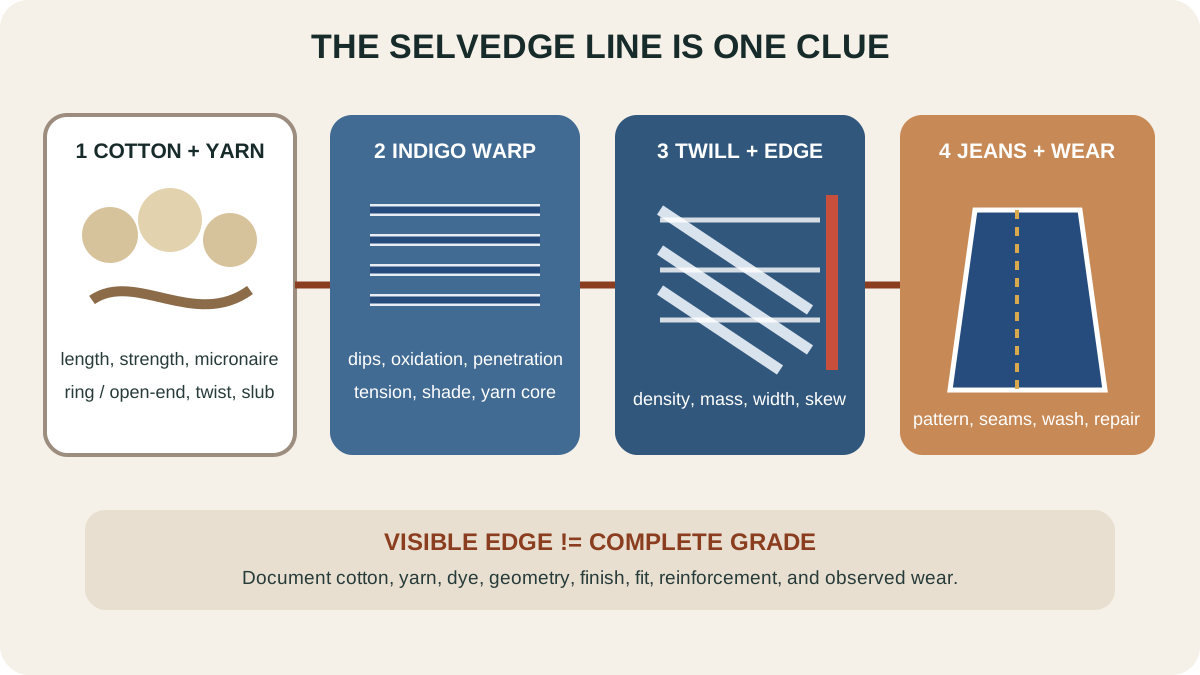
Narrow selvedge cloth changes cutting layout and can carry higher per-yard weaving and material costs. The coloured line can identify a mill convention or simply decorate the edge. What it directly demonstrates is limited: this is the formed edge of this cloth. It does not prove long-staple cotton, ring spinning, slow weaving, natural indigo, high density, strong sewing, good fit, or long service life.
Five systems inside one pair of jeans
1. Cotton class
USDA cotton classing measures properties including colour, trash, micronaire, fibre length, length uniformity, and strength 4. Those variables affect processing and available yarn, but a finished-jeans label rarely discloses them. “Zimbabwe cotton,” “Supima,” or another origin or variety claim may be meaningful; it is not the finished fabric specification.
2. Yarn architecture
Ring-spun yarn gains twist through a spindle-and-traveller system and often has a compact core with protruding fibre ends. Open-end rotor yarn forms yarn inside a rapidly rotating rotor and can have a different internal arrangement, evenness, bulk, and surface. Neither name guarantees good or bad yarn; count, twist, fibre preparation, evenness, and target fabric matter.
CottonWorks emphasizes that denim appearance changes with ring versus open-end yarn and with twist direction and level 5. Combing can remove short fibres and improve alignment before spinning, but it also reduces yield. Slub yarn can be deliberately engineered so thick and thin places create vertical character.
3. Indigo system
Indigo has limited affinity for cotton and is repeatedly applied and oxidized. Dye concentration, number of dips, reduction chemistry, yarn tension, drying, and penetration influence the coloured ring around a lighter yarn core. Ring dyeing can contribute to high-contrast abrasion patterns, but “more dips” is not a universal quality score. Deep penetration, sulphur bottoming or topping, pigment, and post-dye treatments can produce different targets.
4. Fabric geometry
Record twill direction and repeat, warp and filling yarn sizes, density, mass per area, width, skew control, stretch fibre, and sanforization or other shrinkage control. “14 ounce” is a mass description, not a strength certificate. A lighter fabric can be dense and strong; a heavy fabric can be poorly stabilized or uncomfortable for its intended climate.
5. Garment execution and finish
Pattern shape and sewing determine whether the cloth survives use. Inspect crotch seam, pocket corners, belt loops, fly, waistband, hem, thread, stitch density, bartacks, rivets, allowance, and needle damage. Garment washing, enzyme, resin, abrasion, laser, stone, ozone, and hand work can transform a fabric before purchase. A dramatic fade may represent controlled design, labour, damage, or all three.
Raw, one-wash, and distressed are condition statements
Raw usually means the garment has not received a substantial post-sewing wash or artificial wear treatment. It does not necessarily mean the cloth is loom-state, unsanforized, unskewed, or chemically untouched. One-wash can remove shrinkage and soften the garment. Pre-distressed shifts fading and abrasion from the wearer to the factory.
Ask what treatment occurred and what it accomplished. Artificial abrasion that removes attractive blue also removes some fibre. A soft finish may improve immediate comfort while changing dimensional stability or wear. CottonWorks treats testing, care, construction, and finishing as measurable quality-assurance variables rather than aesthetic adjectives 6.
Use WARP
- W — Weight and weave: Record mass, twill, stretch, density where available, and whether the edge is selvedge.
- A — Architecture of yarn and dye: Ring or open-end, slub or even, twist, indigo route, penetration, and what remains unknown.
- R — Reinforcement and repair: Stress-point seams, rivets, bartacks, pocket bags, seam allowance, spare hem cloth, patchability, and available repair service.
- P — Pattern, processing, and personal fit: Rise, thigh, knee, hem, shrinkage treatment, wash, comfort, movement, and care plan.
The cuff-and-seam lab
On two owned pairs:
- Photograph the face, reverse, edge, cuff, crotch, pocket corner, and fly at equal scale.
- Measure garment mass and key dimensions before washing.
- Use a magnifier to compare yarn surface and twill regularity.
- Turn the jeans inside out. Record seam types, allowances, reinforcement, loose thread, and pocket-bag wear.
- After several wears, map abrasion at knee, thigh, seat, hem, phone pocket, and crease lines.
- If washed, follow the label and calculate dimensional change:
(after − before) ÷ before × 100.
Do not manufacture a romantic story from irregularity. Write what you observe, what the maker documents, and what you infer as three separate columns.
Rule of thumb
The selvedge line is an ID tag, not a report card. Read cotton, yarn, dye, weave, finish, pattern, sewing, and wear as a connected system. The best denim is the one whose system fits your body, climate, care, and desired way of aging.
Practice
Selvedge is evidence about fabric width and edge formation. It does not independently grade fibre, yarn, dyeing, density, finishing, sewing, or durability.
Practice
Wear appearance emerges from fibre, yarn, dye, fabric geometry, finish, and use rather than from one material name.
Practice
Country and selvedge can be meaningful context, but a use-specific comparison needs construction and performance evidence.
Lesson complete
Nice work.
Sources for this lesson
- 1Fineas Jackson. $400 for a pair of jeans…why? How is that possible? Part 1 #denim #jeans #education. Fineas Jackson on YouTube. 2026. verifiedChasing Beauty episode 17; 1:55. Used as a case or observation prompt, not as the sole authority for technical claims. Cited at: episode 17.
- 2Fineas Jackson. Why is Japanese denim so expensive? #denim #selvedge #education. Fineas Jackson on YouTube. 2026. verifiedChasing Beauty episode 18; 2:11. Used as a case or observation prompt, not as the sole authority for technical claims. Cited at: episode 18.
- 3Fineas Jackson. How can two “selvedge” jeans be so different in price? What are you paying for? #denim #education. Fineas Jackson on YouTube. 2026. verifiedChasing Beauty episode 19; 2:34. Used as a case or observation prompt, not as the sole authority for technical claims. Cited at: episode 19.
- 4Cotton Classing Services. U.S. Department of Agriculture Agricultural Marketing Service. verifiedOfficial description of bale-level cotton measurements including color, trash, micronaire, length, length uniformity, and strength. Cited at: classing attributes.
- 5Denim Basics. CottonWorks by Cotton Incorporated. verifiedTechnical lesson covering denim yarn choice, twist, ring versus open-end spinning, indigo, fabric construction, and garment finishing. Cited at: yarn variables.
- 6Quality Assurance Basics. CottonWorks by Cotton Incorporated. verifiedOverview of measurable textile attributes and standardized approaches to stretch, comfort, water behavior, stain release, and other performance claims. Cited at: quality assurance.
Further reading
- Yarn Manufacturing. CottonWorks by Cotton Incorporated. verifiedTextile-industry training on opening, carding, combing, drawing, roving, ring spinning, and open-end spinning, with attention to yarn structure and evenness.