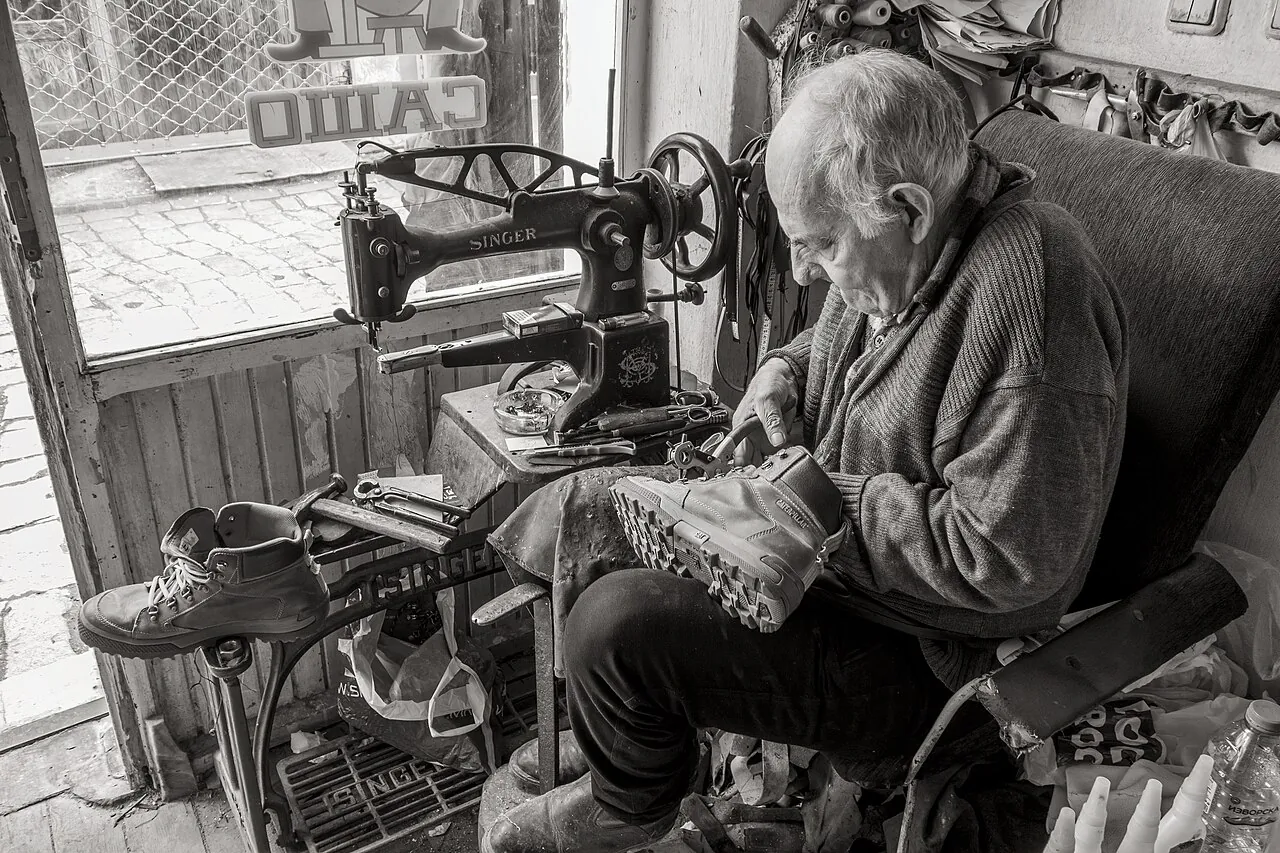
Footwear: Lasts, Uppers, Soles, and Repair
How shoes are built: the last, the upper as a shaped composite, the layers of the bottom, cemented, stitched, and welted construction, why a construction name isn't a warranty, fitting under load, three quality levels, and cost per wear with repair.
- 7 min
- 11 steps
- 3 questions
- Lesson 26 of 49
In this lesson
- Start with the last
- The upper is a shaped composite
- The bottom is not one sole
- Three joining systems
- Construction name is not a warranty
- Fit under load
- Where price can be justified
- Three quality levels
- Cost-per-wear with a repair threshold
- Rule of thumb
Open alongside this lesson
-
Making Tricker's (opens in a new tab)
Track clicking, closing, lasting, welting, shank and cork placement, sole attachment, finishing, and the construction features that permit factory repair.
-
Whole Shoe Flexing and Water Resistance (opens in a new tab)
Repeated bending can expose cracking, delamination, leakage, and joint problems that a static materials list misses.
Picking up where you left off.
A shoe is a negotiated interface among ground, foot, and gait. It must hold the heel, allow toe motion, bend in the right region, manage impact and moisture, resist abrasion, and remain stable on a surface—all while fitting a three-dimensional body that changes under load.
That is why “full-grain leather” or “Italian sneaker” cannot explain price or quality. Fineas Jackson’s sneaker and loafer episodes point toward materials and production; the next step is to map the actual footwear system 1 2.
Playback is optional. If the player is unavailable, open the video at its source.
Start with the last
The last is the form around which a shoe is patterned and shaped. It influences:
.jpg)
- toe width, height, and shape;
- ball girth and where the shoe flexes;
- waist and arch contour;
- heel width and grip;
- instep volume;
- heel-to-toe pitch;
- the visual line of the finished shoe.
The last is not a copy of a bare foot. It includes allowances, intended socks, material behavior, construction thickness, and style. Two shoes in the same marked size can fit radically differently because their lasts allocate volume differently.
FIT’s footwear curriculum combines anatomy, lasts, materials, patternmaking, prototype construction, and production communication 3. That combination matters: an elegant drawing that ignores bottom thickness or toe motion is not yet footwear design.
The upper is a shaped composite
An upper may include:
- outer leather, textile, knit, or synthetic sheet;
- lining;
- toe puff and heel counter;
- eye-stay and reinforcement;
- tongue and padding;
- seams, tapes, adhesives, and edge finishes.
Leather panels have stretch direction and natural variation. A skilled cutter—traditionally called a clicker—places components to use suitable regions and orient stretch. Tricker’s describes clicking, skiving edges, closing the upper, and shaping it over the last before bottom construction 4.
Knit uppers can reduce seams and vary density by zone, but still need reinforcement, stable attachment, and controlled stretch. A thick padded collar can mask loose heel geometry during a try-on, then compress with use.
The bottom is not one sole
From foot toward ground, you may find:
- sockliner or footbed;
- structural insole;
- lasting margin or strobel board;
- shank or torsional element;
- filler such as cork or foam;
- midsole or cushioning carrier;
- welt or sidewall;
- outsole and heel components.
Product pages often call the removable foam insert an “insole.” In traditional construction, the structural insole is part of the shoe. Ask what is removable, what holds the upper, and what takes repeated flex.
Three joining systems
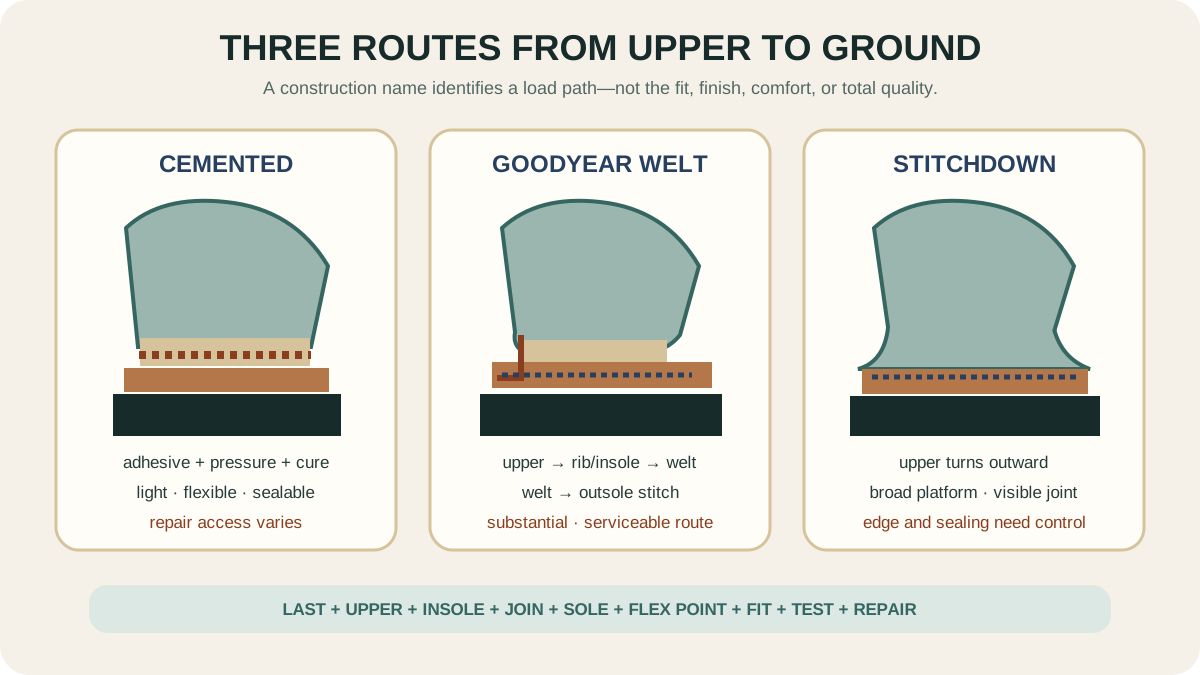
Cemented
The upper and sole assembly are joined primarily with adhesive. This route can produce very light, flexible, waterproof, and high-performance footwear. Success depends on surface preparation, adhesive chemistry, pressure, cure, design, and compatible materials. Resole access varies from straightforward to impractical.
Goodyear-welted
The upper and lining are secured around a rib associated with the insole; a welt creates a flange to which the sole is stitched. This can isolate some sole replacement work from the upper and accommodate a substantial bottom. It also adds parts, labor, mass, and edge width.
Stitchdown
The upper margin turns outward and is stitched to the bottom layers. It can make a broad, stable platform and visible repair route. Sealing, flexibility, edge exposure, and execution vary.
Other systems—Blake stitching, moccasin construction, direct injection, vulcanization, strobel construction—solve different production and performance problems. Do not force every hiking boot, running shoe, loafer, and office shoe onto one hierarchy.
Construction name is not a warranty
SATRA’s TM411 measures peel strength between footwear layers because adhesive or joined interfaces can fail regardless of marketing category 5. SATRA also describes whole-shoe repeated-flex testing that can reveal cracks, delamination, and water entry 6.
Ask:
- Does the flex line fall near the foot’s ball rather than crushing the toes?
- Does the outsole compound suit wet pavement, rock, oil, or indoor floors?
- Is the shoe stiff because it needs support or because the materials have not been resolved?
- Can water travel through stitch holes or upper seams?
- Will foam pack down before the upper wears out?
- Which part is intended to be replaced?
“Handmade” can add careful lasting, selection, pattern adjustment, edge finishing, and repair. It can also describe inefficient inconsistency. Inspect the result.
Fit under load
Try both shoes late enough in the day that feet are not at their smallest. Use the intended socks and any required orthotic. Then:
- seat the heel firmly;
- check toe width and vertical room while standing;
- locate the widest part of the foot relative to the shoe’s flex;
- walk up and down an incline if possible;
- note heel lift, instep pressure, toe contact, and side spill;
- spend at least ten minutes, because padding can create a misleading first softness.
Length alone does not solve a volume mismatch. A bigger size can move the flex point and heel away from the foot. A different last is often the answer.
Where price can be justified
cost ≈ upper materials / cutting yield + last and pattern development + closing + lasting + bottom components + joining + finishing + rejects/testing + distribution + service
Small sizes, multiple widths, and many lasts multiply inventory. Hand clicking increases selection time and can protect quality, but may reduce yield. Complex color blocking creates more pieces and seam risk. A repairable construction has value only if compatible soles, machinery, and a willing repairer remain available.
Three quality levels
| Level | Legitimate strengths | Likely compromise | Evidence |
|---|---|---|---|
| Budget, competent cemented | light, flexible, efficient, replaceable footbed | generic last, short-lived foam, limited repair | even bond, suitable tread, no early delamination, honest use claim |
| Serious production shoe | developed last, zoned upper, controlled cushioning and outsole, repeatable tests | proprietary parts, repair may remain limited | method-specific test claims, fit options, spare laces/footbeds, warranty |
| Craft or repair-led shoe | selective cutting, careful lasting, substantial insole, accessible joining, skilled finishing | weight, break-in, low volume, high labor | named construction, maker process, repair service, available components |
Cost-per-wear with a repair threshold
Use:
annualized wear cost = (purchase + repairs - residual value) / wears
Then add a failure penalty for the job. A work boot that leaks during fieldwork imposes more than replacement price. A special-occasion shoe worn twice a year does not become sensible merely because it can be resoled five times.
Rule of thumb
Fit the last first, then audit the load path from foot to ground. Construction method matters when it supports your use, can be executed well, and leaves a realistic path for maintenance—not because its name belongs to a prestige ladder.
Practice
Last geometry helps establish internal volume, toe shape, heel hold, pitch, and the pattern that wraps around the foot.
Practice
Construction names identify routes and tradeoffs, not total-product scores.
Practice
Components that pass separately can still fail where the complete assembly bends and gets wet.
Lesson complete
Nice work.
Sources for this lesson
- 1Fineas Jackson. $800 for sneakers copied from a 1970s army shoe…why? How is that even possible?. Fineas Jackson on YouTube. 2026. verifiedChasing Beauty episode 37; 2:29. Used as a case or observation prompt, not as the sole authority for technical claims. Cited at: episode 37.
- 2Fineas Jackson. $700 for a pair of leather loafers…why? How is that even possible? #leather #loafers #education. Fineas Jackson on YouTube. 2026. verifiedChasing Beauty episode 13; 3:00. Used as a case or observation prompt, not as the sole authority for technical claims. Cited at: episode 13.
- 3Footwear and Accessories Design AAS. Fashion Institute of Technology. verifiedCurrent academic curriculum covering anatomy, lasts, materials, patternmaking, prototype construction, line development, and production communication. Cited at: academic curriculum.
- 4Making Tricker's. Tricker's. verifiedPrimary shoemaker process account covering clicking, stretch direction, closing, skiving, lasting, welting, cork filling, shanks, soles, edge finishing, and factory repair. Cited at: maker process.
- 5SATRA TM411: Peel Strength of Footwear Constructions. SATRA Technology Centre. verifiedTest method for the peel strength between a shoe upper and sole or between layers of the bottom construction. Cited at: test method.
- 6Whole Shoe Flexing and Water Resistance. SATRA Technology Centre. verifiedTechnical description of repeated whole-shoe flex testing, including inspection for cracking, delamination, and water penetration. Cited at: system test.
Previous: Tailored Jackets: Canvas, Fusing, Pressing, and Balance