Decorative Details That Used to Work
Reading small details as evidence: a detail's job now, its origin, and its social meaning, the well-documented copper rivets on jeans, coin-edge ridges, design stories that outrun the evidence, and a five-minute detail autopsy.
- 7 min
- 7 steps
- 3 questions
- Lesson 33 of 49
In this lesson
- The four lives of a detail
- Rivets and pockets: an unusually well-documented case
- One edge, several possible jobs
- Beware the story-shaped answer
- A five-minute detail autopsy
- Rules of thumb
Open alongside this lesson
-
They look like decoration, but they’re why jeans exist. Behind those buttons on your jeans... (opens in a new tab)
Compare the rivet's documented reinforcing job with the way it now identifies jeans at a glance.
-
Why is there that tiny pocket on your jeans? The strange reason behind the 150 year old pocket... (opens in a new tab)
A compact case of a specific use becoming a stable part of a product type.
-
The weird ridges on your quarter…what are they for? The hidden reason coins have ridges… (opens in a new tab)
Separate the history of marked precious-metal edges from the current reasons denominations retain different edges.
-
Why you never fasten the bottom button on a suit jacket. It started with a fat king… (opens in a new tab)
Treat the dressing rule as observable convention and the famous king story as a claim still needing documentary evidence.
-
They do nothing, so why are there holes in dress shoes...? It all starts with Scottish bog farmers (opens in a new tab)
Inspect what the holes do on the shoe in front of you before repeating the Scottish-bog origin tale.
-
They look like decoration, but there’s a reason...behind the collar on your shirt (opens in a new tab)
Look for pieces that shape, stiffen, roll, anchor, or merely signal a dress-shirt tradition.
-
That weird button on baseball caps…what is it for? The hidden reason on top of every cap… (opens in a new tab)
Ask whether the cap-top detail joins panels, covers their meeting point, identifies the type, or does several jobs at once.
-
That corduroy collar on work jackets...why is it there? (opens in a new tab)
Compare abrasion, skin feel, weather behavior, replacement, and visual identity rather than accepting a single-purpose explanation.
-
The hidden reason the strange V saved the sweatshirt (opens in a new tab)
Determine whether your own example is an inserted gusset, a printed outline, an extra layer, or no V at all.
-
Why does every pen cap has a hole in the top? And no, it's not for the ink… (opens in a new tab)
A safety claim is testable only when tied to the cap's dimensions, airflow, standard, and date—not to resemblance alone.
Picking up where you left off.
A keyhole buttonhole looks ornamental until you compare it with the button passing through it. The circular end can give the button’s shank or thick thread a place to settle while the slit controls the opening. On a heavy coat, the shape, reinforcement, corded edge, and grain direction can work together under a load. On another garment, a machine may stitch the same outline around an ordinary flat button because buyers recognize it as tailored detail. The outline is identical; the job is not.
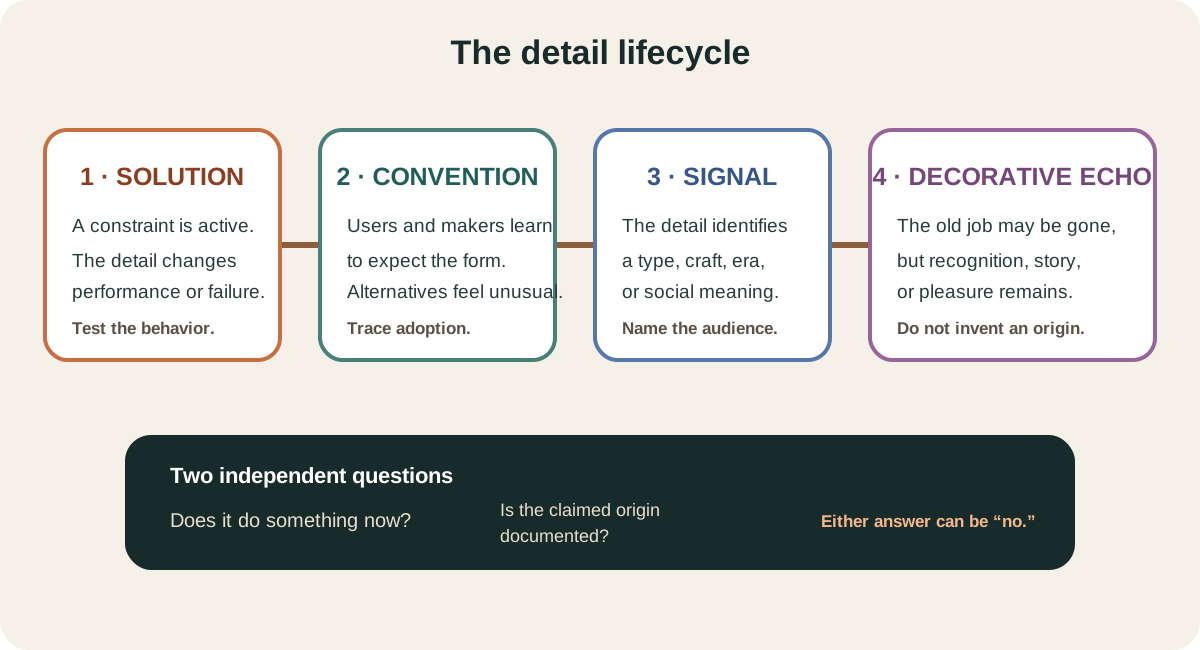
Fineas Jackson’s buttonhole episode is valuable because it makes a tiny feature large enough to investigate 1. Its larger lesson is not that every old-looking detail hides one ingenious origin. It is that details acquire biographies. A feature may begin as a response to force, material, manufacturing, safety, or use. Repetition makes it conventional. Later versions preserve it for familiarity, identity, or pleasure. Sometimes the old job remains; sometimes it changes; sometimes only the story remains.
Playback is optional. If the player is unavailable, open the video at its source.
The four lives of a detail
Use JOBS when a video, salesperson, or museum label explains a curious feature:
- J — Job now: What measurable task does this exact example perform?
- O — Origin evidence: What dated object, patent, specification, advertisement, or archive supports the history?
- B — Behavior: What changes when the feature is loaded, removed, blocked, or substituted?
- S — Signal: What type, craft, era, group, or promise does the feature communicate now?
These questions prevent two opposite mistakes. The first is function romance: assuming every ornament must conceal a forgotten survival trick. The second is function blindness: dismissing a familiar detail as decoration without testing it.
Rivets and pockets: an unusually well-documented case
The copper points on jeans show why dated records matter. Levi Strauss & Co.’s archive ties the feature to the 1873 patent for an improvement in fastening pocket openings. Rivets reinforced openings and other stressed locations 2. Here JOBS produces a clear first pass:
| Question | Evidence-based answer |
|---|---|
| Job now | A correctly placed rivet can transfer load and help stop stitches or fabric at a pocket corner from opening. |
| Origin | The patent and archival garments connect rivets to reinforcement, not merely western styling. |
| Behavior | Compare a loaded pocket corner with and without reinforcement; inspect distortion around the hole. |
| Signal | Exposed copper now says “jeans” even when modern stitching could carry the expected load. |
The biography did not stop in 1873. The archive records that back-pocket rivets were covered and later removed after complaints that they scratched saddles and furniture. A working reinforcement created a new failure elsewhere, so the product changed. That is more instructive than a perfect-origin tale: a detail can solve one problem, cause another, and still become iconic.
The small right-front pocket is similarly specific. It was intended for a pocket watch, yet it survives after wristwatches and phones displaced that everyday use 3. Today it may hold a coin, key, or nothing. It still helps define the five-pocket-jean type. An inactive original use does not make the pocket fraudulent; it changes the category of value from necessary function to optional use and continuity.
One edge, several possible jobs
Jackson uses the ridges on a quarter to tell a clean anti-clipping story 4. The history has a real foundation, but it needs boundaries. A 1663 British “Petition Crown” has an inscribed edge, and the British Museum says edge marking was then being adopted in England as a guard against clipping precious metal 5. That supports a claim about marked edges in that monetary setting.
It does not prove that every ridge on every modern base-metal coin exists for that same active reason. The U.S. Mint distinguishes plain, reeded, lettered, and decorated edges 6. That taxonomy shows reeding is one current design option; the anatomy page does not establish why a particular denomination retains it. A good sentence therefore sounds like this: “Marked edges historically helped reveal removal from some precious-metal coins; this quarter has a reeded edge today, but its current jobs require separate evidence.” It is less magical and more accurate.
Beware the story-shaped answer
Some design stories are so memorable that they become detached from evidence. Consider two:
The bottom suit button. The rule that it is normally left open is a living convention in many single-breasted jackets. It also has a practical relationship to how a jacket is cut and how the body sits. The popular explanation that the convention began because a particular king could not fasten his jacket is an anecdote, not a substitute for dated tailoring records. You can follow the convention while marking its viral origin story unverified 7.
Brogue perforations. Contemporary makers punch and arrange holes as part of brogue construction and ornament; the V&A documents that craft without claiming that today’s holes drain water 8. The tale about Scottish or Irish bog workers punching drainage holes may be repeated widely, but repetition is not documentation. On a lined modern shoe, the visible holes may not pass through the complete upper at all. Record the current construction first; label the origin plausible, contested, or unsupported according to the evidence you actually have 9.
Cable-knit “clan codes,” a sweatshirt V that supposedly always absorbs sweat, and a cap button with one universal purpose deserve the same discipline. A real inserted sweatshirt gusset can stretch or manage strain; an embroidered V may only quote it. A cap-top button may cover the panel junction while also becoming a recognizable flourish. Multiple jobs are allowed.
A five-minute detail autopsy
Choose one garment, tool, or household object and find three small features: a seam, ridge, hole, flap, change in material, or repeated mark.
- Photograph each feature close-up and in context.
- Write one observation without purpose words: “six radial seams meet under a covered button.”
- Write two competing job hypotheses: “covers a rough junction” and “reinforces the junction.”
- Apply a gentle comparison: flex it, shine light through it, inspect the reverse, or compare a version without it. Do not damage the object.
- Search for the oldest evidence you can identify. Prefer patents, catalogs, dated objects, standards, and archives over listicles that repeat one another.
- Finish with a signal sentence: “Even if the original job is absent, this detail tells today’s viewer ___.”
Score the history separately from the mechanics: 0 = attractive story only, 1 = credible secondary account, 2 = dated primary or museum evidence. Then score present function: 0 = no detected effect, 1 = plausible effect, 2 = observable or tested effect. A detail can score 2/0, 0/2, or anything between. That is the point.
Rules of thumb
- A visible remainder is not a lie. Familiarity, identity, and delight are legitimate jobs when named honestly.
- Present behavior does not prove historical intent. A specified high-copper alloy can show antimicrobial behavior under stated test conditions without proving that an earlier maker chose brass for hygiene 10.
- A neat origin is a hypothesis, not a reward. The stronger the story’s surprise ending, the more you should ask for a dated source.
- Inspect the exact specimen. “The sweatshirt V” may be a structural gusset, an applied patch, printed ink, or absent entirely.
The best reading of a detail has two endings: what it does to the object, and what it does to the observer. Beauty often appears when those endings reinforce each other—but good judgment begins by keeping them separate.
Practice
Present behavior can be observed; a specific historical origin needs separate documentary evidence. A nonfunctional detail can still carry recognition and meaning.
Practice
Contemporary patent and archive evidence connects the feature to a stated failure mode. Current price and appearance do not establish origin.
Practice
JOBS keeps present performance, historical documentation, observed behavior, and cultural meaning from collapsing into one appealing story.
Lesson complete
Nice work.
Sources for this lesson
- 1Fineas Jackson. Not all buttonholes are made the same. Why your coat and jeans have that strange keyhole shape…. Fineas Jackson on YouTube. 2026. verifiedChasing Beauty episode 55; 2:03. Used as a case or observation prompt, not as the sole authority for technical claims. Cited at: episode 55.
- 2Tracey Panek. Pockets Full of History. Levi Strauss & Co.. 2017. verifiedCompany-archive account of the 1873 rivet patent, the original watch pocket, later pocket changes, and the removal or concealment of rivets that scratched furniture. Cited at: company archive and patent context.
- 3Fineas Jackson. Why is there that tiny pocket on your jeans? The strange reason behind the 150 year old pocket.... Fineas Jackson on YouTube. 2026. verifiedChasing Beauty episode 52; 2:25. Used as a case or observation prompt, not as the sole authority for technical claims. Cited at: watch-pocket case.
- 4Fineas Jackson. The weird ridges on your quarter…what are they for? The hidden reason coins have ridges…. Fineas Jackson on YouTube. 2026. verifiedChasing Beauty episode 56; 2:41. Used as a case or observation prompt, not as the sole authority for technical claims. Cited at: coin-edge episode.
- 5Petition Crown, 1663. The British Museum. 1663. verifiedMuseum record explaining that marked coin edges were being adopted in England as a guard against clipping; useful evidence for a bounded historical claim, not a universal explanation of every modern reeded edge. Cited at: museum record.
- 6Anatomy of a Coin. United States Mint. verifiedOfficial terminology for coin edges, rims, relief, fields, inscriptions, and plain, reeded, lettered, or decorated edge treatments. Cited at: official coin vocabulary.
- 7Fineas Jackson. Why you never fasten the bottom button on a suit jacket. It started with a fat king…. Fineas Jackson on YouTube. 2026. verifiedChasing Beauty episode 57; 2:44. Used as a case or observation prompt, not as the sole authority for technical claims. Cited at: the popular account.
- 8The Art of Shoe Making. Victoria and Albert Museum. 2024. verifiedMuseum demonstration of contemporary bespoke brogue construction and decorative punching; it does not substantiate the popular bog-drainage origin story. Cited at: making demonstration.
- 9Fineas Jackson. They do nothing, so why are there holes in dress shoes...? It all starts with Scottish bog farmers. Fineas Jackson on YouTube. 2026. verifiedChasing Beauty episode 62; 2:54. Used as a case or observation prompt, not as the sole authority for technical claims. Cited at: episode prompt.
- 10EPA Registers Copper Surfaces for Residual Use Against Coronavirus. United States Environmental Protection Agency. 2021. verifiedOfficial, carefully bounded claims for specified high-copper alloy surfaces under test conditions, with the warning that they supplement rather than replace infection-control practices. Cited at: bounded surface claims.
Further reading
- Fineas Jackson. That weird button on baseball caps…what is it for? The hidden reason on top of every cap…. Fineas Jackson on YouTube. 2026. verifiedChasing Beauty episode 38; 2:07. Used as a case or observation prompt, not as the sole authority for technical claims.
- Fineas Jackson. They look like decoration, but they’re why jeans exist. Behind those buttons on your jeans.... Fineas Jackson on YouTube. 2026. verifiedChasing Beauty episode 42; 2:51. Used as a case or observation prompt, not as the sole authority for technical claims.
- Fineas Jackson. That corduroy collar on work jackets...why is it there?. Fineas Jackson on YouTube. 2026. verifiedChasing Beauty episode 45; 2:44. Used as a case or observation prompt, not as the sole authority for technical claims.
- Fineas Jackson. The hidden reason the strange V saved the sweatshirt. Fineas Jackson on YouTube. 2026. verifiedChasing Beauty episode 58; 2:42. Used as a case or observation prompt, not as the sole authority for technical claims.
- Fineas Jackson. Why does every pen cap has a hole in the top? And no, it's not for the ink…. Fineas Jackson on YouTube. 2026. verifiedChasing Beauty episode 59; 2:34. Used as a case or observation prompt, not as the sole authority for technical claims.
- Fineas Jackson. They look like decoration, but there’s a reason...behind the collar on your shirt. Fineas Jackson on YouTube. 2026. verifiedChasing Beauty episode 66; 2:58. Used as a case or observation prompt, not as the sole authority for technical claims.